



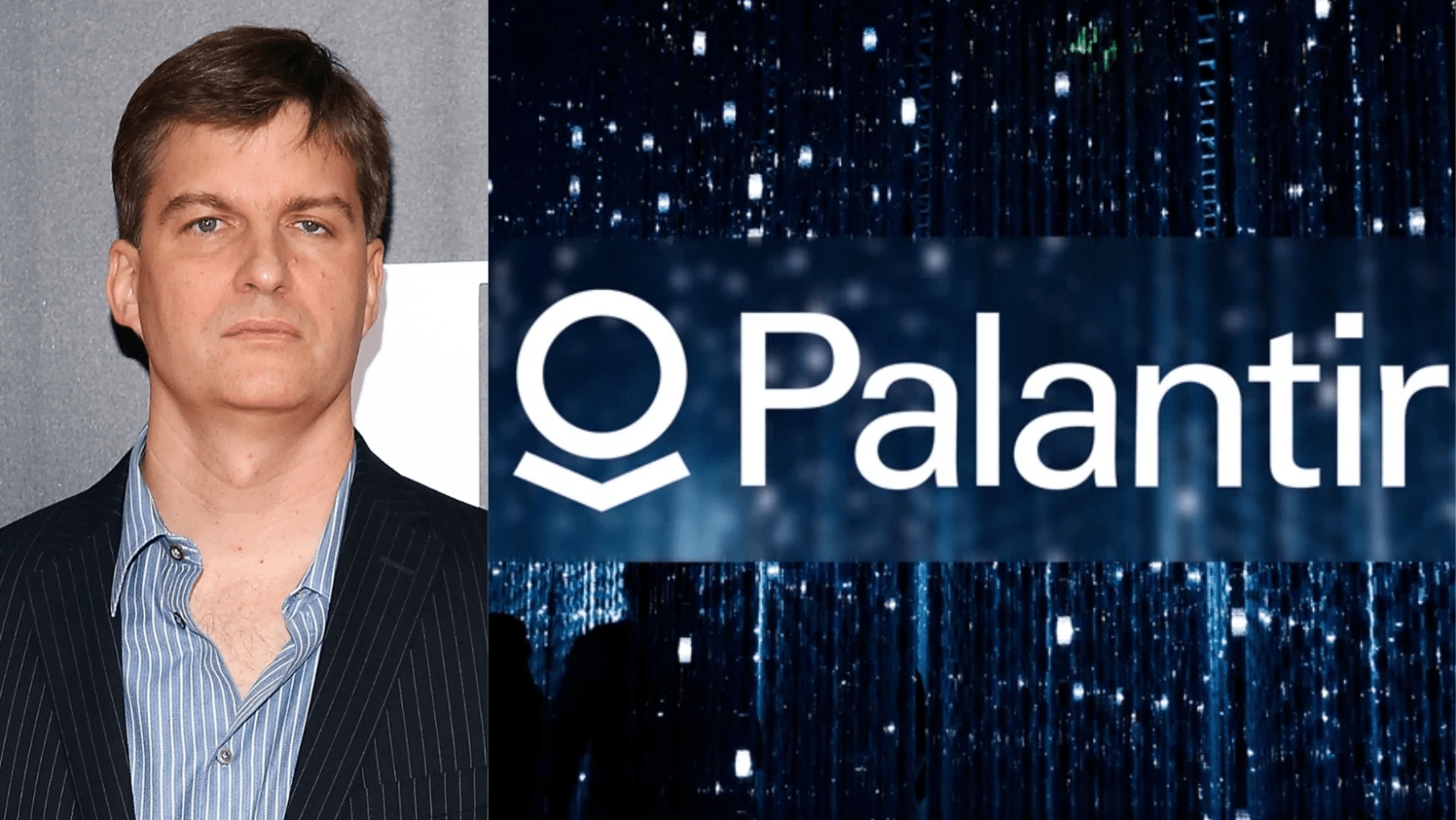
In November 2025, Michael Burry filed his quarterly 13F with the SEC. Hidden inside: put options on 5 million shares of Palantir Technologies. The notional value of those contracts — $912 million.
The headlines exploded.
Except Burry, never missing a chance to correct the record, immediately posted on X: he had actually spent just $9.2 million buying those puts, not $912 million. The $912 million is simply what those 5 million shares were worth at the time. And crucially, each contract gave him the right to sell Palantir stock at $50 a share — by 2027.
“Each of those doodads let me sell $PLTR at $50 in 2027,” he wrote.
So, I bought 50,000 of these things for $1.84.
— Cassandra Unchained (@michaeljburry) November 13, 2025
Each of those things is 100 doodads.
So I spent $9,200,000,
Not $912,000,000. @CNBC @WSJ @FT
Each of those doodads let me sell $PLTR at $50 in 2027.
That was done last month.
On to much better things Nov 25th. pic.twitter.com/9Voy3nwiTD
At the time, Palantir was trading near $182.
So Burry wasn’t just betting against Palantir. He was betting it would crater by 73%.
Let’s talk about what Palantir actually is.
Founded in 2003 by Peter Thiel, Alex Karp, and others, Palantir started as a surveillance and intelligence tool built for the US government — the kind of software the CIA uses to make sense of enormous, murky datasets.
It went public in 2020 and spent years struggling to convince Wall Street that its business was worth the hype.
Then AI happened.
Palantir’s Artificial Intelligence Platform, or AIP, became the hottest product in enterprise software. The company pivoted hard into commercial markets — helping companies run AI operations on top of their own data — and the revenue followed. US commercial revenue grew 121% year-over-year in Q3 2025. Then 137% in Q4 2025. Total Q4 revenue hit $1.41 billion, growing 70% from the year before, smashing every consensus estimate. For 2026, management guided to $7.19 billion in revenue — implying 61% growth — against a Street estimate of $6.22 billion.
CEO Alex Karp, never one for understatement, called Palantir “an n of 1.” He boasted a Rule of 40 score — the sum of revenue growth and adjusted operating margin — of 127%. For context, anything above 40 is considered exceptional.
The stock soared 340% in 2024. Then doubled again in 2025, hitting an all-time high of $207 in November.
Then came the bill.
The problem isn’t what Palantir is doing. It’s what investors are paying for it.
At its peak, Palantir was trading at a price-to-sales ratio of over 150. To put that in perspective: during the dot-com bubble, a period of legendary excess, internet pioneers like Amazon and Microsoft peaked at P/S ratios of 30 to 50 before the crash. Palantir blew past all of them.
Its forward P/E ratio stood at 245. Its EV/EBITDA at over 215. These aren’t just high numbers. They’re numbers that require a particular kind of faith, the belief that Palantir will grow explosively for many, many years without a stumble.
Burry wasn’t having it.
In a 10,000-word Substack post titled “Palantir’s New Clothes: Foundry, AIP & the Failure of Reason,” he laid out his case. His headline estimate: Palantir is worth around $46 a share, with a range of scenarios stretching from $21 to $146. He was careful to note these weren’t traditional price targets. But his central message was blunt: “I believe Palantir’s recent winning streak will not endure.”
What exactly was his argument?
Three things, mainly.
First, stock-based compensation. Palantir’s non-GAAP margins look impressive because they exclude stock based compensation, but SBC is a real cost. When you add it back, the margins become significantly less flattering.
Second, accounting optics. Burry pointed to how Palantir classifies costs related to its “forward-deployed engineers”, the people physically embedded at client sites to help implement the software. Those engineers are partly counted as R&D and partly as sales and marketing expenses, rather than as cost of revenue. The result, Burry argues, is gross margins that look far more like a pure software company than Palantir really is. “If Palantir were following the accounting standards of Accenture or Deloitte, gross margins would collapse,” he wrote.
Third, the underlying business model. At its core, Palantir sells expensive, custom software that requires significant human deployment. That’s not necessarily bad, but it means you shouldn’t value it at the same multiple as a clean, scalable SaaS business. The market, Burry believes, has confused the two.
Karp hit back immediately.
When Burry’s Q3 filing came out, Palantir CEO Alex Karp went on CNBC’s Squawk Box the next morning. His verdict on Burry’s position: “bats— crazy.”
“The two companies he’s shorting are the ones making all the money, which is super weird,” Karp said. “He’s actually putting a short on AI. It was us and Nvidia.”
He also accused Burry of market manipulation.
Burry declined to comment.
The stock dropped 8% that day — even after Palantir had just reported a blowout quarter.
Since then, Burry has not let up.
In February this year, he posted a Palantir chart on X with a hand-drawn “head-and-shoulders” pattern — a technical formation traders watch as a bearish reversal signal. He marked the August 2025 high as the left shoulder, the November peak of $207 as the head, and the subsequent rally as the right shoulder. Then he added the Fibonacci sequence to show, presumably, that he really means business. “I am working on something $PLTR,” he wrote.
His implied target from the chart: a drop to below $100, with a potential landing zone around $50.
He then turned to Twitter forensics against the company itself — posting a 2024 report that Palantir had secretly hired a marketing agency to run an influencer campaign to counter criticism of a controversial patient data platform it was building for the UK’s NHS. A separate 2017 report alleged Palantir had actively obstructed the New York Police Department from building internal tools that might replace its software.
Let’s try this again. If you have real evidence that Palantir has continued this practice of covert smearing campaigns against the enemies Karp and $PLTR cannot quite reach with Fentanyl-laced urine drones, please contact me.
— Cassandra Unchained (@michaeljburry) February 16, 2026
Also please contact me if you simply know something… pic.twitter.com/OYKBBTEW6w
This is Burry at his most Burry — using market commentary, fundamental analysis, technical charts, and guerilla-style document drops all at once.
So who’s right?
Here’s the honest answer: both sides have a point, and it depends almost entirely on your time horizon.
The bulls aren’t delusional. Palantir’s US commercial pipeline — remaining deal value rose 145% year-over-year to $4.38 billion — suggests demand is genuinely accelerating, not slowing. A $10 billion US Army contract and a $448 million US Navy deal anchor the government side. Adjusted operating margins expanded 12 percentage points year-over-year in Q4 to reach 57%.
An analyst at DA Davidson, one of the more measured voices on the stock, said Palantir needed to grow at 50% annually for five years with 50% margins to bring its forward P/E in line with something like Microsoft. That’s a steep ask — but Palantir is currently growing faster than that.
The bears, meanwhile, have a valuation argument that is simply very hard to dismiss. Palantir is trading at over 100 times forward sales. Even if it executes perfectly, the current price has already borrowed from years of future growth. One mis-step — a government budget cut, a big contract loss, a slowdown in AIP adoption — and the multiple could compress violently.
Burry knows this better than anyone. He was also early — and wrong for a while — on the housing market before he was spectacularly right. His Palantir puts at a $50 strike don’t expire until 2027. He’s not in a hurry.
What’s made this episode unusual isn’t just that Burry is short a hot stock. It’s the escalation. The Substack essays. The X posts. The corporate allegations. This isn’t the quiet, methodical trade that defined The Big Short. It feels more personal — a public argument about what AI is really worth, waged between a deeply unconventional investor and a deeply unconventional company.
Meanwhile, the stock that soared 340% in 2024 and doubled again in 2025 has now shed nearly 40% from its peak. It is still down roughly 27% in 2026 even after a blockbuster earnings report.
The market is listening to someone.
Whether that someone is right by 2027, we’ll find out.
Sonia Boolchandani is a seasoned financial writer She has written for prominent firms like Vested Finance, and Finology, where she has crafted content that simplifies complex financial concepts for diverse audiences.
Disclosure: The writer and her his dependents do not hold the stocks discussed in this article.
The website managers, its employee(s), and contributors/writers/authors of articles have or may have an outstanding buy or sell position or holding in the securities, options on securities or other related investments of issuers and/or companies discussed therein. The content of the articles and the interpretation of data are solely the personal views of the contributors/ writers/authors. Investors must make their own investment decisions based on their specific objectives, resources and only after consulting such independent advisors as may be necessary.