



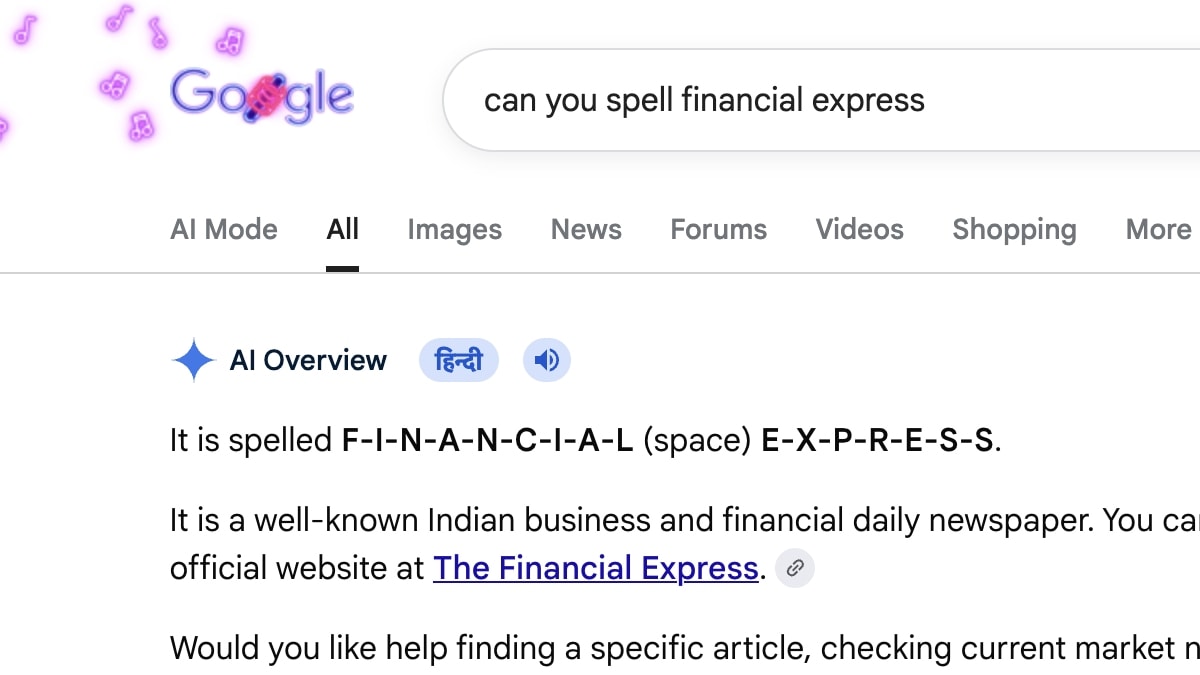
Google isn’t alien to controversies surrounding AI. A year ago, the AI Overviews feature was struggling to figure out the correct year, suggesting that the year was 2024, even though the query was made in 2025. At the time, Google had explained the reasons behind the anomaly and rectified the issues eventually. Since then, the search giant has been keen on integrating its AI model into everything, including the web search function and Android phones. Just as that was expected to happen smoothly, Google is now part of another controversy.
Google’s latest update to AI Overviews has hit a roadblock – it can’t spell its name correctly. The AI model is unable to count the letters and is struggling with basic spelling.
Recently, social media users have pointed out that Google’s AI Overviews feature, integrated directly into its flagship Search engine, is failing at simple linguistic queries. In several tests, the AI model confidently hallucinated letters that do not exist in common words, including its own brand names.
During the experiments, the AI model suggested that the alphabet “p” shows up twice in the word “Google” and the alphabet “t” appears twice in the word “Gemini.”
In another instance, the tool claimed the word “journalism” contains the alphabet “d” twice, despite spelling the word perfectly right next to its explanation. Another query regarding the name “Armaan” prompted the AI to initially claim it contained two “t” letters, before correcting itself to zero.
As expected, screenshots of these linguistic blunders have quickly gone viral across X (formerly Twitter) and Reddit. Users mocked the tech giant, joking that while the AI can write software and solve complex math, it fails a primary school spelling bee.
But why do LLMs struggle with basic spelling?
Once you look past the standard internet humour, users raise concerns regarding the glitch, worrying about the reliability of AI-generated search results.
Google, however, has acknowledged the shortcomings of its AI system. In a statement, a company spokesperson addressed the viral errors, stating, “Counting within words has been a known challenge for LLMs, and we’re working to fix this particular issue.”
The limitation emerges from how LLMs process information. Instead of reading words letter by letter like humans, AI breaks text down into tokens, which are chunks of characters or syllables. This architectural design, as a result, impairs its ability to accurately count individual letters within a word without specific algorithmic training.
This is why scientists and researchers are stressing over developing AI systems based on world models. The recently released paper on world models, published by AI’s Godfather, Yann LeCun, suggests that AI currently lacks basic common sense and hence, it needs to understand the world to solve our problems better. World models understand the context of things and hence can analyse things like humans. They also require lesser resources to process than LLMs.
This isn’t the first controversy for Google’s AI Overview
This is not the first time AI Overview has landed Google in trouble. Shortly after its initial rollout last year, the feature was heavily criticised for serving dangerous or absurd advice gathered from across the web. In previous high-profile blunders, the AI treated satirical articles as factual news, instructed users to eat rocks for health benefits, and suggested adding glue to pizza sauce.
The latest case involving spelling mishaps has only added fuel to a growing backlash against Google’s aggressive push toward AI-dominated search results. Many users and web creators are expressing frustration that AI Overviews frequently push authoritative and links to human-written content websites further down the search page. Critics argue that instead of making Search intuitive, the unreliability of this AI layer has made finding simple facts cluttered, complicated, and untrustworthy.