



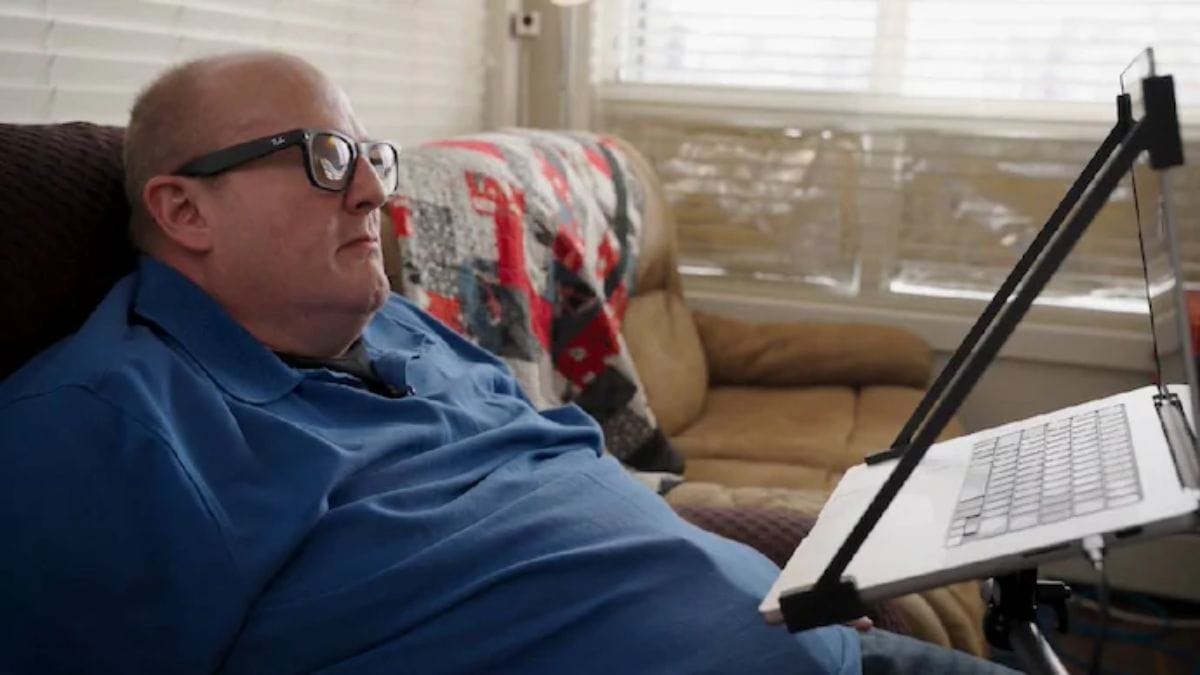
In a significant development in the field of medical science, Elon Musk’s company, Neuralink, has shown that its brain chips can help people with amyotrophic lateral sclerosis (ALS). As an individual named Kenneth Shock posted on ‘X’ about how he received the Neuralink implant earlier this year, and since then his life has changed.
ALS has gradually taken away Kenneth’s ability to speak. Through Neuralink’s VOICE clinical trial, he’s exploring how a brain-computer interface designed to translate thought to speech could help restore autonomy in his daily life.
— Neuralink (@neuralink) March 24, 2026
Watch to learn more: pic.twitter.com/C9QufqhI6R
What is the Neuralink chip?
The Neuralink chip is a small device that is placed inside the skull. It connects to the brain using very thin wires that read brain signals. These signals are then turned into actions on a computer.
For instance, an individual with paralysis can move a cursor, type messages, or even create speech just by thinking. This is much faster and easier compared to older tools like eye-tracking devices, which many ALS patients currently use.
Who is Kenneth Shock?
Kenneth Shock, an ALS patient from the United States, has become one of the early recipients of Neuralink’s experimental brain implant. Before his diagnosis, Shock led a relatively normal life, but over time, amyotrophic lateral sclerosis gradually took away his ability to control muscles and eventually his speech.
Sharing his experience, Shock said the technology has transformed how he communicates. Despite losing his natural voice due to ALS, the brain-computer interface allows him to speak again using an AI-generated version of his own voice. By simply thinking, he can form words and sentences, giving him a renewed sense of independence and connection with others.
He was also able to use a computer, edit videos, and interact with digital tools on his own, showing how useful the technology can be in daily life.
Kenneth’s partner described the surgery as simple.
Interestingly, the partner of Kenneth Shock described the surgical process as simple. She noticed that Shock returned home the next day, and after the operation, he was trained by Neuralink in several stages.
Engineers helped Shock to get familiar with the charger initially and how its accompanying app works. They reportedly guided him through the speaking process and forming sentences. At this stage, the collected data helped the engineers to map his neural intent to speak words. Later, Shock began the second phase, where the AI system was trained on the data. Finally, Shock progressed to the third phase, where he could just think of sentences and the machine could speak on his behalf.
Challenges Ahead
Even though the Neuralink results are promising, the technology is still new. There are concerns about safety, surgery risks, and how well the device will work over time.
It will also take time for approvals before the chip becomes widely available.
Still, this breakthrough offers hope that in the future, people with ALS may be able to communicate easily again, even if they lose their ability to speak.