



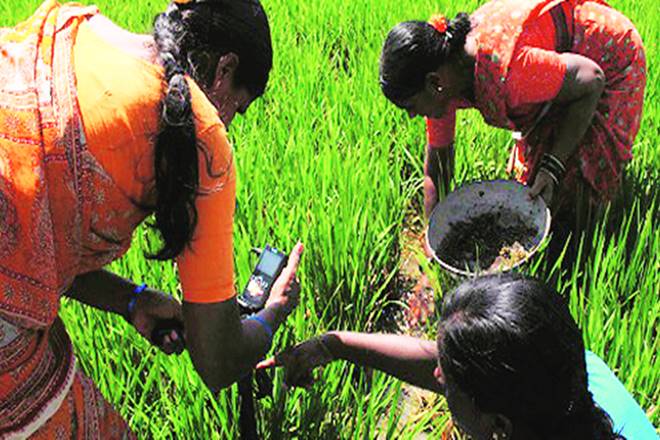
The government of Karnataka has decided to partner US tech giant Microsoft to use artificial intelligence (AI) for digital agriculture. The collaboration intends to empower smallholder farmers with technology-oriented solutions that will help them increase income using ground-breaking, cloud-based technologies, machine learning and advanced analytics. The collaboration will experiment with the Karnataka Agricultural Price Commission (KAPC), department of agriculture to help improve price forecasting practices to benefit farmers. Microsoft, with guidance from KAPC, is attempting to develop a multi-variant agricultural commodity price forecasting model considering the following datasets—historical sowing area, production, yield, weather datasets and other related datasets as relevant. For this season, Tur crop has been identified for this prediction model. Microsoft, in collaboration with the International Crops Research Institute for the Semi-Arid Tropics (ICRISAT), has also deployed a sowing advisory service in the kharif season on a limited pilot, under the Bhoochetana project. Built on the Microsoft Cortana Intelligence Suite including Machine Learning and Power BI or Business Intelligence, these tech solutions aim at promoting digital farming practices in the state. TN Prakash Kammardi, chairman, Karnataka Agricultural Price Commission, government of Karnataka, said, “We are certain that digital agriculture supported by advanced technology platforms will truly benefit farmers.”
David Bergvinson, director general, ICRISAT, highlighted how digital tools can transform agriculture to reduce risk, increase incomes and improve food safety and nutrition: “Farmers who adopted the sowing advisory service have already seen yield increases by timing their crop sowing based on advanced analytics that is delivered by SMS in a targeted manner to help manage risks due to rainfall variability,” he added. Meanwhile, Bhopal Smart City Development Corporation Ltd. (BSCDCL) has selected Hewlett Packard Enterprise (HPE) to implement the country’s first cloud-based integrated command and control centre in Madhya Pradesh. The project includes HPE’s Universal IoT Platform which will enable BSCDCL to run several city command centre operations in parallel.
The selected cities include Bhopal, Gwalior, Jabalpur, Indore, Ujjain, Satna, and Sagar under the 100 smart cities mission. The centre will enable monitoring and administration of multiple city civic utilities and citizen services through a central cloud. It will also allow for state-wide monitoring of cities from a central command view. “The vision of Bhopal Smart City Development Corporation to create the country’s first integrated command and control centre in Madhya Pradesh is driven by a future-focused vision for their cities and citizens,” said Som Satsangi, MD, HPE India. The HPE Universal IoT platform will play a major role in the ICCC, as it will adapt and integrate thousands of discrete sensors and applications on the platform. Satsangi added, “A benefit of creating one unified command centre will be significant cost savings as compared to deploying individual command centres across each city separately.”