



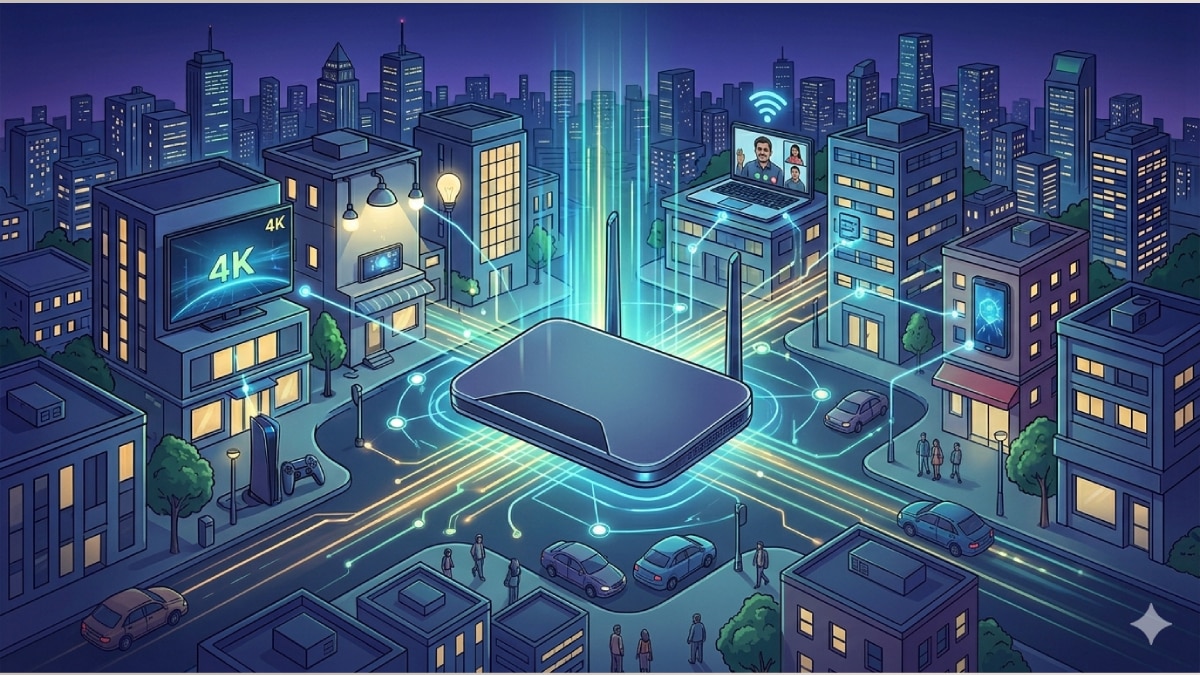
It is no longer about buying more speed to address the concern of a household’s internet woes – the goalpost has shifted. With dense urban environments becoming more connected yet complex, the broadband industry is already underway on the idea of a radical transformation, focusing on utilising currently available resources smartly and efficiently until the next major hardware upgrade arrives. And to help with that, the broadband industry is relying heavily on AI, not just cables.
Hence, to understand how AI, the tech of the hour, is helping your home broadband become better, we sat down to have a conversation with Dr Sarath Kumar, Chief Technology Officer at ACT Fibernet, where he shared glimpses of how the broadband industry is going to build a network with the capability to heal itself.
From bandwidth (capacity) to intelligence
Traditionally, the broadband industry followed a linear path – laying more fiber cables and upgrading hardware to push for higher speeds. However, Dr Kumar argues that this model is no longer sufficient for the modern age.
“AI is not simply an add-on to broadband infrastructure; it is redefining how networks are built, managed, and experienced,” says Dr Kumar. “Networks today must respond to dynamic, real-time demands across thousands of devices, applications, and user behaviours simultaneously,” he added.
In India’s dense urban markets, where multiple high-bandwidth applications, ranging from 4K streaming to cloud gaming, run concurrently in a single home, dynamic optimisation of network resources has become more critical than ever. Kumar says that ACT Fibernet is utilising AI across the entire infrastructure stack to allow predictive maintenance and intelligent bandwidth allocation.
Hence, AI systems will monitor the network performance and be predictive in nature as far as maintenance is concerned.
The definition of network quality has also evolved significantly over the last five years. While 100 Mbps was once the gold standard, Dr Kumar notes that “speed is the floor, not the ceiling” in today’s multi-device household era.
“The definition has shifted from ‘fast’ to ‘frictionless,” Dr. Kumar explains. “Our goal is not simply to deliver bandwidth, but to deliver an experience that is invisible in the best possible sense. When the network works perfectly, you do not notice it,” he stated.
With AI at the helm, customers now expect a network that is smart enough to prioritise a critical video call over a background software update on your laptop, or the operation of a light bulb, completely without manual configuration.
Modern Indian homes often have more than 10 to 15 connected devices, with all of them competing for bandwidth. This leads to spectrum congestion in the 2.4 GHz and 5 GHz bands. While the industry looks toward the 6 GHz band as a long-term fix, Kumar views AI as the immediate solution.
“A smart bulb and a live video conference should not be treated as equals by the network, but without AI-driven prioritisation, that is often what happens,” notes Dr Kumar.
He goes on to add that customers often cannot diagnose the root cause of a dropped call or a buffering video stream, hence the responsibility falls on the hardware. Under this new operation model, the Wi-Fi router is transformed from a passive distributor into a “context-aware system” that monitors dozens of parameters every second to address problems automatically.
The self-healing network
For ACT Fibernet, the shift to AI-driven optimisation after a partnership with Aprecomm has yielded “stark” technical results. By monitoring 16 parameters every second per device, the network has achieved:
– Up to 5x better performance for mobiles and laptops.
– 3x improvement in connection stability for legacy devices.
– A 17% overall improvement in Quality of Experience (QoE).
Ultimately, this AI-driven technology is moving the industry from a reactive model, i.e., where you only call your ISP when something breaks, to a proactive, “self-healing” one.
“By reducing the frequency of performance dips, AI is quietly building a level of trust that speed alone never could,” Dr Kumar states.
“In today’s market, the most successful network is the one the user never has to think about. That, to me, is the real promise of AI in broadband,” he concludes.