



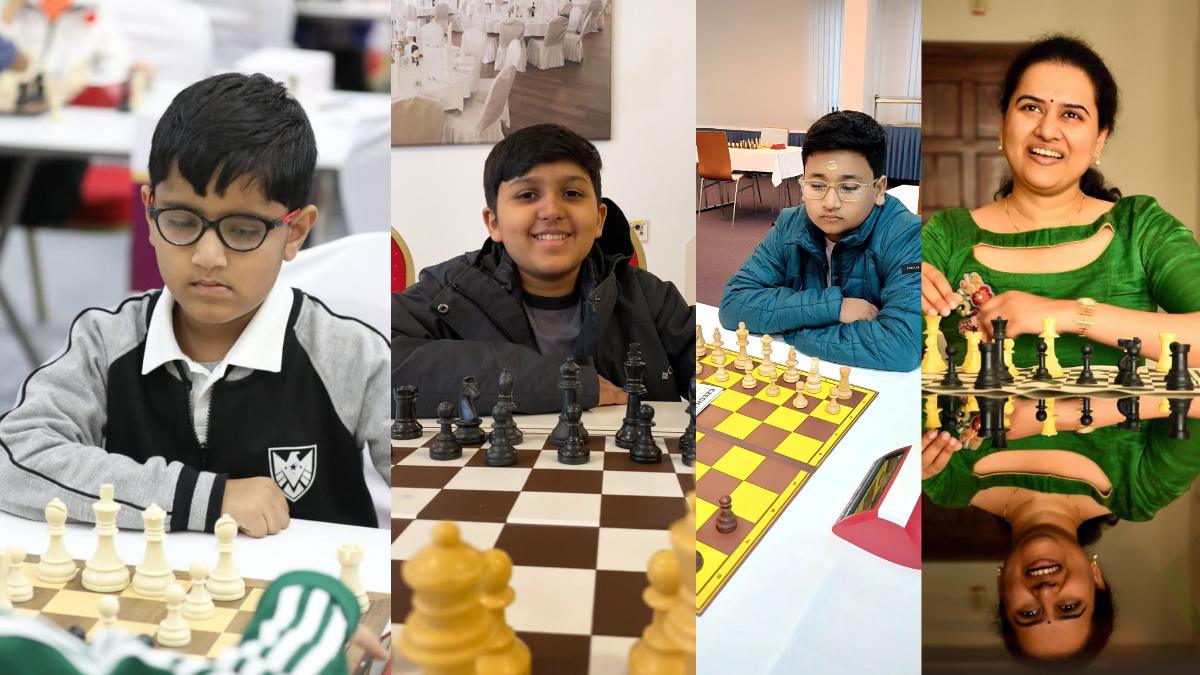
At 4 am, while most of the city sleeps, Anish Ramkumar, 13, is already awake. There are no school buses yet, no rush-hour horns. His day begins with yoga. “It keeps me calm,” says the Chennai-based chess player. In a game where a single lapse in concentration can undo hours of preparation, calm is currency.
For Ramkumar, chess is not an extracurricular activity. It is structure, discipline, and ambition rolled into 64 squares. “I started chess because I love strategy games,” he adds.
Meanwhile, in Bengaluru, international travel may keep Aarav Sarbalia busy, but the 12-year-old chess prodigy dedicates one to two hours daily to academics at Harvest International School. Technology helps him keep pace. “Chess has made studying easier for me. I can concentrate better and understand things faster,” he says.
Born in Delhi and based in Bengaluru since 2022, Sarbalia discovered chess when he was just six-and-a-half years old. His goal is clear—to become a Super Grandmaster—in five years. “I know it is a very big and difficult goal,” he says with a smile. Grounded by his parents and supported by mentor Deepti Shidore of Firgun Talent, Sarbalia remains focused.
Up north, Delhi boy Aarit Kapil, 10, has already faced the ultimate test—holding World No. 1 Magnus Carlsen to a draw in the ‘Early Titled Tuesday’ online tournament last year. Competing from Georgia during the Under-10 World Championship, Kapil battled the five-time world champion for 49 blitz moves. While the game ended in a draw, the message was unmistakable: India’s next wave of young players is becoming a force to reckon with.
Exposure to international circuits, access to advanced training tools, and mentorship from grandmasters have created a pipeline of fearless competitors. In early morning routines, in European tournament halls, and in packed academies across Chennai, New Delhi or Bengaluru, young players are thinking several moves ahead—not just on the board, but for the nation’s place in global chess.
Learning from legends
Ramkumar’s association with chess began when he was just four years old, as an extension to his fascination for strategy games. What started as play evolved into discipline. Weekends gave way to tournaments; idle hours turned into post-game analyses. “The attacking style of former World Champion Mikhail Tal, famous for audacious sacrifices, captured my imagination and I got inspired by it,” he says.
Closer home, the breakthrough of Gukesh Dommaraju, the youngest undisputed world champion, has expanded what feels possible for young Indian players. “It shows what is possible with dedication and belief,” adds Ramkumar.
That belief has already taken him across borders—competing in the UAE, Malaysia, Thailand and the Czech Republic. His rating has crossed 2000, a major milestone, and 2200 is firmly in sight. Under the guidance of coach RB Ramesh at Chess Gurukul in Chennai, he balances elite tournaments with schoolwork, treating time management as carefully as calculation.
If Ramkumar is inspired by Tal and Dommaraju, Sarbalia looks up to Carlsen and Anand, and wants to become a world champion just like them. The numbers suggest his ambition is not misplaced. During his first European tour in 2023, his rating leapt from 1400 to 2000 in five tournaments. He became a FIDE Master at 11, climbed to World No. 2 in his age group in 2024, and maintained a top-10 world ranking in 2025.
Making a difference
From Ramkumar’s dawn yoga sessions in Chennai to Sarbalia’s relentless puzzle-solving in Bengaluru and Kapil’s fearless duel with Carlsen, a pattern emerges: discipline, belief, and ambition. But talent alone does not create champions. It requires ecosystem—coaches, schools, federations, and sponsors—moving in sync.
India’s journey into chess started in the 1970s, when on a humid afternoon in Chennai, a six-year-old boy was dismantling older opponents in under 15 minutes. Viswanathan Anand was not merely playing faster—he was thinking faster. In his memoir Lightning Kid, he reflects: “I was playing—and beating—India’s best senior players, most of whom were much older and more experienced.”
By 15 years, Anand was winning national tournaments. He became an International Master while still in school, secured the national championship in Class 10, earned the Grandmaster title in 1988 at 18, and rose to World No. 5. He transformed Indian chess from a peripheral pursuit into a national aspiration.
India’s rise as a global chess powerhouse is no accident, says RB Ramesh, founder of Chess Gurukul and longtime coach of chess prodigy R Praggnanandhaa. The premier academy is also known for nurturing top Indian chess talents such as Vaishali R and Aravindh Chithambaram.
But a key factor, explains Ramesh, is infrastructure. “Chennai alone has more than 100 chess academies. Across India, children have places to learn, compete, and grow as part of the structured district-to-national selection system,” says the 2023 Dronacharya Award recipient, calling it “a well-oiled, largely corruption-free process” that ensures deserving players rise through merit. “It is not aspirational rhetoric anymore. India’s ascent in global chess is a measurable reality backed by results and institutional commitment,” says Dev Patel, secretary, All India Chess Federation (AICF).
According to Patel, three Indian players currently sit in the world’s top ten—Gukesh, Praggnanandhaa, and Arjun Erigaisi. “This concentration of elite talent from a single country is unprecedented. It mirrors the Soviet dominance of the past, but with a distinctly youthful profile. Our top players average just 21 years of age, giving us a very long runway.”
Pan-India phenomenon
If there is a geographic epicentre to India’s chess explosion, it is Tamil Nadu. More than 30 of India’s Grandmasters hail from the state. But long before India became a global powerhouse, Chennai had chess clubs, school competitions, international exposure, and corporate patrons.
The Tal Chess Club, established in 1972, played a formative role—not just in Anand’s career, but in building a chess-first culture. “We started playing chess when Anand was world champion,” Praggnanandhaa said in a media report. “He inspired all of us.”
State support, early adoption in schools, and corporate backing from companies like Ramco Group, Adani Group and Tata Steel created a virtuous cycle. While other regions relied largely on individual grit, Tamil Nadu benefitted from ecosystem momentum. Yet today, the geography of success is widening.
Take the case of Koneru Humpy, a Padma Shri and Arjuna Awardee. Her journey began not in a fancy academy, but at home in Andhra Pradesh—learning from her father and coach, Koneru Ashok, a state-level champion and 2007 Dronacharya Awardee. “I was ambitious from the start,” Humpy recalls. “I wanted to win every game, every tournament.”
She won her first city championship at six, claimed gold at the Under-10 Girls World Championship in France in 1997, and went on to become one of the most decorated players in women’s chess. In 2025, she added another jewel to her crown by winning the FIDE Women’s Grand Prix in Pune. Her rise was classical, built on discipline, structure, and longevity.
Institutionally, the AICF has amplified many such journeys through dedicated initiatives such as the ‘Women in Chess’. The programme supports at least 50 women-centric tournaments annually, alongside reservation policies for coaching certifications, arbiters, and ambassadors. This ecosystem—combining tradition, institutional backing, and emerging talent—validates India’s trajectory toward chess superpower status while maintaining realistic optimism.
As per Prachura PP, former international chess player and co-owner of FYERS American Gambits, a franchise in Global Chess League, chess in India is at its peak right now. He says: “The 45th FIDE Chess Olympiad success in 2024 followed by Gukesh’s World Championship victory has catapulted the sport in the country and perhaps one can even draw parallels with the USSR who dominated world chess in the 80s and 90s. India today has multiple top-ranked female players. Humpy, Harika Dronavalli, R Vaishali, and now Divya Deshmukh—who won the 2025 FIDE Women’s World Cup at just 19—signal sustained dominance.”
“Now with at least four players from India in the world top 15, there is tremendous corporate support and brands are constantly vying for an opportunity to work closely with these chess stars—making it sustainable for players. According to industry estimates, India’s chess economy is now valued at Rs 500 crore—an unprecedented figure in a cricket-obsessed nation,” adds Prachura.
While Chennai remains influential, talent is now emerging nationwide—Divya Deshmukh from Nagpur; Vidit Gujrathi from Nashik; Harika Dronavalli and Arjun Erigaisi from Andhra Pradesh; Anish Sarkar, the world’s youngest FIDE-rated player at three, from Kolkata.
Even school-level competitions and standardised platforms are accelerating this shift. In 2025, the ISSO National Chess Competition hosted by Adani International School saw participation from 370 students across 80 schools.
In fact, the backbone of India’s chess rise is its academy ecosystem. At the forefront is the WestBridge Anand Chess Academy (WACA), launched in 2020 through a partnership between Anand and WestBridge Capital. Its merit-based fellowship programme has nurtured five standout talents: Gukesh, Praggnanandhaa, Nihal Sarin, Raunak Sadhwani, and R Vaishali. “What distinguishes WACA is mentorship at a truly global level,” Patel explains.
The academy’s coaching roster includes Grzegorz Gajewski, Artur Yusupov, Boris Gelfand, and Sandipan Chanda—all former seconds to world champions. “This ensures our players receive guidance comparable to the best systems anywhere in the world,” Patel says.
Overcoming barriers
One of the biggest historical barriers in Indian chess has been its sustainability. That equation is now changing. In June last year, the AICF launched the Top National Players Stipend Scheme (TNPSS)—a landmark initiative providing quarterly stipends ranging from Rs 60,000 to Rs 1.5 lakh to 78 players across Under-7 to Under-19 categories. The two-year outlay exceeds Rs 6.15 crore. “This allows players to focus entirely on chess, not on survival,” says Patel.
“Chess today is holistic,” says Sanjay Adesara, chief business officer, Adani Sportsline, the sports arm of Adani group that invests in prestigious leagues like the Women’s Premier League, Pro Kabaddi League, Ultimate Kho Kho League, and the International League T20 UAE. “Travel planning, sports psychology, tournament selection—these are what turn juniors into sustainable professionals,” adds Adesara.
While corporate partners provide stable backing, Ramesh says, unlike Western models that encourage children to sample many activities, India often backs focused commitment, “If a child shows interest in chess, parents go all out. That exposure makes a difference.”
Nevertheless, the need for sponsorships remains a concern. “To compete at the highest level, our players must travel abroad. And we need strong, rating-restricted tournaments in India. Corporate support can change the ecosystem,” adds Ramesh.
Currently a student at Somerville School, Aarit Kapil continues to attend classes regularly and sit for examinations like any other child his age. In recognition of his extraordinary talent, the school has waived his tuition fees—a gesture that has helped support his rising career. But behind every international tournament lies a logistical and financial puzzle. Global exposure is essential, but it comes at a cost few families can shoulder alone.
Due to his age, Kapil is always accompanied by one parent during his travels—doubling travel expenses. Adjusting to new environments, food and time zones adds to the challenge. “International tournaments are expensive,” says Kapil’s father, Vijay Kapil, who works as a mutual fund distributor in Delhi. “With strong corporate backing, he would be able to compete more widely on the global stage.”
Though Kapil has received meaningful support from organisations such as ChessBase India and Chola Chess, his family acknowledges that securing a full-fledged sponsor would significantly ease financial pressures and allow him to compete more consistently on the international stage. Meanwhile, experts like Ramesh feel the need to have sponsorship in essential areas. “Currently, India lacks sufficient strong tournaments domestically, so ambitious players have to travel to Europe or other Asian countries to gain rating points and competitive exposure.
\Many open international tournaments allow lower-rated players to participate for high entry fees (Rs 15,000-Rs 20,000). Organisers profit from these fees, as large numbers of young players enter. However, this dilutes the tournament’s strength, discouraging top players from participating since they would mostly face weaker opponents. As a result, strong Indian players often prefer to compete overseas,” explains Ramesh.
To address this, there is a need for rating-restricted tournaments in India, where only players above a certain rating threshold can compete. “Such events would maintain high competitive standards but would not generate the same profits from entry fees. Therefore, strong corporate sponsorship is needed to support them,” feels Ramesh.
Corporate support
Since chess aligns with brand values— strategy, excellence, global reach—corporates are coming forward to help. For instance, Adani backs Praggnanandhaa through its Garv Hai initiative, easing financial pressures and enabling international exposure.
“There is already significant interest and curiosity among corporates to understand how they can benefit from this chess boom in India,” Prachura says, giving a recent example of how the American Gambits signed on FYERS, an online trading company from Bengaluru, as the title sponsor, and S45, India’s ‘first AI-native investment bank’, as the co-sponsor.
“Both these associations are unprecedented as we have signed three-year, multi-crore deals with them. While this is at the franchise level, individual players, too, are getting corporate support and endorsements,” he adds.
Corporate sponsorships have also moved from short-term endorsements to long-term ecosystem building. Quantbox Research’s five-year $1.5 million deal with Arjun Erigaisi is among the largest in Indian chess history. WestBridge Capital’s five-year support for Gukesh, RBL Bank appointing Gukesh as brand ambassador, and Tech Mahindra’s Global Chess League —projected to generate $40 million in value—underscore growing confidence.
WestBridge Capital’s pioneering five-year sponsorship of Gukesh Dommaraju exemplifies long-term institutional commitment to player development, covering training expenses, coaching fees, travel, and competition costs. Arjun Erigaisi’s five-year, $1.5-million (approximately Rs 12.4-crore) agreement with Singapore-based Quantbox Research represents perhaps the largest individual sponsorship in Indian chess history. The Adani Group backs R Praggnanandhaa, while Vidit Gujrathi receives support from Ambit, Persistent, and ONGC. RBL Bank recently appointed Dommaraju as brand ambassador, aligning strategic financial planning with chess’s forward-thinking nature.
Tata Steel, JSW, and Microsense support major tournaments, while Quantbox serves as title sponsor for the Chennai Grand Masters. These partnerships typically provide financial stipends, cover training and travel expenses, offer performance bonuses, and create brand visibility opportunities—enabling players to focus entirely on chess without financial anxiety. The ecosystem is clearly moving toward comprehensive, multi-year support structures rather than opportunistic short-term arrangements.