



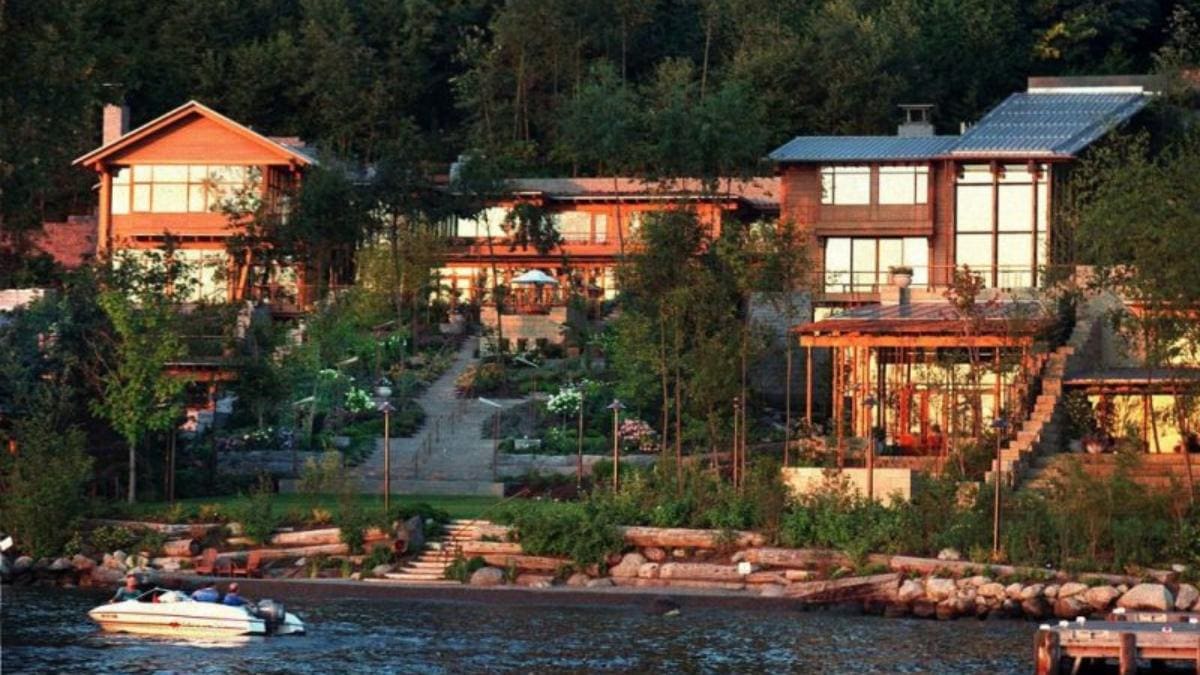
When Bill Gates purchased a wooded hillside plot in Medina, Washington in 1988 for $2 million, few could have anticipated what would rise from it. Seven years, 300 labourers, and a construction budget of over $63 million later, the result was Xanadu 2.0 – a 66,000 sq ft estate built from 500 Douglas fir trees and seven types of stone.
Named after the fictional mansion in the film Citizen Kane, the property is today valued at more than $130 million according to Robb Report and remains one of the most talked-about private residences in the world. Gates once called it, quite simply, “the coolest house ever.”
A home that knows who you are
What sets Xanadu 2.0 apart from other billionaire estates – apart from its scale – is how the home functions. Guests spending the night receive a pin with GPS tracking that syncs to a range of sensors, adjusting lighting, temperature, and music according to each individual’s preferences.
Speakers hidden in the walls ensure a favourite tune follows guests from room to room. The walls themselves behave like an ever-changing gallery: as per Architectural Digest, the mansion features $80,000 worth of computer screens that display artwork, photos, or videos at the touch of a button, with a storage system for the digital displays alone costing $150,000.
AD reports that the estate includes a 60-foot swimming pool with an underwater music system, a 2,500 sq ft gym, a 1,000 sq ft dining room, six kitchens, and 24 bathrooms. There is also a reception hall built to host 150 guests, alongside a domed private library.
That library, as reported by the Economic Times, is home to one of the estate’s most remarkable possessions: the Codex Leicester – a 16th-century Leonardo da Vinci manuscript that Gates purchased at auction for $30.8 million in 1994. Inscribed on the library’s ceiling is a line from The Great Gatsby: “He had come a long way to this blue lawn, and his dream must have seemed so close that he could hardly fail to grasp it.”
Built for privacy, designed for the future
The estate was designed with seclusion as a guiding principle. Guests access the property through a private tunnel built in 2006 under Highway 106, connecting the mansion to the main road. The property sits embedded into the hillside above Lake Washington, with 475 feet of the lake’s waterfront and artificial streams stocked with salmon and trout.
A private beach, featuring sand imported annually from the Caribbean by barge, gives guests a taste of the tropics despite being located in the Pacific Northwest corner of the United States.
According to the same AD feature, Gates’ home also uses a geothermal heating and cooling system, a heat recovery ventilation system, and a rainwater collection system for irrigation – a nod to Gates’ long-standing interest in sustainable design.
A 23-car garage, a trampoline room with a 20-foot ceiling, and a 20-seat Art Deco home theatre round out a property that feels less like a house and more like a small, meticulously engineered town. The annual property tax bill alone amounts to over $1.1 million. For a man who built his fortune on software, Xanadu 2.0 remains his most ambitious piece of hardware.