



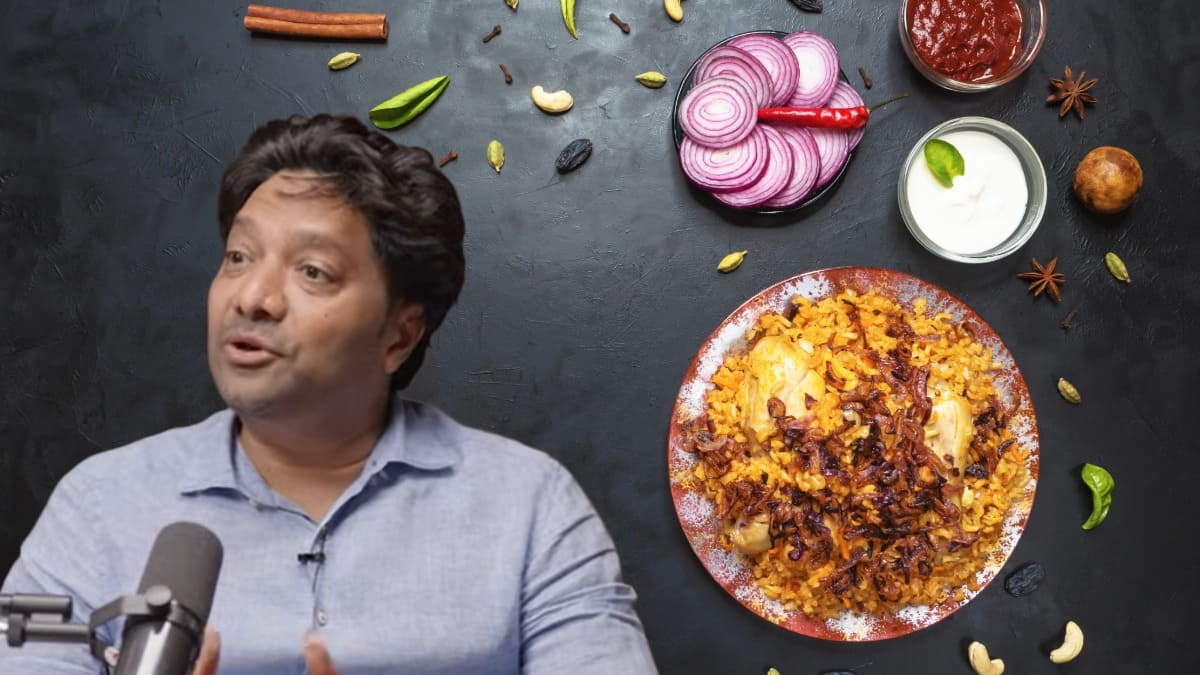
Food delivery is one of the most accessible business models today. For consumers, a hot meal is just a few clicks away, while restaurants—even dark kitchens—are effortlessly streamlining their operations via these apps. However, this was not always the case in India. For the longest time, until about a decade ago, households relied on drawers filled with local menus and phone numbers quickly scribbled next to the promise of ‘free home delivery’.
By 2025, Zomato, one of India’s largest food delivery platforms, recorded a staggering 18.72 lakh simultaneous orders at 8:25 PM—a slot dubbed ‘India’s national dinner time’. Amidst this booming ecosystem, which features over 10 lakh listed restaurants, stands one of the first and largest cloud kitchen successes India has ever seen: Biryani By Kilo.
The brand was co-founded by Vishal Jindal, an IIT alumnus who worked in fintech for over a decade before building one of India’s biggest cloud kitchen networks.
Who is Vishal Jindal?
Born in Agra, Jindal later moved to Delhi with his parents. He completed his engineering degree from IIT BHU, went on to earn an MBA in Finance in New York, and returned to India in 1996. Speaking to Ganesh Prasad on The Indian Business Podcast in December 2024, Jindal revealed that he initially ran a successful IT business for over a decade.
He eventually chose to sell the company and relocate to Singapore. Exploring new opportunities and expanding his horizons, Jindal worked in finance from 2008 to 2012. “I used to invest in a lot of businesses, with a specific focus on consumer brands,” he shared.
Upon returning to India, Jindal even started a private equity fund, but he always carried a deep fascination with the consumer and food sectors.
‘Why is there no McDonald’s in India?’
Haunted by a question that hit home, Jindal was puzzled by why India had never produced its own McDonald’s, Burger King, or Domino’s—global chains that hold a market monopoly and become nearly synonymous with the food items they serve. Driven by a belief in the universal appeal of Indian cuisine, from Gujarat to Assam, he found his answer in biryani.
Jindal believed that biryani, a rice-based dish, naturally bypassed the gluten-heavy carb issues found in flour-based fast food. More importantly, it was a testament to Indian culture dating back centuries. Jindal shared, “Why can’t India have a massive food chain built around its own dishes? I thought biryani was the perfect category.”
The Biryani By Kilo co-founder also highlighted the unique logistics of the dish. From packaging to delivery, biryani is incredibly versatile and can be prepared with a variety of hero ingredients. Moreover, he noted that it is an ideal item for transit, especially when compared to the fragile nature of a dosa, a sandwich, or traditional Indian flatbreads.
Aiming for a global footprint, Jindal utilized the power of standardization to deliver a uniform experience across different states. Today, Biryani By Kilo operates 110 outlets across 29 cities in India. Committed to sustainability, the brand replaces plastic containers with ethically sourced materials like earthen pots (handis).
According to Startupedia, Biryani By Kilo reported a 14% surge in revenue to ₹310 crore in FY25, alongside planned increases in employee benefits and advertising expenses. As of March 2025, the company held assets worth ₹55.5 crore and an estimated bank balance of ₹23 crore. In April 2025, Devyani International—the largest franchisee for KFC and Pizza Hut in India—acquired a strategic stake in Sky Gate Hospitality, the legal entity behind Biryani By Kilo.
Jindal’s core philosophy centers on authentic flavors that evoke traditional Indian home cooking. “If we maintain this taste, we can do wonders in this category,” Jindal shared, explaining his thesis for entering the segment. “We can grow bigger than chains like McDonald’s and Burger King—both in India and beyond,” he added, aiming to compete with global giants that boast over $200 billion in revenue and 40,000 outlets worldwide.
“I want to leverage my experience from the US, Singapore, investing, and scaling an IT business. If I can build a company from India that competes with global giants, it will make the nation truly proud,” he expressed.
Building a Cloud Kitchen Empire
Jindal acted early and moved fast. Drawing inspiration from DoorDash, which was just emerging in the US when he returned to India via Singapore, he noticed that India was still a stranger to the concept of cloud kitchens. In 2015, a large section of Indian consumers still prioritized the physical experience of dining out.
While ‘eating out’ and ‘ordering in’ have skyrocketed recently, it was an occasional luxury rather than a daily habit a decade ago. Comparing this to Singapore—where cheap, hygienic dining options mean its 60-lakh (6 million) residents frequently opt for delivery over home-cooked meals—Jindal realized there was a massive market gap to bridge in India.
Given the skyrocketing cost of commercial real estate in India, Jindal concluded that a cloud kitchen could function from virtually anywhere. Whether situated in an industrial zone or a nook on a third floor, the physical location didn’t matter to the consumer; all that mattered was the quality and taste of the food arriving at their doorstep.
Ultimately, for Jindal, the venture is about more than just food—it is about expanding India’s cultural soft power. In a society where culture and community are deeply intertwined, food has always been a powerful historical anchor, and Jindal firmly believes in its ability to unite the world.