



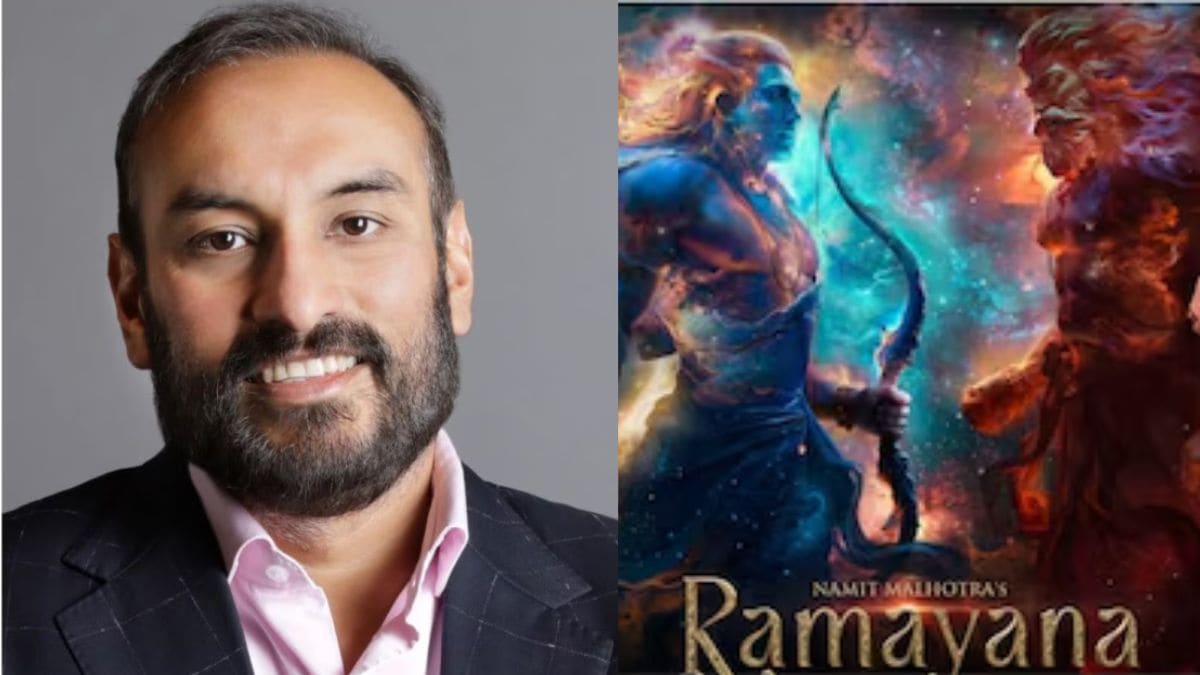
While movie fans are busy debating Ranbir Kapoor’s look as Lord Rama, the real ‘big picture’ story is about the man signing the cheques. Namit Malhotra, the producer of the upcoming Ramayana epic, has officially joined the world’s elite billionaire circle. According to the Hurun Global Rich List 2026, Namit has made a massive debut with a personal net worth of Rs 9,204 crore.
His story isn’t just about inherited wealth; it’s a classic Mumbai tale of starting small and dreaming big. Before he was winning Oscars in Hollywood, he was just a teenager working out of his father’s dusty garage.
A legacy that spans three generations
Namit Malhotra didn’t just stumble into the movie business by accident. He comes from a family that has lived and breathed Indian cinema for over 70 years. His grandfather, M.N. Malhotra was a true pioneer. He was the cinematographer for the 1953 classic Jhansi Ki Rani, which was one of the very first Indian movies ever shot in colour.
His father, Naresh Malhotra, was a successful producer and director. He was the man behind major Bollywood hits, like the Amitabh Bachchan starrer Shahenshah (1988). Growing up, Namit saw the magic of movies up close, but he was fascinated by something different: the technology and the visual effects that make the impossible look real on screen.
A 1995 garage startup
In 1995, when Namit was only 19 years old, he decided to start his own venture called Video Workshop. He didn’t have a fancy corporate office or a big investment. Instead, he cleared out some space in his father’s garage and set up a few computers.
In a move that sounds like a movie script, he actually convinced three of his own teachers from his computer graphics school to quit their jobs and join his tiny startup. They started by doing small editing jobs for 90s TV shows like Boogie Woogie. To keep the business running and buy better machines, Namit even had to mortgage his family’s only house. It was a massive gamble, but he was convinced that digital tech was the future of cinema.
Conquering Hollywood and winning Oscars
By 1997, Namit merged his small workshop with his father’s business to create Prime Focus. The company grew fast, becoming the first Indian media services firm to go public in 2006. But Namit’s real goal was to prove that an Indian company could beat the best in the world.
He eventually merged his firm with Double Negative (DNEG), a world-famous visual effects studio in the UK. Today, as the Chairman and CEO of DNEG, Namit is a giant in the global film industry. His company has won eight Academy Awards (Oscars) for Best Visual Effects. If you loved the visuals in Inception, Interstellar, Tenet, or Dune, you were actually watching the work of Namit’s team.
The Rs 4,000 crore Ramayana
Now, Namit is bringing all that global experience back home to produce what is being called the most expensive Indian film ever made. He is producing a new, grand version of the Ramayana, which will be released in two parts.
Namit himself, in one of the earlier interviews, confirmed that this project is being made at a Rs 4,000 crore (around $500 million) budget. This kind of money is usually only spent on massive Hollywood superhero movies. Namit’s plan is to use the same ‘Oscar-level’ technology he uses for Hollywood films to tell India’s greatest story on a scale the world has never seen.
The stars and the strategy
The movie is being directed by Nitesh Tiwari, the man who made Dangal. To make sure the film is a hit across India, Namit has put together a massive cast, including Ranbir Kapoor as Lord Rama, Sai Pallavi as Sita, Yash (of KGF fame) as Ravana and Sunny Deol as Lord Hanuman.
In a smart business move, the South superstar Yash is also a co-producer. The two joined hands because they want to ensure that Ramayana isn’t just a local hit, but a global cinematic event.
What lies ahead in 2026
The first part of Ramayana is set to release during Diwali 2026. Namit has been very clear that he isn’t just making a ‘regional’ film; he wants Ramayana to be India’s answer to global franchises like Star Wars. All eyes are now on the box office to see if his multi-crore dream pays off.