



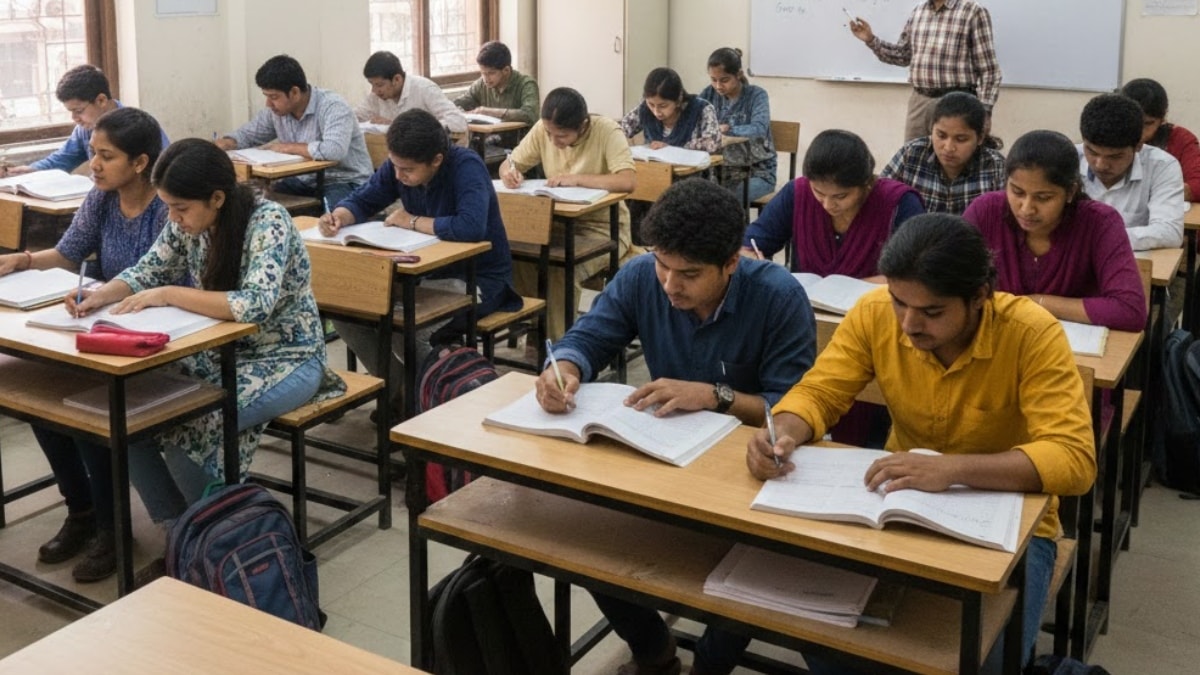
A central government-appointed committee has suggested major changes to India’s high school education system to reduce students’ heavy dependence on coaching centres, according to a report by The Indian Express.
The committee has proposed limiting coaching classes to 2–3 hours a day, redesigning school syllabi so they match the pattern of competitive exams, giving more importance to board exam marks during college admissions, and even exploring whether competitive tests can be introduced in Class 11.
Formation and members of the committee
This committee is headed by Vineet Joshi, Secretary of the Department of Higher Education, and was formed by the Ministry of Education on June 17, 2025. Its job is to study gaps in school education, review the “effectiveness and fairness of competitive entrance examinations”, look into the rise of dummy schools, and understand how coaching institutes are influencing students’ academic paths, as per the report.
The panel which includes CBSE chairman Rahul Singh, NTA Director General Rajesh Lakhani, and professors from IIT Kanpur, IIT Madras and NIT Trichy have met in Shastri Bhawan in New Delhi on August 26 and November 15 last year. In both meetings, members repeatedly pointed out that coaching centres have “emerged to fill certain gaps”, and that the “long-term solution must come from strengthening the school ecosystem itself”, the report said.
Concerns about coaching centres
During their discussions, the committee recognised the growing concern around the proliferation of coaching centres and their impact on student well-being, equity of education, and the role of schools.
They also identified a clear disconnect between school curricula and the demands of competitive examinations such as JEE and NEE”, and noted that the shift from Class 10 to Class 11 has become a major “stress point” for students.
The committee said the “lack of alignment between CBSE’s analytical and conceptual approach and the objective, MCQ-based format of entrance exams” is a “root cause” of students depending so heavily on coaching. According to the members, this gap has encouraged the growth of dummy schools and a parallel coaching-driven system that is slowly sidelining regular schooling, the IE report said.
Teachers and school ecosystem gaps
The committee also pointed out that many school teachers are “not adequately trained to teach beyond board exam requirements”, while coaching centres “often employ subject experts, including engineers and medical graduates to deliver targeted instruction”.
Schools, the panel noted, often lack the support system coaching institutes offer – such as “regular testing, performance analytics and curated study materials”. Because of this, students feel the need to seek structured preparation outside school.