



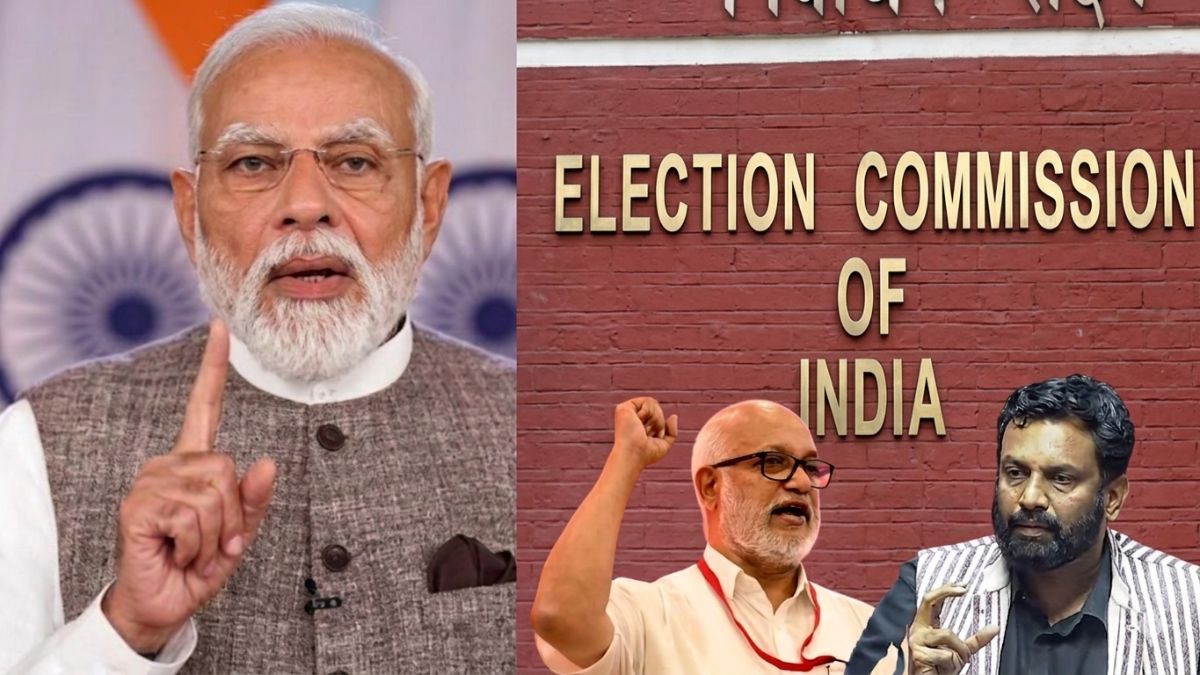
Following PM Narendra Modi’s spirited national address on April 18, where he blamed opposition for defeating Women’s Reservation Bill and Delimitation Bill, leaders from Left parties have called it a violation of the model code of conduct.
The leader also wrote to Chief Election Commissioner Gyanesh Kumar, seeking action against PM Modi for “violating the model code of conduct” ahead of assembly polls.
According to a PTI report, CPI(M) General Secretary MA Baby and CPI Rajya Sabha MP P Sandosh Kumar wrote separately to the poll panel chief, stating that the PM misused the public broadcast to influence public opinion in states where polling is scheduled in coming days.
What did PM Modi say in his national adress
In his national address on Saturday, PM Modi issued an ‘apology’ to the women of India, citing the parliament’s failure to clear the bills on speeding up the women’s reservation exercise in the parliament by linking it with the delimitation exercise.
After issuing an apology, PM Modi called out opposition parties for celebrating “the insult/defeat of the women of India”.
“Women will make the opposition pay for the disrespect,” PM Modi said during his national address, accusing the Congress and its INDIA bloc partners of “betraying” women.
“Parties like Congress, DMK, TMC and Samajwadi Party have committed foeticide by defeating bill on women’s reservation,” he further said.
Opposition reacts
Following PM Modi’s charged national address, opposition parties have united to flag the content and tone of the Prime Minister’s speech. “The content, tone, and messaging of the address can by no stretch of imagination be termed as governmental communication,” CPI (M) leader MA Baby said.
MA baby further argued that the Prime minister’s recent address constitutes a “flagrant breach” of the MCC provision laid down in Section 4 under the heading “Party in Power”.
“Usage of a public broadcaster as a platform for political messaging during an election by the incumbent prime minister creates an uneven playing field and undermines the principle of free and fair elections, which is the cornerstone of our parliamentary democratic framework,” MA Baby said.
In their letter to the chief election commissioner, CPI(M) leaders urged the EC to “take cognisance of this violation and urgently initiate appropriate proceedings against the Prime Minister and concerned authorities”.
After submitting their letter, CPI Rajya Sabha MP P Sandosh Kumar also issued a warning to the EC suggesting that the chief polling body’s failure to act in such an instance could erode public confidence in the impartiality of the Election Commission and signal “institutional complicity”.
PM Modi delivered his latest national address in the backdrop of the defeat of a major Constitution Amendment Bill in the Lok Sabha that proposed to increase the assembly seats through delimitation and implement 33 per cent reservation for women in legislatures under the Nari Shakti Vandhan Adhiniyam.
What was the Centre’s push for Delimitation all about?
In simple terms, delimitation is like redrawing the electoral map of India to make sure every Member of Parliament (MP) represents a fair and roughly equal number of people.
Since India’s population has grown significantly over the decades, the government introduced the Delimitation Bill, 2026 to increase the total number of seats in the Lok Sabha from 543 to 850.
The bill had been introduced in the parliament by the NDA by explicitly linking the seat increase proposal with the Women’s Reservation Bill. While presenting the bill in this unique arrangement, the centre argued that by adding more seats, they could guarantee a 33% quota for women without taking away seats from current male representatives.
However, the plan faced a “North-South” divide. Southern states feared that because they successfully controlled their population growth, redrawing the map based on old Census data would give more seats (and more power) to Northern states with higher populations.
As per the bill floated in the parliament, the exercise was to conduct census data from 2011 that is 15 years old as of today.
Some of the critics of the bill argued that even if the delimitation exercise should be conducted, why should it not be done on the basis of the census to be conducted in the near future, with more accurate data of India’s population density across states.
When the opposition blocked the bill in Parliament, it effectively also stalled the increase in women’s quota.