



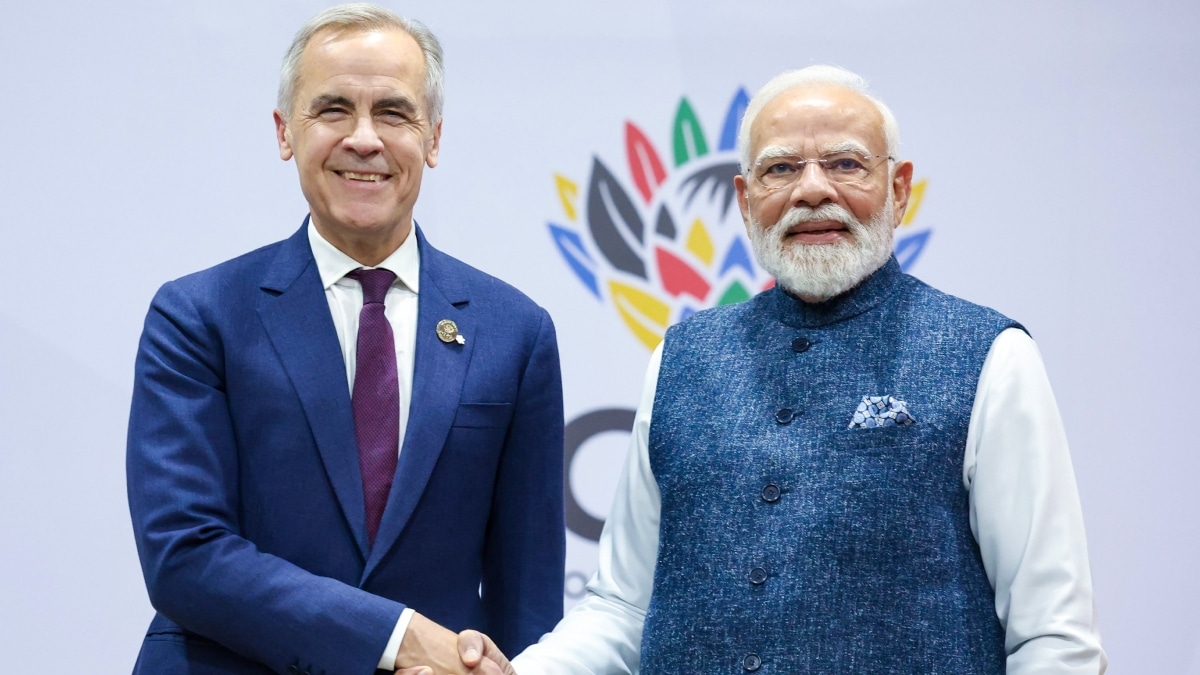
Canadian Prime Minister Mark Carney will arrive in Mumbai today, February 27, for his first official visit to India. The four-day visit is being seen as his latest effort to reduce Canada’s trade dependence on the United States and improve ties with India.
Carney left Ottawa on Thursday and is expected to land in Mumbai later today. After India, he will travel to Australia and Japan next week.
The visit aims at “expanding” bilateral ties and building new partnerships in important sectors such as defence, energy and Artificial Intelligence (AI), according to a press release from his office earlier this week.
“The leaders will focus on elevating and expanding the Canada-India relationship, with ambitious new partnerships in trade, energy, technology and AI, talent and culture, and defence,” the statement read.
Carney last met Prime Minister Narendra Modi in November 2025 during the G20 Leaders’ Summit in Johannesburg, where they reviewed progress in the India–Canada partnership.
Mark Carney’s India visit: What’s on agenda?
Canadian PM Carney will arrive in Mumbai on 27 February. Over the next two days, he will attend business meetings and interact with Indian and Canadian CEOs, industry leaders, financial experts, innovators, educators and representatives of Canadian pension funds operating in India, the government said.
“Prime Minister Carney will arrive in New Delhi on 1 March. On 2 March, the two Prime Ministers (Carney and PM Modi) will hold delegation-level talks at Hyderabad House,” it said.
Both leaders are expected to review the progress made in different areas of the India-Canada Strategic Partnership. This will build on their earlier meetings in Kananaskis in June 2025 and in Johannesburg in November 2025.
They will also review cooperation in key areas such as trade and investment, energy, critical minerals, agriculture, education, research and innovation, and people-to-people ties. The two leaders are also expected to discuss regional and global developments, the government said.
Prime Minister Modi and Prime Minister Carney will attend the India-Canada CEOs Forum on March 2.
Carney’s visit comes at key moment in relations
“Carney’s visit to India comes at an important juncture in the normalisation of India-Canada bilateral relations. The two Prime Ministers have earlier agreed to pursue a constructive and balanced partnership grounded in mutual respect for each other’s concerns and sensitivities, strong people-to-people ties, and growing economic complementarities,” the government statement said.
The statement added that the Carney-Modi meeting will help reaffirm the positive momentum and shared vision of both countries to build a forward-looking partnership.
India-Canada diplomatic tensions and gradual reset
India and Canada agreed to restore diplomatic services last year after relations were strained in 2023. Ottawa had accused New Delhi of involvement in the killing of a Sikh separatist leader, which led to serious tensions between the two countries.
In September 2023, Carney’s predecessor, Justin Trudeau, told Parliament there were credible allegations linking India to the killing of Canadian citizen Hardeep Singh Nijjar near Vancouver. India strongly denied the allegations and accused Trudeau’s government of supporting extremists.
The diplomatic dispute worsened in October 2024, with both countries recalling and expelling senior diplomats. However, the situation began to improve after Carney, leader of the Liberal Party, won the parliamentary elections in April 2025, opening the door for reconciliation.
Carney’s India visit is being seen as a diplomatic “reset.”
India-Canada growing trade and economic cooperation
The visit comes at a time of growing economic ties. In 2024, India became Canada’s seventh-largest trading partner, with total two-way trade reaching USD 30.8 billion.
Building on discussions held during last year’s G20 Leaders’ Summit, both countries have agreed to formally begin negotiations for a Comprehensive Economic Partnership Agreement (CEPA). The proposed deal aims to more than double bilateral trade to $70 billion by 2030.
Dinesh Patnaik, India’s High Commissioner to Canada, told Bloomberg that the visit will have an “immense” agenda. This could lead to agreements in research, artificial intelligence, quantum computing and education.
Patnaik said the visit may also include a deal to increase Canada’s uranium exports to India. India is also interested in buying Canadian heavy crude and other energy resources, and may invest in infrastructure projects such as pipelines and terminals, he said.
In November, Carney and Prime Minister Modi agreed to restart talks on a free-trade agreement, with the possibility of signing it within a year, according to Patnaik.
He added that despite past challenges, both economies have grown stronger, and the momentum to finalise a deal is increasing.