



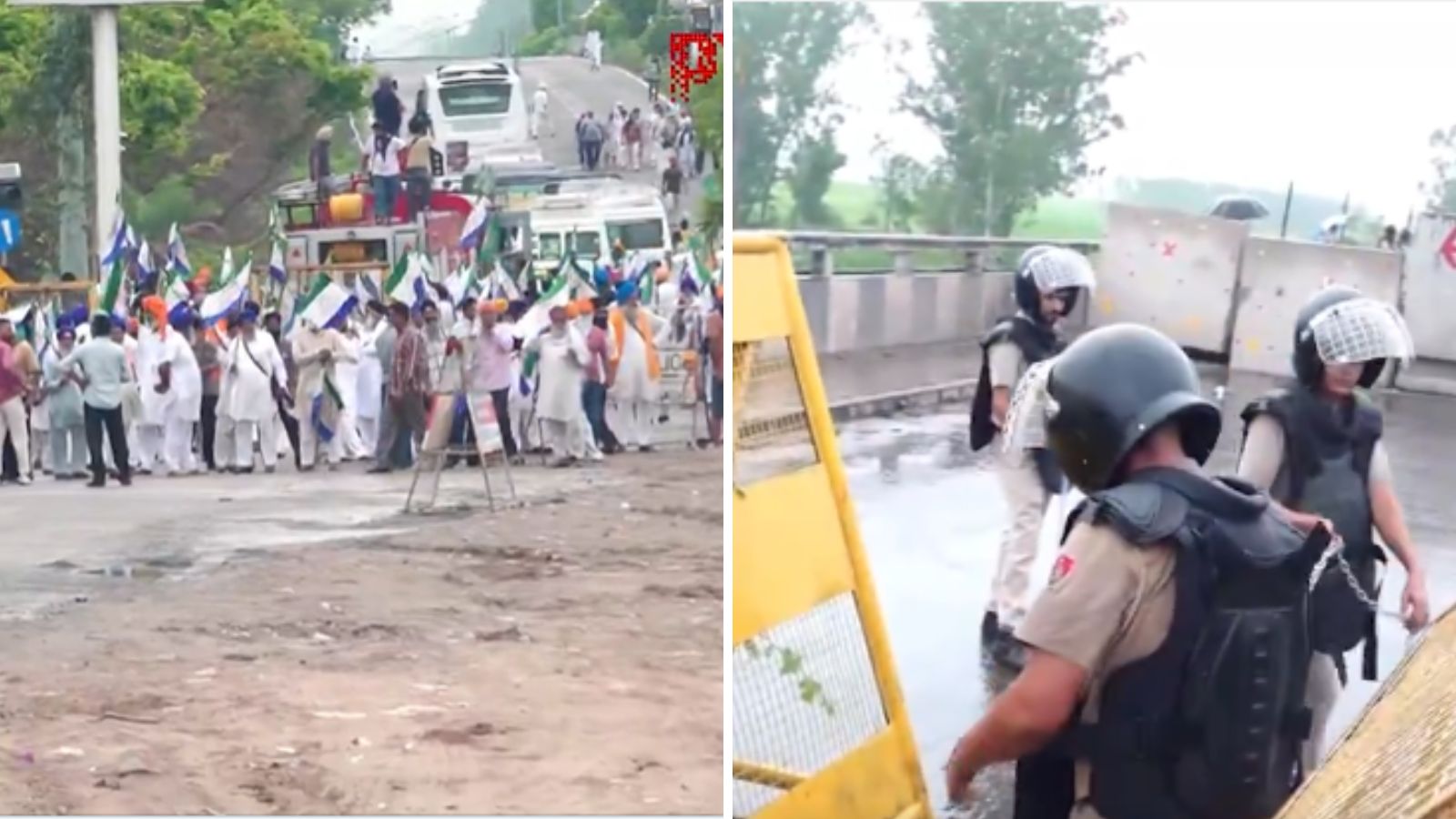
Thousands of farmers from Punjab, Haryana and other parts of the country started marching towards Delhi on Tuesday morning to attend a mahapanchayat at Kisan Ghat. The farmers are protesting against the proposed India-US trade deal, which they fear could hurt Indian agriculture and the livelihoods of farmers and agricultural workers.
As farmers began their journey, Haryana Police tightened security at the Shambhu border between Punjab and Haryana. The border was sealed, key roads were blocked, and Bharatiya Kisan Union (Charuni) chief Gurnam Singh Charuni was detained.
Farmer leaders fear that the agreement could allow cheaper American agricultural products to enter the Indian market in larger quantities. They argue that this could put Indian farmers at a disadvantage, especially if the government is unable to use protective tariffs to shield domestic producers.
The Centre, however, has strongly rejected the concerns raised by farmer organisations. Union Commerce and Industry Minister Piyush Goyal has repeatedly said that the interim agreement is “fair, equitable and balanced” and that it fully protects the interests of Indian farmers.
VIDEO | Shambhu Border: Farmers gather at the Shambhu border ahead of their planned march to the national capital for a 'mahapanchayat' to protest against the proposed Indo-US trade deal.
— Press Trust of India (@PTI_News) July 21, 2026
(Full video available on PTI Videos – https://t.co/n147TvrpG7) pic.twitter.com/IJq6ubAmVY
Why are farmers heading to Delhi for Mahapanchayat?
The mahapanchayat has been organised by the Desh Bachao Morcha, an umbrella group of farmer organisations formed to oppose the proposed India-US trade agreement.
Farmers from Haryana, Punjab, Uttar Pradesh, Rajasthan, Uttarakhand, Telangana, Tamil Nadu and Kerala are expected to take part in the rally.
Unlike earlier farmer protests, where tractor convoys played a major role, farmers taking part in Tuesday’s mobilisation largely chose buses and private vehicles to travel towards Delhi.
Large groups of farmers started leaving Fatehgarh Sahib in Punjab as early as 5 am. The move brought traffic and movement between the two states to a halt at the crossing.
Police also increased security on important stretches of national highways, expecting a large number of farmers to try to enter Haryana on their way to Delhi.
VIDEO | Haryana Police put concrete barricades at Shambhu border as farmers prepare to head to Delhi for a planned 'mahapanchayat' to protest against the proposed Indo-US trade deal.
— Press Trust of India (@PTI_News) July 21, 2026
(Full video available on PTI Videos – https://t.co/n147TvrpG7) pic.twitter.com/kfjwDQXnEW
Charuni has earlier warned that the proposed agreement could affect much more than agriculture. According to him, the deal could also have an impact on dairy, industry, digital trade, e-commerce, government procurement, intellectual property and services.
The farmers are now demanding that the Centre completely abandon the proposed trade pact and protect the interests of farmers, agricultural labourers, livestock rearers and small traders across India.
Key concerns of farmers over India-US trade deal
- Fear of cheaper US farm products flooding Indian markets
- Risk of lower crop prices and farmer incomes
- Limited freedom to impose protective tariffs
- Concerns over US dairy and poultry imports
- Possible impact on rice, sugar, soyabean, apple and maize farmers
- Fear of long-term price fluctuations and income losses
- Lack of transparency over the deal’s full terms
- Concerns over the deal’s impact beyond agriculture
- Demand to protect farmers and rural livelihoods
- Demand to scrap the proposed trade deal
What is the India-US trade deal?
The interim trade framework between India and the US was officially announced on February 6, 2026.
Under the framework, the reciprocal US tariff on Indian goods was reduced to 18 percent from 25 percent. The tariff had briefly reached as high as 50 percent during the negotiations.
In return, India agreed to allow greater imports of certain American products and committed to gradually reducing its purchases of Russian oil.
The agreement also gave several Indian agricultural exports zero-duty access to the US market. These products include spices, tea, coffee, cashew nuts, chestnuts, avocado, banana, mango, kiwi and papaya.
The government has said the reciprocal tariff on Indian exports, which had once reached 50 percent, has now been reduced to 18 percent.
However, a few independent assessments have raised concerns about how farmers growing rice, sugar, soyabean, apples and maize could face a greater risk of price fluctuations and income losses over time. At the same time, sectors such as poultry, dairy and textiles could benefit from the agreement.
Negotiations on a larger and more detailed trade agreement have continued since February. The two sides have reportedly been working on safeguards for individual sectors.
Government says farmers’ interests are fully protected
According to Goyal, agricultural and dairy products that are already produced in sufficient quantities in India, including maize, wheat, rice, sugar, soybean and poultry, have been kept outside tariff concessions.
He has also said that the agreement protects India’s farmers and rural economy by keeping sensitive agricultural and dairy products such as maize, wheat, rice, soy, poultry, milk, cheese, fuel ethanol, tobacco, certain vegetables and meat protected.
At the same time, Goyal has spoken about the economic opportunities that could come from greater access to the US market, which is worth around $30 trillion.
Agriculture and Farmers’ Welfare Minister Shivraj Singh Chouhan has also strongly defended the agreement. Chouhan has said the deal “fully safeguards the country’s agricultural interests, particularly the farm and dairy sectors,” and called it “a new benchmark of diplomacy, development and dignity.”
He has also said that Prime Minister Narendra Modi made it clear from the beginning that the interests of farmers were “non-negotiable.”
He has assured that the government will not allow foreign products to suddenly enter the Indian market in a way that could disrupt domestic farmers. Rejecting criticism from the opposition, Chouhan has also said that no product that could harm Indian farmers has been included in the agreement.
He said India would not allow genetically modified products and that no tariff concessions had been given on a wide range of agricultural products, including meat, dairy, grains, oilseeds, fruits, vegetables, spices and processed food.
Chouhan has dismissed claims that the trade deal could turn India into a “dumping ground” for American products, calling such concerns unnecessary fear-mongering.
Farmer groups say their concerns will remain until the government makes the detailed text of the agreement public. They argue that without knowing exactly what India has agreed to, it is difficult to trust claims that farmers will be fully protected.
That lack of clarity has now become one of the main reasons behind Tuesday’s mahapanchayat in Delhi, as thousands of farmers head towards the capital while authorities in Punjab and Haryana step up security to stop the march.