



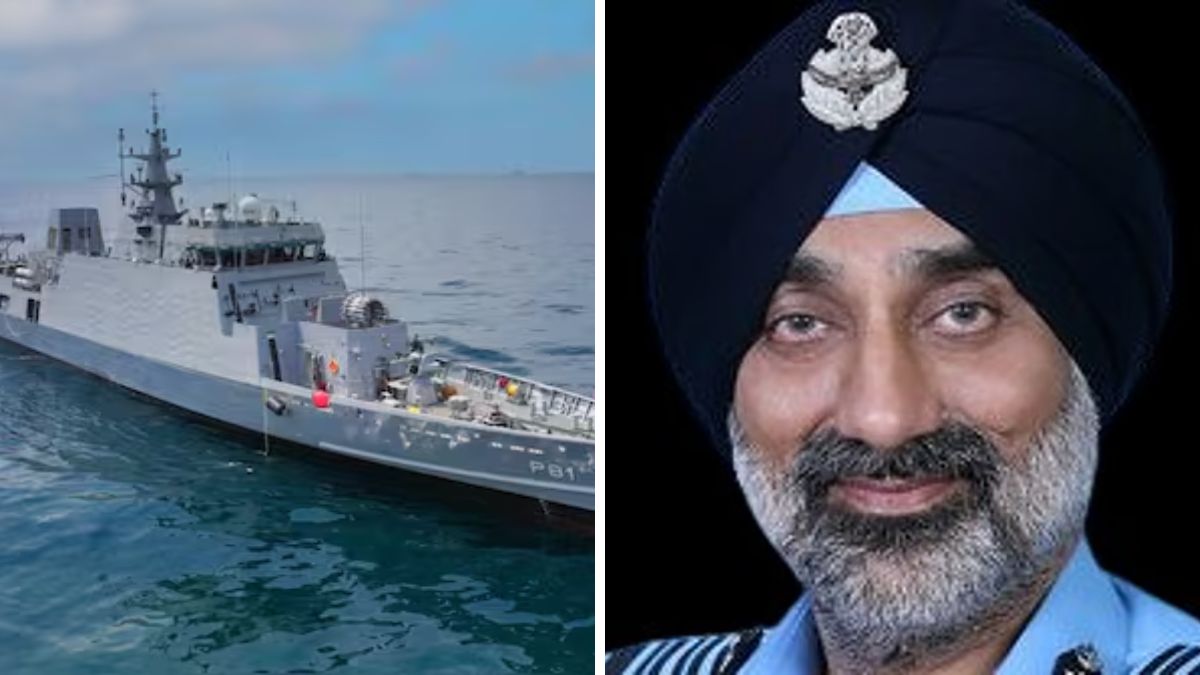
India’s military preparedness must evolve beyond individual service capabilities, Air Chief Marshal A P Singh said on Wednesday, asserting that future conflicts will require seamless integration between the Army, Navy and Air Force. He also stressed that delays in developing indigenous defence technologies could leave the armed forces behind rapidly changing battlefield requirements.
Speaking at the commissioning ceremony of INS Malvan — the second Mahe-class Anti-Submarine Warfare Shallow Water Craft (ASW-SWC) — at Naval Base Karwar, the Air Chief said the armed forces have made significant progress towards jointness since the creation of the Chief of Defence Staff (CDS), but the effort must continue to deepen.
Jointness no longer optional in future conflicts
Highlighting the changing character of warfare, Singh said military operations can no longer be planned or executed by individual services in isolation. Modern conflicts increasingly require integrated planning, shared capabilities and coordinated execution across land, air and maritime domains.
“No future war is going to be fought by an individual service. All of us, whether we are in blues (IAF), whites (Navy), or OGs (Olive Green of the Army), or whichever colour, whether we are in allied services, we all have to fight together as one nation, and then only we will succeed,” he said, according to PTI.
The Air Chief added that the momentum created over the past four to five years, particularly after the appointment of the CDS, has strengthened inter-service cooperation.
“All of us will move forward together and bring greater glory to the nation,” he said.
Referring to India’s growing economic and strategic interests, Singh underlined the importance of maritime security in safeguarding trade and national growth.
“We all understand how important maritime security and the maritime power for India’s growth are. Because any nation, they say, the maritime routes decide your trade and your trade decides your destiny. And as far as India is concerned, we all understand how important the Indian Ocean region is to us,” he said, according to PTI.
Without directly referring to any recent conflict, Singh said global developments have reinforced the importance of securing sea lines of communication and protecting maritime trade routes.
Self-reliance in aviation must match Navy’s model
While praising the Navy’s progress in indigenous shipbuilding, the Air Chief said the aviation sector must adopt a similar long-term institutional approach to achieve self-reliance.
He pointed out that the Navy has embedded its officers within shipbuilding programmes from the design stage, creating continuity and institutional expertise that continues even after retirement.
“I just hope that the other two services, especially the Indian Air Force, learn the lesson as to how the Indian Navy has been able to get this whole concept right, where you have your Indian Navy officers who are embedded in your shipbuilding right from the beginning,” he said, as per PTI.
“And even after retirement, they continue to render the services. Something similar, I think, the Indian Air Force has to adopt to make sure that even in the aviation sector, our self-reliance, our dream of being self-reliant becomes a reality and becomes a reality soon,” Singh added.
He acknowledged that the Air Force entered the self-reliance journey later than the Navy because aviation technologies generally involve longer development cycles.
“The Indian Navy adopted this vision of self-reliance very early on. In fact, it is we who took longer, because different sectors require different amounts of time to develop,” he said.
Speed of innovation critical for future warfare
The Air Chief said self-reliance cannot be measured only by domestic manufacturing but also by the speed at which technologies are developed and inducted into service.
Warning against lengthy development timelines, he said defence technologies risk becoming obsolete before deployment if innovation does not keep pace with global advancements.
“If you are growing at a speed that by the time you design and develop something, by the time you produce something, the world has moved over to a new technology, then that has no meaning. According to me, any technology delayed is technology denied,” he said, as per PTI.
Singh noted that INS Malvan has nearly 80 per cent indigenous content by value, describing it as a reflection of the success of the government’s Atmanirbhar Bharat initiative. While some critical technologies continue to be imported or co-developed internationally, he said these gaps would gradually narrow as India’s research and manufacturing ecosystem matures.
The Air Chief also commended the Indian Navy for commissioning its seventh warship this year and praised Cochin Shipyard Ltd. and the Navy’s project teams for delivering INS Malvan. Referring to Naval Base Karwar, he described it as one of the world’s most modern naval bases and a key pillar of India’s maritime strategy under Project Seabird.