



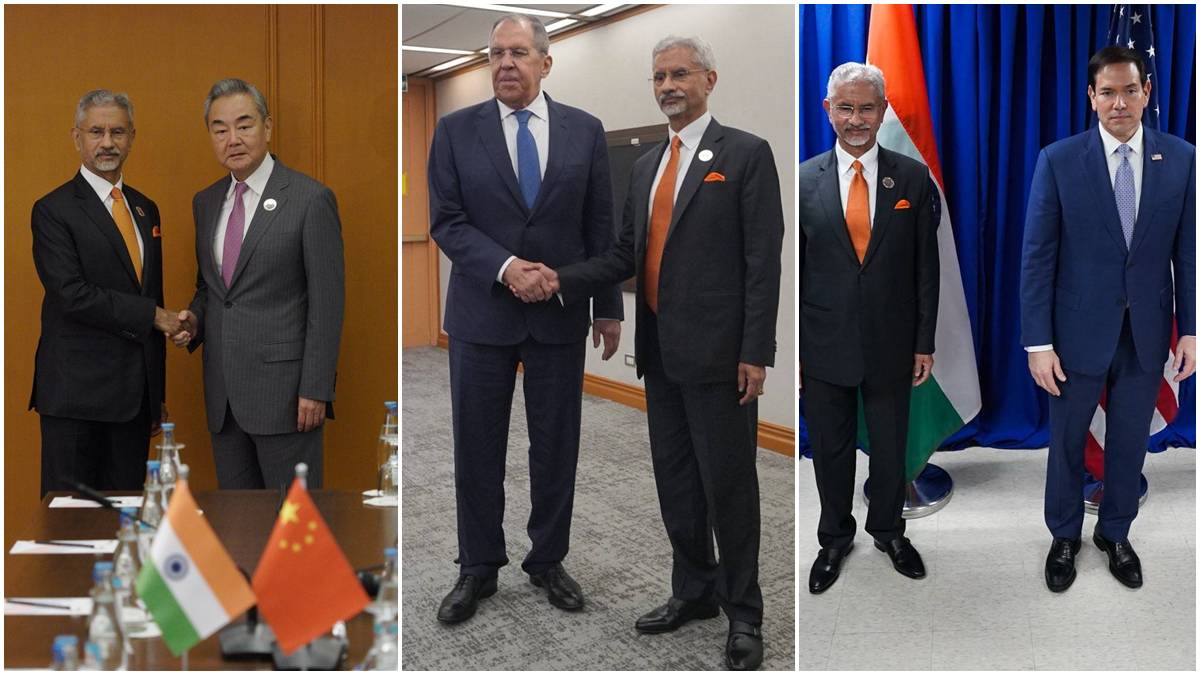
External Affairs Minister S Jaishankar held separate talks with Russian Foreign Minister Sergey Lavrov, US Secretary of State Marco Rubio and Chinese Foreign Minister Wang Yi in Manila on Wednesday, July 22. The meetings covered the safety of Indian seafarers, tariffs, energy security, India-China border relations and global developments.
Jaishankar was in the Philippine capital for ASEAN-related engagements and a Quad Foreign Ministers’ Meeting.
Safety of Indian seafarers raised with Lavrov
Jaishankar said he conducted an “in-depth review” of India-Russia relations with Lavrov.
“Reiterated our strong concern regarding the safety of Indian seafarers in the region,” he wrote on X.
According to Jaishankar’s official post, the ministers discussed trade and investment, energy and connectivity, science and technology, and mobility. They also exchanged views on the Ukraine conflict and the Gulf situation.
ANI reported that the issue was raised after four Indian nationals were killed in an attack on the commercial vessel MV Golden Leo while it was departing Ukraine’s Odesa port on July 19. Another Indian crew member was reportedly critically injured. Citing the Ministry of External Affairs, ANI said five of the ship’s 17 crew members were Indians.
According to ANI, the MEA summoned Russian Charge d’Affaires Vladimir Ladanov on Tuesday and conveyed India’s “grave concerns and unequivocal condemnation” of the attack.
ANI, citing the Ukrainian Navy, reported that Ukraine accused Russia of attacking the Guinea-Bissau-flagged grain vessel with three cruise missiles
Tariffs and energy discussed with Rubio
Jaishankar said his meeting with Rubio focused on priority areas under the India-US Comprehensive Global Strategic Partnership.
“Our meeting focused on areas which are priority for the India-US Comprehensive Global Strategic Partnership, including trade and tariffs, energy, defence and security, critical minerals and artificial intelligence,” he wrote on X.
The two also exchanged views on regional, global and multilateral matters. According to PTI, they were understood to have discussed the West Asia crisis and its impact on global energy supplies and market stability.
Both diplomats were in Manila for high-level discussions under the ASEAN framework and the Quad grouping.
Border peace flagged in talks with Wang Yi
Jaishankar also held a “wide-ranging discussion” with Wang Yi. According to the opening remarks shared on his official X account, Jaishankar said India-China ties had been gradually normalising since the countries’ leaders met in Kazan in October 2024. He said this direction was reaffirmed during their Tianjin meeting in August 2025.
Jaishankar said stable relations should be based on “mutual respect, mutual interest and mutual sensitivity.”
“Peace and tranquility in the border areas is obviously the pre-requisite for normal ties,” he said, calling for continued attention and support for relevant border mechanisms. He added that differences should not become disputes.
Jaishankar welcomed the resumption of direct flights, updates to the visa regime, the restart of the Kailash Manasarovar Yatra and the recommencement of border trade.
He also raised concerns over fair market access, the trade imbalance and supply-chain predictability, while calling for greater official and people-to-people exchanges. Jaishankar thanked China for supporting BRICS activities during India’s chairship.
Quad reviews Indo-Pacific situation
At the Quad meeting, the foreign ministers reviewed the Indo-Pacific landscape and followed up on the outcomes of their recent New Delhi meeting.
According to Jaishankar’s official post, the grouping reaffirmed its commitment to a “free and open Indo-Pacific” while recognising ASEAN’s central role in the region.