



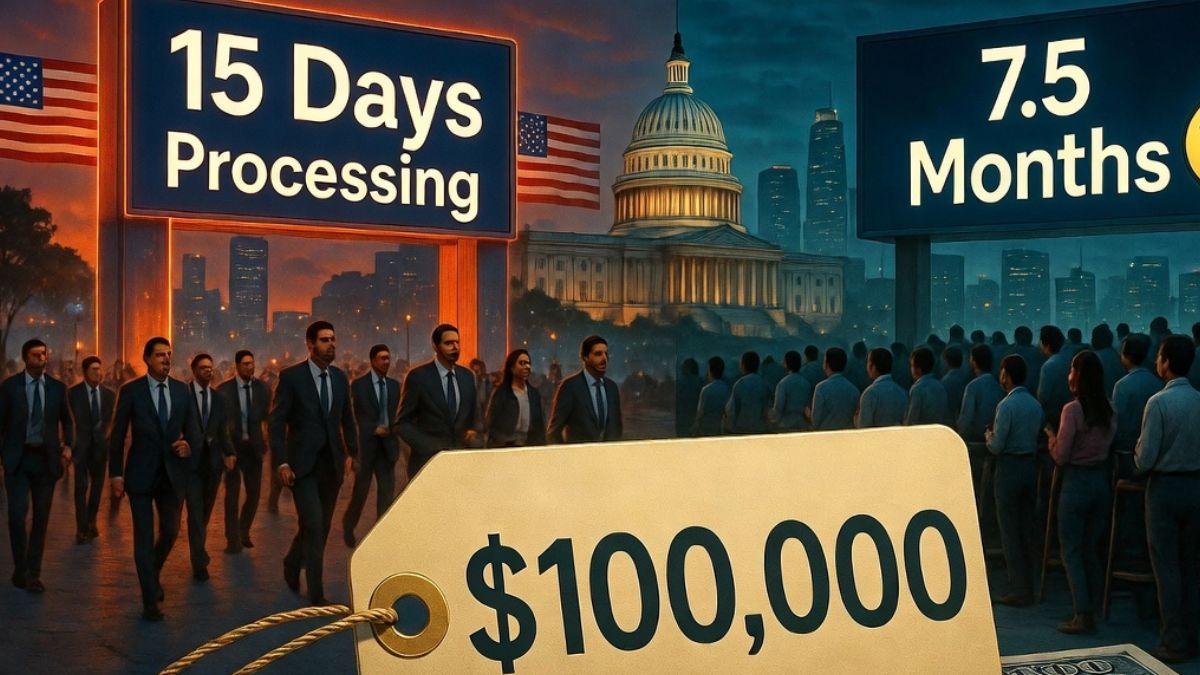
Newly released DHS figures show that more than 2 lakh H-1B applicants have paid a $100,000 fee for faster visa processing this year. The disclosure has sparked concerns among lawmakers, who say the policy may be making it harder for rural hospitals and clinics to recruit foreign doctors needed to fill critical healthcare shortages.
The debate comes at a time when the H-1B program itself is undergoing major changes. USCIS reported that there were 343,981 eligible H-1B registrations for fiscal year 2026. That represents a 26.9% drop from the 470,342 registrations recorded a year earlier.
Most H-1B applicants are choosing to pay – DHS
Speaking before the Senate Appropriations Subcommittee, Homeland Security Secretary Markwayne Mullin said the Department of Homeland Security (DHS) has received about 286,000 H-1B applications so far in fiscal year 2026. Of those, more than 200,000 applicants, nearly 70%, paid the $100,000 fee to receive a decision in roughly 15 days.
“We had 286,000 applicants a year to date for the H-1B visas. Out of those, over 200,000 of them paid the $100,000 to be able to come in, because it allows us to process them in a little bit faster manner. In fact, when we do that, we’re able to process them in about 15 days because we’re able to throw stuff out. If people want to look for an exemption and come in that process, which we had roughly 80,000 look for a different path forward, it takes about seven and a half months to go through that process to be able to exempt them,” Mullin said.
The figures offer the clearest look yet at how much the policy has changed the H-1B system since it was introduced by the Trump administration last year.
How the $100,000 fee was introduced
The fee was created through a presidential proclamation signed by President Donald Trump on September 19, 2025. The order, titled “Restriction on Entry of Certain Nonimmigrant Workers,” took effect two days later.
Under the policy, employers hiring certain H-1B workers from outside the United States must pay $100,000 before those workers can enter the country. The administration said the move was aimed at protecting American jobs and ensuring that only those foreign nationals who can contribute significantly to the US economy can come.
USCIS later clarified that the fee applies only to new H-1B petitions filed on or after September 21, 2025, for workers who are outside the US and do not already hold a valid H-1B visa. Several categories are exempt.
These include petitions filed before the deadline, visa extensions, and change-of-status applications for people already living in the United States.
The fee is non-refundable, meaning employers do not get the money back even if the visa application is denied. Payment must be made through pay.gov before filing the petition with USCIS.
The proclamation also allows DHS to grant exemptions in rare cases if a worker is considered to be in the national interest, if no qualified American worker is available for the position, and if there are no security concerns. However, USCIS has said such exemptions are “extraordinarily rare.”
Rural hospitals say the H-1B fee is hurting recruitment
One of the biggest concerns raised during Tuesday’s hearing was the effect the policy may be having on rural healthcare systems. Senator Susan Collins of Maine pointed to a recent example from her state. She said a hospital in Presque Isle, a remote town in northern Maine, had to pay the full $100,000 fee in order to recruit a surgeon from abroad.
Collins argued that there is a major difference between large technology companies hiring foreign workers and small hospitals trying to bring in doctors.
She asked Mullin whether DHS would consider creating a specific exemption for healthcare workers in areas that have documented doctor shortages. Mullin appeared open to the idea.
“We’re happy to look into it, look at language, try to get it better, because I agree. From a very rural area, I understand how hard it is to get doctors,” he said. Senator Lisa Murkowski of Alaska raised similar concerns. She pointed to teacher shortages in rural Alaskan communities.
Rural America relies heavily on foreign doctors
Back in February, Representatives Jill Tokuda of Hawaii and Don Bacon of Nebraska led a bipartisan group of 33 lawmakers in asking DHS to create a broad exemption for healthcare workers. According to their data, USCIS processed 76,085 H-1B petitions for physicians between 2016 and 2022. Around 8,349 of those doctors, roughly 11%, worked in rural counties.
In 2025 alone, 564 rural employers used the H-1B program. They hired 534 new healthcare professionals and retained another 422 doctors and practitioners already working in their facilities.
Many of these places have very limited access to medical care, and patients may have to travel hours to find another provider. “For small rural hospitals and clinics operating on thin or negative margins, the uncertainty and upfront costs alone are prohibitive,” the lawmakers wrote.
“With no categorical exemption, many facilities are being forced to pause or completely abandon recruitment of critically needed healthcare workers.”