



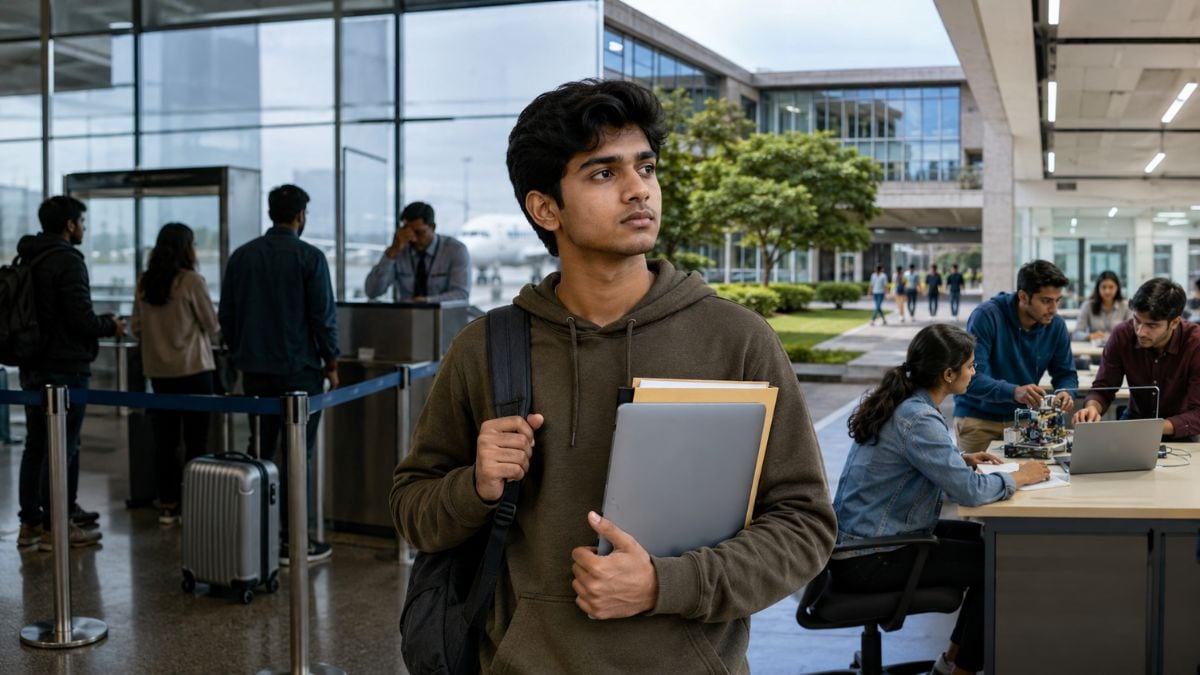
As visa regimes tighten and overseas education becomes more expensive, India’s long-standing study-abroad dream is undergoing a quiet but significant reset. For decades, foreign universities symbolised aspiration, opportunity and social mobility for millions of Indian families. But in 2026, a growing number of students are beginning to ask a different question: can they access a truly global education without leaving India?
The shift is already visible in the numbers. Data shared in Parliament earlier this year showed a steady decline in the number of Indian students travelling overseas for higher studies over the past three years. Behind the trend lies a combination of rising costs, stricter immigration rules and growing uncertainty across traditional destinations such as Canada, the UK and Australia.
For families, the economics of international education are becoming harder to justify. Escalating tuition fees, soaring living expenses, housing shortages and increasingly unpredictable visa policies have forced many parents and students to reassess what “global education” really means in a rapidly changing world.
At the same time, India’s own higher education ecosystem is beginning to transform. Under the National Education Policy (NEP) 2020, the country has opened doors to international collaborations, dual-degree programmes and even foreign university campuses. Over the past year, several global institutions have announced partnerships and expansion plans in India, signalling a structural shift in how international academic exposure may be delivered in the future.
The emerging model focuses less on geography and more on experience – interdisciplinary learning, industry integration, innovation-driven classrooms and exposure to diverse perspectives. Universities such as ATLAS SkillTech University are increasingly positioning themselves around this globally aligned approach, seeking to replicate international learning ecosystems within India itself.
According to Siddharth Shahani, Co-Founder and Executive President of ATLAS SkillTech University, students today are looking beyond the traditional idea of simply obtaining a foreign degree.
Today’s students are looking for globally relevant learning experiences that prepare them for an interconnected world. India, today has the opportunity to build institutions that combine international exposure, industry integration, and interdisciplinary learning within the country itself. At ATLAS SkillTech University, our focus has been on creating an ecosystem that reflects this shift and contributes to the larger vision of strengthening ‘Study in India’ as a globally competitive education movement,” says Siddharth Shahani.
The transition could mark a deeper change in India’s role within global education. Rather than being viewed merely as a source of outbound student talent, India is gradually positioning itself as a destination capable of hosting international-quality academic experiences domestically.
The aspiration for global education remains intact. What is changing is the pathway to achieving it. For a generation navigating uncertainty around affordability, employability and migration, the possibility of accessing world-class exposure without building a future overseas may become one of the defining education shifts of this decade.