



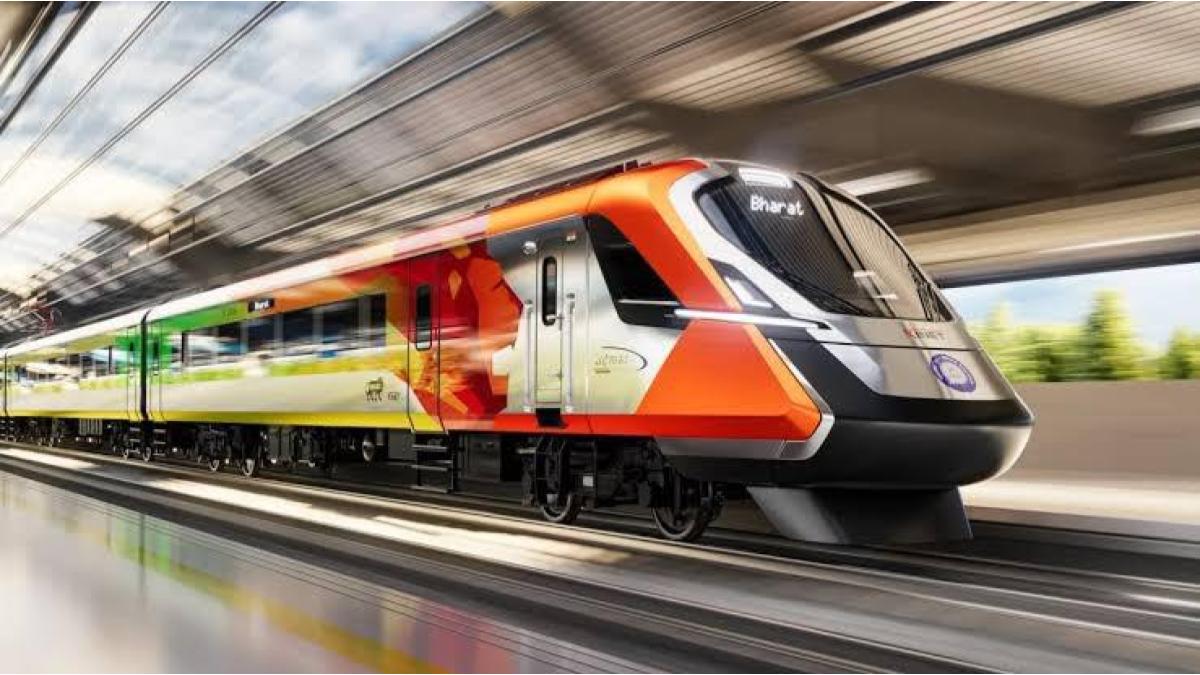
Nirmala Sitharaman, in the Union Budget 2026-27, has proposed seven high-speed rail corridors in order to increase the ease of travel. The seven proposed corridors are:
- Mumbai to Pune
- Pune to Hyderabad
- Hyderabad to Bengaluru
- Hyderabad to Chennai
- Chennai to Bengaluru
- Bengaluru to Varanasi
- Varanasi to Siliguri
“A scheme for enhancement for construction and infrastructure equipment will be introduced to strengthen domestic manufacturing,” the FM said.
What are rail corridors?
Rail corridors are basically strips of land to support infrastructure like stations and signalling, used for railway operations.
Key railway stocks in focus
The key railway stocks that have run up the most include Container Corp, BHEL, RailTel, IRFC,. Other railway stocks like IRCTC, RITES are also in focus.
What the government provided in the previous Budget
According to the Indian Express, construction on the country’s first high-speed rail corridor, the Mumbai–Ahmedabad bullet train project, is currently underway. Last month, Railway Minister Ashwini Vaishnaw said the project would have a strong integration and multiplier effect on the Indian economy. He added that once completed, travel time between Mumbai and Ahmedabad will be cut to under two hours.
A key reform was announced for maintenance, repair and overhaul (MRO) activities. To support the development of domestic railway MRO capabilities, the government extended to railways the same trade facilitation framework available to aircraft and ship repairs.
Furthermore, the time limit for re-exporting foreign-origin goods imported specifically for repairs was increased from six months to one year, with a further extension of another year permitted on a case-by-case basis.
Beneficiaries of wider infrastructure
Railways were also positioned as beneficiaries of wider infrastructure planning initiatives. The Budget proposed opening up relevant PM Gati Shakti portal data and maps to the private sector to aid project planning and encourage public–private partnerships.
This was complemented by the announcement of a National Geospatial Mission, which will use the Gati Shakti platform to support infrastructure design and modernise land records.
On logistics integration, the government announced the creation of BharatTradeNet, a new digital public infrastructure for international trade, designed to work alongside the Unified Logistics Interface Platform. While not rail-specific, the platform is expected to improve multimodal logistics efficiency, where railways play a central role.
The Budget also reinforced funding avenues for rail-linked projects at the state level. An outlay of Rs 1.5 lakh crore was earmarked as 50-year, interest-free loans to states for capital expenditure, which states can deploy for priorities such as metro rail, intra-state rail connectivity and urban transport. In parallel, the second Asset Monetisation Plan (2025–30) targeted Rs 10 lakh crore in proceeds to be reinvested into new infrastructure, including greenfield railway assets.
What the railway sector is seeking this year
The Confederation of Indian Industry (CII) has called for the government to formally announce and expedite implementation plans for three proposed dedicated freight corridors, the East Coast corridor from Kharagpur to Vijayawada, the East–West corridor from Palghar to Dankuni, and the North–South corridor from Itarsi to Vijayawada.
As per Deloitte’s budget expectations, Indian Railways has struggled to attract investment under the build–operate–transfer model and has consistently missed private participation targets.
CII has echoed this assessment, arguing that weak returns and high risk perceptions have dampened interest in public–private partnership projects. Industry is seeking a reworking of concession agreements and risk-sharing mechanisms, particularly for large-ticket projects such as high-speed rail.