



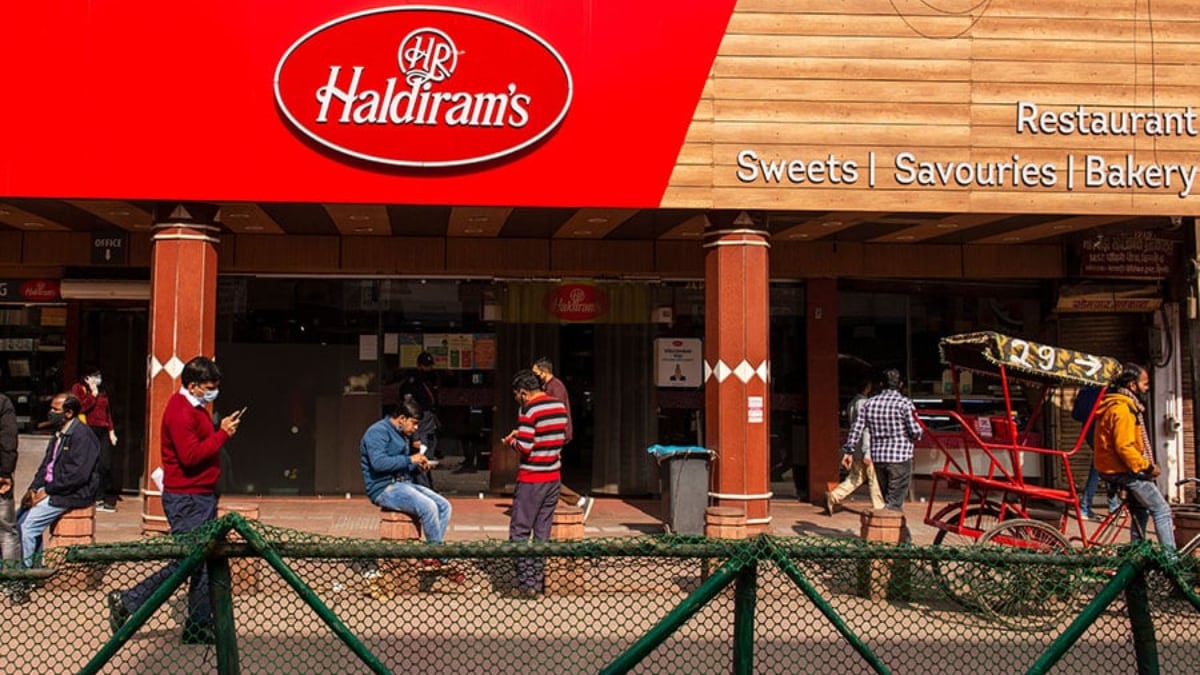
Haldiram’s name is no stranger to any household across the country. Be it namkeen or sweets, we are all familiar with the hundreds of snack varieties and shelves stocked in dozens of countries. According to Hurun’s Global Rich List 2026, Rajendrakumar Shivkisan Agrawal of the Haldiram family delivered one of India’s most surprising wealth stories of 2026, becoming the country’s biggest percentage gainer as his fortune surged 280% to $3.8 billion.
What made Haldiram so big as a brand? The story begins with a boy in Bikaner experimenting with a humble snack that would eventually change the way India eats.
From a Bikaner experiment to a national brand
Haldiram traces its roots to Ganga Bhishen Agarwal, a young entrepreneur from Bikaner, whose one of the many nicknames was Haldiram. In the early 20th century, he began experimenting with bhujia, a fried snack traditionally made with gram flour. According to accounts of the family business, he developed a thinner, crispier version using moth beans instead of besan, a small innovation that quickly became popular among customers in the region.
“India’s oldest and most powerful ambassador has always been its food. The aroma of Indian flavours has reached every corner of the globe, and the world is asking for more.
Our journey reflects that evolution: from our beginnings in Bikaner, to expanding operations in Nagpur, opening our first Delhi store in Chandni Chowk, and becoming a global brand,” a Haldiram spokesperson told financialexpress.com.
According to accounts of the family business, Agarwal created a thinner, crispier version of the snack using moth beans instead of gram flour. The innovation quickly gained popularity and eventually spread across the country.
The grandsons who scaled the business
The transformation of Haldiram from a regional sweetshop to a modern snacks empire was largely driven by the next generation, particularly Shiv Kishan Agarwal and Manohar Lal Agarwal, grandsons of the founder.
Shiv Kishan Agarwal moved to Nagpur in 1970 to start a new outlet selling namkeen, sweets and Indian foods. Nagpur, at the time, was a much smaller city compared to Kolkata, where he had earlier spent over a decade working in the family business. In fact, at that point of time, Agarwal used to work nearly 19 hours a day, the company said.
One of those experiments would become a classic. Agarwal began producing kaju katli, a sweet made from cashews, at a time when the dessert was not widely available across India, the company said. Cashews were more easily available than almonds in Nagpur, and the sweet quickly found an audience.
Meanwhile, in 1982, Manohar Lal Agarwal established a Haldiram outlet in Delhi’s Chandni Chowk, bringing the brand into one of the country’s busiest food markets. Together, the brothers expanded the family business into new regions and new formats.
Innovation in snacks and packaging
Much of Haldiram’s rise was driven by the brothers’ willingness to modernise a traditional industry. According to consultancy firm EY, Haldiram was among the first Indian snack companies to emphasise branded packaging and presentation for ready-made snacks. Innovations such as zip pouches, stand-up pouches and multi-layer flexible packaging later became industry standards.
Their approach helped transform namkeen from a product sold loosely in neighbourhood sweet shops into a packaged snack that could travel across cities, supermarkets and eventually international markets. Haldiram also moved early toward automation in the manufacturing of traditional snacks. The company later expanded into quick-service restaurants offering Indian street food.
A family business that grew into an empire
Over time, the business spread across multiple cities and branches of the Agarwal family.
Different parts of the family developed separate regional businesses. The Delhi operations were run by Manohar Lal and Madhusudan Agarwal, while Shiv Kishan Agarwal led the Nagpur-based arm. Other relatives built businesses in Bikaner and Kolkata, creating parallel enterprises with shared roots.
As per media reports, despite family divisions and legal disputes over brand rights that lasted for decades, the businesses continued to grow. By the 2020s, Haldiram had become one of India’s largest snack brands, selling more than 400 varieties of products ranging from namkeen and sweets to ready-to-eat foods. Its products are now available in around 100 countries.
As per another Hurun list in collaboration with JM Financial, the company reported revenue of around Rs 14,000 crore (based on 2024 filings), placing it among the country’s largest unlisted consumer goods players. As per Euromonitor International, the company holds an estimated 13% share of India’s organised savoury snack market, with namkeens contributing roughly 60% of total revenue and accounting for a dominant presence in that category. Its valuation stands at about $10 billion, with Temasek acquiring a 10% stake for $1 billion in March 2025, alongside interest from investors such as Alpha Wave Global.
A new chapter for the brand
In recent years, the Delhi and Nagpur businesses, long operated separately, have moved towards consolidation. The two arms merged to form Haldiram Snacks Food Limited, a step widely seen as preparation for a potential public listing.
The unified entity has also attracted global investors. Singapore’s state-owned investment firm Temasek has acquired a stake in the business as the company positions itself for further expansion.
The legacy of a snack maker
“We always say this in our speeches and general conversations – the customer is God, so we should never work with ill will or use shortcuts. That philosophy shapes how we operate every day. Our employees are at the heart of this journey because they are the ones preparing the food people love.
There is something quietly instructive about a business that has scaled through reinvesting and discipline rather than debt. Our model doesn’t attract attention because it’s dramatic. It attracts attention because it’s the opposite… simple,” a Haldiram spokesperson said.
More than a century after Ganga Bhishen Agarwal first experimented with bhujia in Bikaner, the brand that bears his nickname has become synonymous with Indian snacks. For Shiv Kishan Agarwal, the formula has remained simple: keep an eye on quality and on what customers want.
It is perhaps why, in many Indian households, the name Haldiram still evokes the same association it did decades ago, a box of sweets for celebration or a packet of namkeen opened at the start of a conversation. Today, as the family behind this brand shines on the Hurun list, the fortune it reflects traces back to a simple strand of bhujia first fried in a small Bikaner shop more than a century ago.