



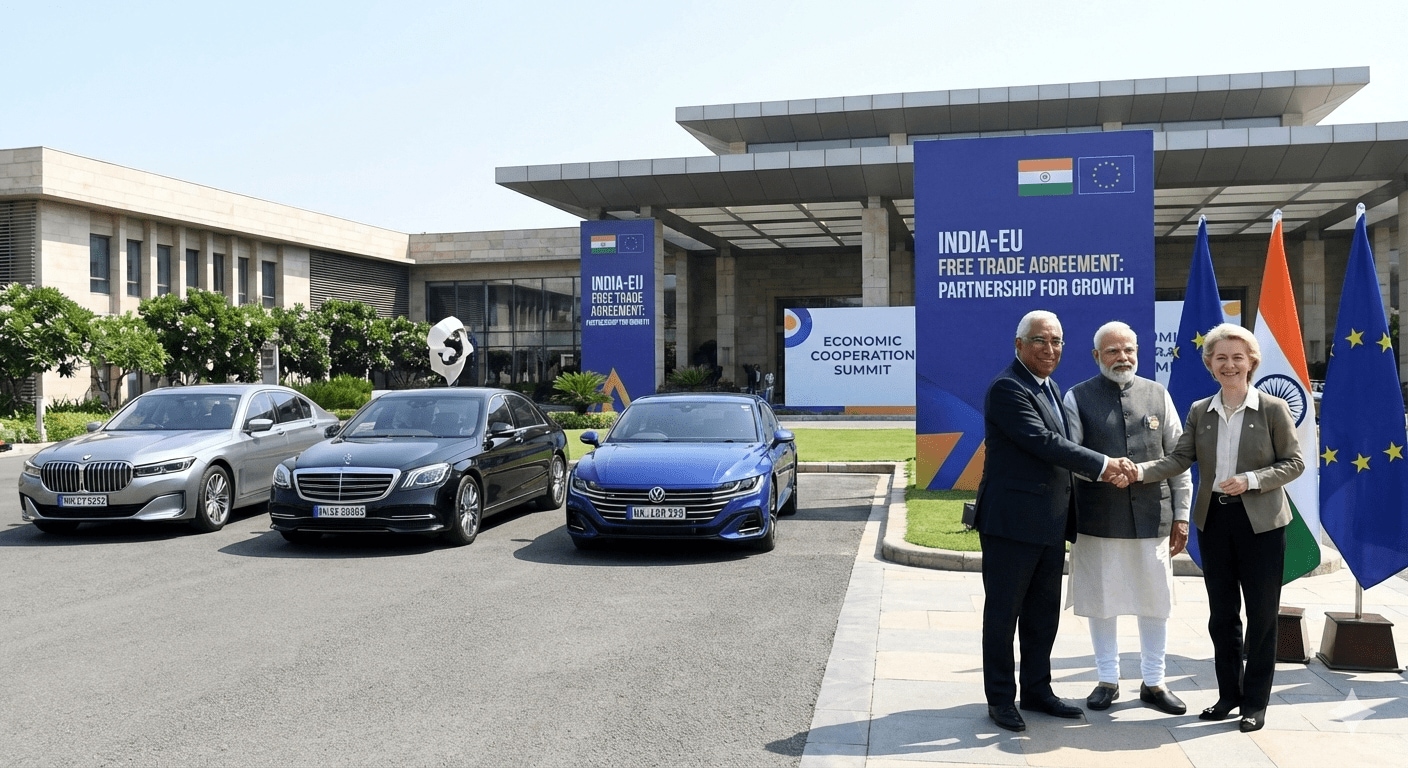
Delhi recently finalized the schedule for the long awaited India-EU summit. The upcoming summit slated for 27 January in New Delhi, marks a pivotal moment in bilateral ties between the two entities.
The summit, to be co-chaired by Prime Minister Narendra Modi and EU leadership, follows the participation of European Council President António Costa and European Commission President Ursula von der Leyen as chief guests at India’s 77th Republic Day celebrations on 26 January.
While the official agenda spans trade, technology, defence cooperation and multilateral coordination, the centre of gravity of negotiations has shifted decisively towards automobile tariffs and the finalisation of a comprehensive India-EU Free Trade Agreement (FTA).
The widely anticipated FTA was recently labelled as the “mother of all deals” by European Commission President Ursula von der Leyen at the World Economic Forum meet in Davos.
The much anticipated meet is expected to facilitate wide-ranging economic, strategic and people-centric deliverables.
Delhi likely to slash auto tariffs: Report
India is reportedly planning to slash tariffs on cars imported from the European Union to 40% from as high as 110%, marking the biggest opening yet of the country’s vast market to the European auto industry.
According to a Reuters report, Prime Minister Narendra Modi’s government has agreed to immediately reduce the tax on a limited number of cars from the 27-nation bloc with an import price of more than 15,000 euros ($17,739).
“This will be further lowered to 10% over time, easing access to the Indian market for European automakers such as Volkswagen, Mercedes-Benz and BMW,” Reuters reported citing sources.
India, the world’s third-largest car market after the US and China, has historically maintained some of the highest import barriers in the global auto industry, with duties ranging from 70% to 110% on imported vehicles.
These tariffs have long been a major friction point in trade negotiations, drawing criticism from global automakers and industry leaders.
At present, European manufacturers account for less than 4% of India’s 4.4 million-unit annual car market, which is dominated by Suzuki Motor, Tata Motors, and Mahindra & Mahindra, together controlling nearly two-thirds of domestic sales.
‘Mother of all deals’: India-EU FTA expected soon
The long-pending India-EU Free Trade Agreement (FTA) which has been under negotiation since 2007 and reinvigorated in 2022 is expected to reach a definitive conclusion at the summit.
Indian and EU officials have indicated that the announcement of the negotiated pact will be made on 27 January, with formal signing to follow after necessary legal and legislative processes.
The envisaged agreement aims to lower tariffs on a wide range of goods, expand market access, and improve investment frameworks between India and the 27-member EU bloc.
The deal is expected to unlock a wide set of people centric and economic deliverables to the two entities that comprise nearly two billion people and account for approximately a quarter of the global GDP.