



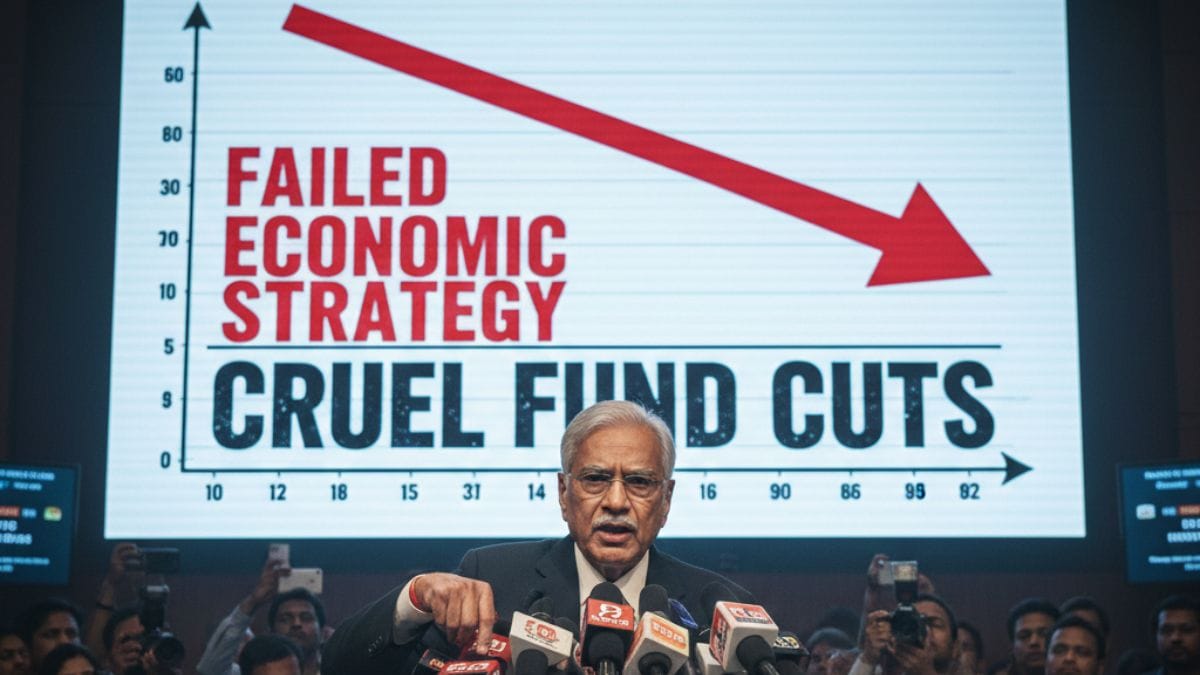
Former Finance Minister P Chidambaram launched a scathing attack on the Union Budget 2026-27 on Sunday, describing it as a “failed test of economic strategy and statesmanship.”
Addressing a press conference at the AICC headquarters, the veteran Congress leader argued that Finance Minister Nirmala Sitharaman ignored the harsh realities flagged in the government’s own Economic Survey.
According to Chidambaram, the Budget has missed the mark on job creation and fiscal consolidation. He accused the government of falling back on its ‘favourite pastime’ of throwing acronyms at citizens while cutting funds for essential sectors like rural development and healthcare.
The capex paradox: Falling percentages vs record outlays
While the government touted a record Rs 12.2 lakh crore capital expenditure (Capex) outlay, Chidambaram pointed to a “worrying” downward trend when measured against the national GDP. He argued that the real management of finances in the previous year (2025-26) was poor, characterized by significant spending cuts.
In his rather elaborate critique of the union budget, Chidambaram mentioned that while the government made some ‘big claims’, their past track record on executing budgetary plans suggests a wide implementation gap. He cited that total expenditure in the previous fiscal fell short by Rs 1,00,503 crore.
Highlighting a statistic that went unannounced by the government on Sunday, Chidambaram noted that the Centre’s Capex has effectively fallen from 3.2% of GDP in 2024-25 to 3.1% in 2025-26.
The former Finance Minister further singled out the Jal Jeevan Mission and labelled the reduction in its funding as ‘cruel’, stating it was slashed from Rs 67,000 crore to just Rs 17,000 crore in revised estimates.
“Even by an accountant’s standards, it was a poor account of the management of finances. Not a word was said to explain this miserable performance,” Chidambaram remarked.
Strategy or a jigsaw of jargons? Questions left unanswered by the budget
According to the former finance minister, the budget announcement by Sitharaman made in the parliament on Sunday failed to address several worrying global trends reflected in the government’s latest economic survey of India.
Elaborating on the subject, Chidambaram listed at least 10 major challenges ranging from US penal tariffs to the trade deficit with China that he felt were left unanswered by the Finance Minister’s address in the parliament on Sunday. Some of the challenges raised by Chidambaram have been listed as follows.
Failure to meet geopolitical realities: He pointed to the government’s failure to address harsh geopolitical realities with their budgetary plans as a critical shortcoming and cited India’s growing trade deficit with China and the lack of a response to US penal tariffs affecting Indian exporters as prime examples for his argument.
Employment: On the employment front, he questioned the viability of the VB-G RAM G scheme, a controversial successor of MGNREGA that is offering 125 days of work on a Rs 95,000 crore budget.
0.1% reduction: Furthermore, he dismissed the 0.1% reduction in the fiscal deficit (from 4.4% to 4.3%) as “meagre” and lacking boldness.
Inflation Gap: Finally, he flagged a persistent “inflation gap,” noting the disconnect between official government statistics and the actual, rising costs of hospital and transport bills faced by ordinary citizens
Chidamabaram ended his address with a precise critique of the rise in the number of ‘unachievable ’new schemes that he juxtaposed have been put up as false promises. Counting at least 24 new initiatives or “hubs” in the speech, he remarked, “I leave it to your imagination how many of these will be forgotten and vanish by next year,” concluding his argument that an “acronym-led policy” cannot substitute for a coherently structured, long-term economic strategy.