



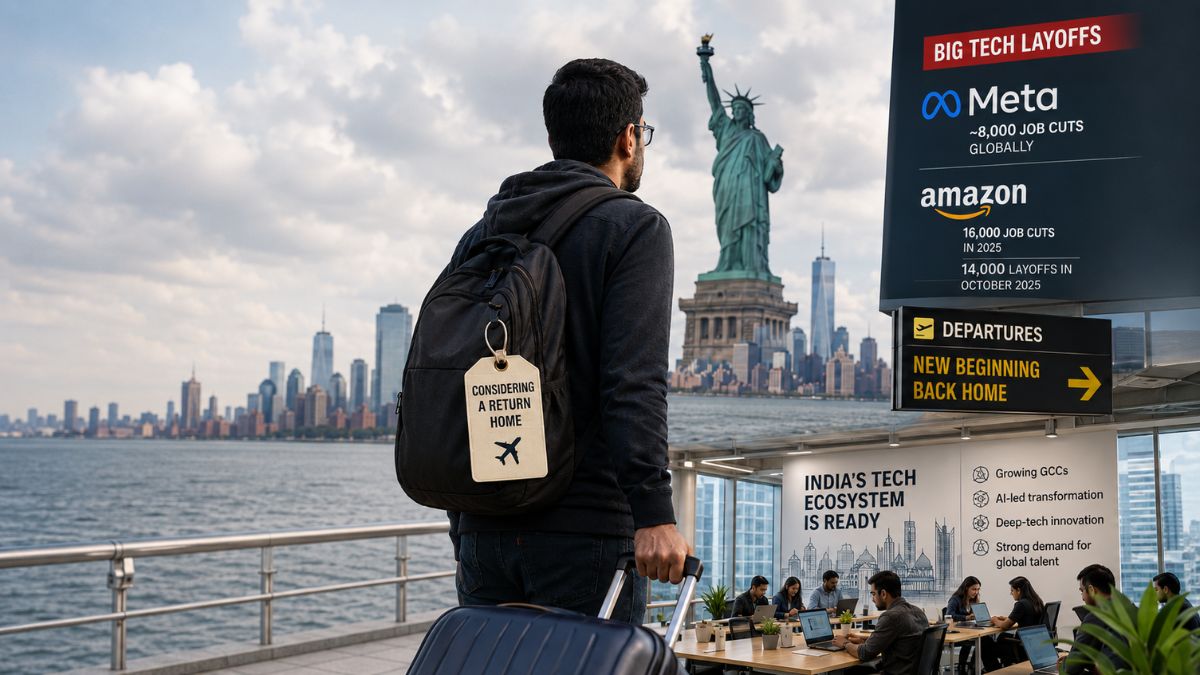
A wave of AI-driven layoffs across global technology companies, coupled with growing uncertainty around immigration policies in the US, is prompting an increasing number of Indian professionals overseas to consider returning home, according to affected employees and recruiters.
Last week, Meta cut about 8,000 jobs globally, with several Indian-origin employees in the US and the UK among those impacted. The move follows Amazon’s ongoing workforce reduction programme, under which the company has announced 16,000 job cuts this year, in addition to 14,000 layoffs announced in October 2025.
For many Indian professionals abroad, the latest round of job cuts has accelerated plans that were already under consideration.
“I have been living in the US since 2015 and was already planning on going back to India, but this has just pulled up the timeline,” said a former data engineer who worked with Facebook’s product analytics team in Trust & Safety and was affected by the latest layoffs. “It’s not just Big Tech but the general environment in the US, the additional hurdles in the visa process and responsibilities back in India as well,” he said.
The Bay Area-based professional, who requested anonymity, said he had been given a 60-day grace period to secure another role following his termination.
Others say they are reassessing their long-term future in the US despite having immigration security. Shyam BV, a former senior integrity science engineer and AI specialist at Meta who was affected in the latest round of layoffs, said he would consider relocating to India for the right opportunity despite holding a green card under the EB1-A category.
For employees on work visas, the uncertainty is even greater. A senior supply chain manager at Amazon said losing a job would effectively require a return to India because of visa-linked employment restrictions.
“I have an L1-A visa, which means if I am fired, I have no choice but to return. I have made my peace with these circumstances,” the executive said, requesting anonymity.
Recruiters say the situation is unfolding at a time when India’s technology ecosystem is far better positioned to absorb returning professionals than it was a decade ago.
“The expansion of GCCs, AI-led transformation, digital engineering and deep-tech innovation has created strong demand for globally experienced talent,” said Varun Sachdeva, SVP and APAC head at NLB Services. Professionals returning from the US bring exposure to advanced technologies, product development and global business practices that can strengthen India’s innovation ecosystem, he said.
According to Sachdeva, demand continues to outstrip supply in specialised areas such as artificial intelligence, cybersecurity, cloud computing, data engineering, semiconductors and digital transformation.
However, he added that returning professionals may need to recalibrate compensation expectations. Salary structures in the US differ significantly from those in India, and returnees could face moderation in pay unless they move into leadership or highly specialised positions.
While an influx of overseas professionals could intensify competition for some mid-level roles, according to recruiters, the broader impact will be positive as India’s technology sector increasingly shifts from a services-led model towards product development, innovation and deep-tech capabilities.