



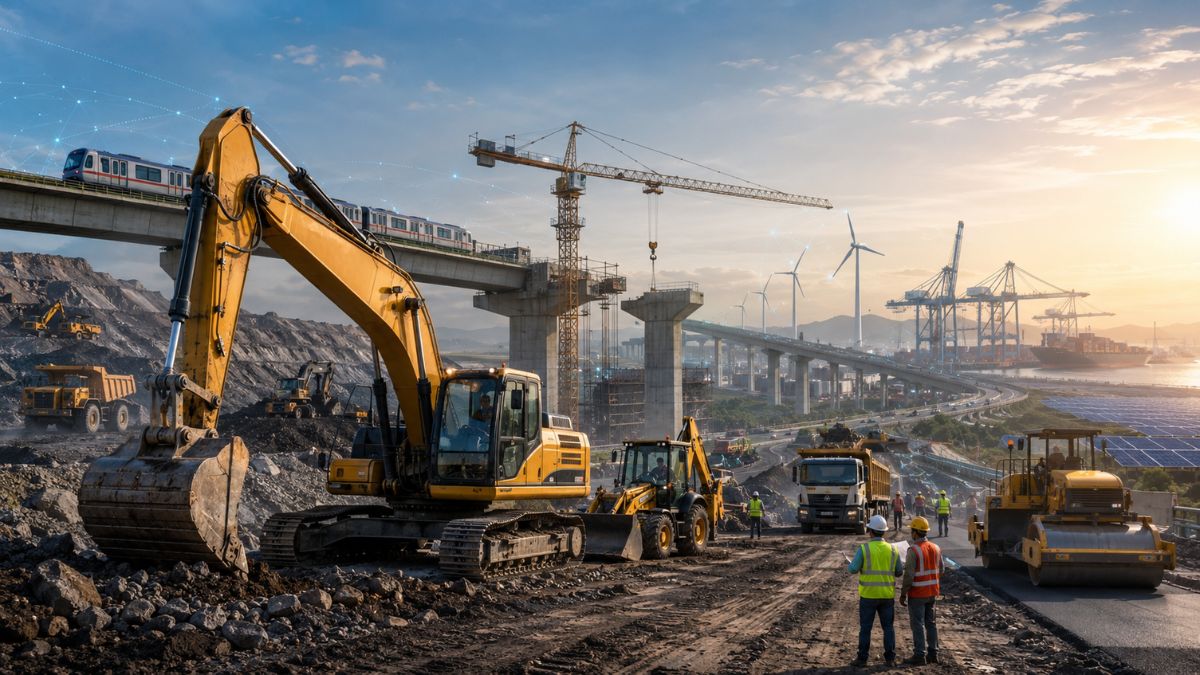
India’s Rs 9-10 lakh crore infrastructure-linked capital expenditure pipeline by 2030 is set to put the country’s $17-billion mining and construction equipment industry through a major scale-up test, as demand rises across highways, railways, ports, airports, mines and clean-energy projects.
A CII-BCG report said capital expenditure in sectors linked to mining and construction equipment could nearly double from Rs 5.5 lakh crore in 2025 to Rs 9-10 lakh crore by 2030. The expansion will be driven by national highways, freight corridors, metro rail, ports, airports, critical-mineral extraction and the clean-energy build-out required to reach 500 GW of non-fossil capacity.
India’s mining and construction output is estimated at $430 billion, close to 11% of GDP, and supports more than 70 million livelihoods across the value chain. The equipment industry serving it reached $17 billion in 2025 and is growing 10-12% annually, among the fastest rates for any major market. It could expand to $180-200 billion by 2047 under the Viksit Bharat pathway.
The demand runway is wider because Indian project sites remain under-mechanised. The country generates about $5 of machinery demand per $1,000 of construction spending, compared with a global average of $12. Closing part of that gap could allow equipment demand to grow faster than construction spending.
“Not long ago, the best machines on Indian sites came from elsewhere. Today, our equipment works in close to 100+ countries. That tells you what this industry can do,” said Vivek Bhatia, Chairman, CII Mining and Construction Equipment Division.
The opportunity, however, comes with gaps in localisation and technology. Overall localisation in construction equipment is around 50%, while high-value components such as hydraulics, electronic controls and undercarriages remain largely imported. Backhoe loaders are 85-90% localised, compared with 55-60% for excavators.
Electrification, autonomous equipment and connected fleet management are also reshaping the market. BEML launched its first electric dump truck in 2025, while Coal India’s SECL has deployed real-time fleet monitoring. Indian manufacturers, however, remain at an earlier stage than global leaders.
“For years, India’s story in the MCE industry was about catching up. Today it is a sunrise sector,” said Abhishek Bhatia, Managing Director and Partner, BCG.
Exports provide a second growth engine. India now exports more MCE than it imports, with shipments nearly tripling over the past decade to $4.9 billion in 2025. The global MCE import market is around $150 billion annually, while Southeast Asia, Africa, the Gulf and South America are seeking alternatives to China.
The report called for tiered duties, procurement preference, anti-dumping action and fleet renewal. It also asked industry to deepen Tier-2 supplier networks, build overseas after-sales systems and raise R&D spending closer to the 3-6% of revenue invested by global leaders.