



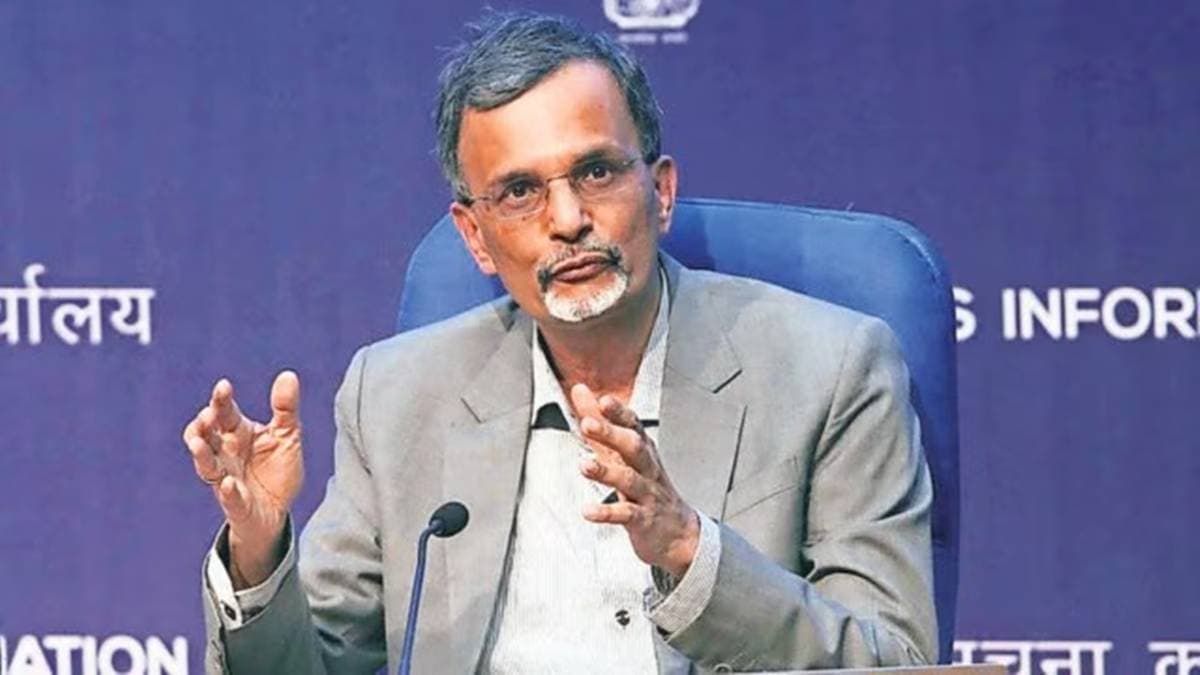
Artificial Intelligence’s (AI) impact on IT sector jobs is only a small part of India’s employment challenge, with the country needing to generate millions of jobs annually in sectors less exposed to AI automation, according to Chief Economic Adviser V Anantha Nageswaran.
“India has to generate 8 million jobs a year and the IT sector as a whole employs about 5 to 6 million people. So, AI impact on the IT sector is only a part of the story and a very small part of the story,” Nageswaran said.
8 Million Job Mandate
He was delivering a special address on ‘Technology, Talent and the Trillion-Dollar Ambition’ at IIT Madras’ 67th Institute Day here on Thursday.
Nageswaran said countries such as Korea, Japan, China, and those in Europe expanded manufacturing while also investing in trade skills across the care economy, allied health, skilled trades and green manufacturing areas where AI is less likely to replace human labour. India, he noted, largely skipped these segments from the 1960s through the 1990s and even beyond.
“Whatever areas that AI will not necessarily replace humans are the areas where our education and academic system must concentrate,” he said.
He flagged the evolving geopolitical context as a key challenge, citing a potential G2 consolidation and closer alignment between the US and China across technology, finance and security architectures, which could come at the expense of third countries including India. With the G7’s coherence weakening, he said India has an opportunity given its scale, democratic legitimacy and credibility in the Global South to shape an alternative.
From a policy perspective, Nageswaran outlined five priorities amid the ongoing West Asia crisis: energy security and resilience, decriminalisation and deregulation, agricultural productivity, development of AI-insulated trade skills, and tax policy certainty.
He noted that the manufacturing sector is facing big question marks due to competition from China while the services sector is facing question marks from AI development, “We should not ignore agriculture and the potential it still holds to develop an extra 0.5% to 0.75% of GDP as incremental growth every year.”
Technology Nationalism
On technology and supply chains, he pointed to rising “technology nationalism”, export controls on semiconductors, AI chip restrictions, and supply chain friend-shoring and onshoring. Access to frontier technology, he said, is increasingly shaped by geopolitical alignments rather than market forces. “Strategic autonomy is something that India lacks because India is yet to develop indigenous capability, not merely for economic efficiency, but because dependence on a single supplier, however friendly, is a strategic vulnerability.”
He added that dependence on external sources for energy, rare earths, critical minerals, fertilisers and active pharmaceutical ingredients exposes India to strategic risks, especially when supplier nations have mixed alignments.