



“The good news is for the first time, because of AI, we have the tools to do modernisation fast and economically,” Infosys co-founder and board chairman Nandan Nilekani said at the company’s investor summit today.
Amidst the growing impact of AI juggernaut putting a question mark on the very existence of the tech services industry Nilekani outlined a strategic vision for the “fundamental surgery” enterprises need to transition into the AI era.
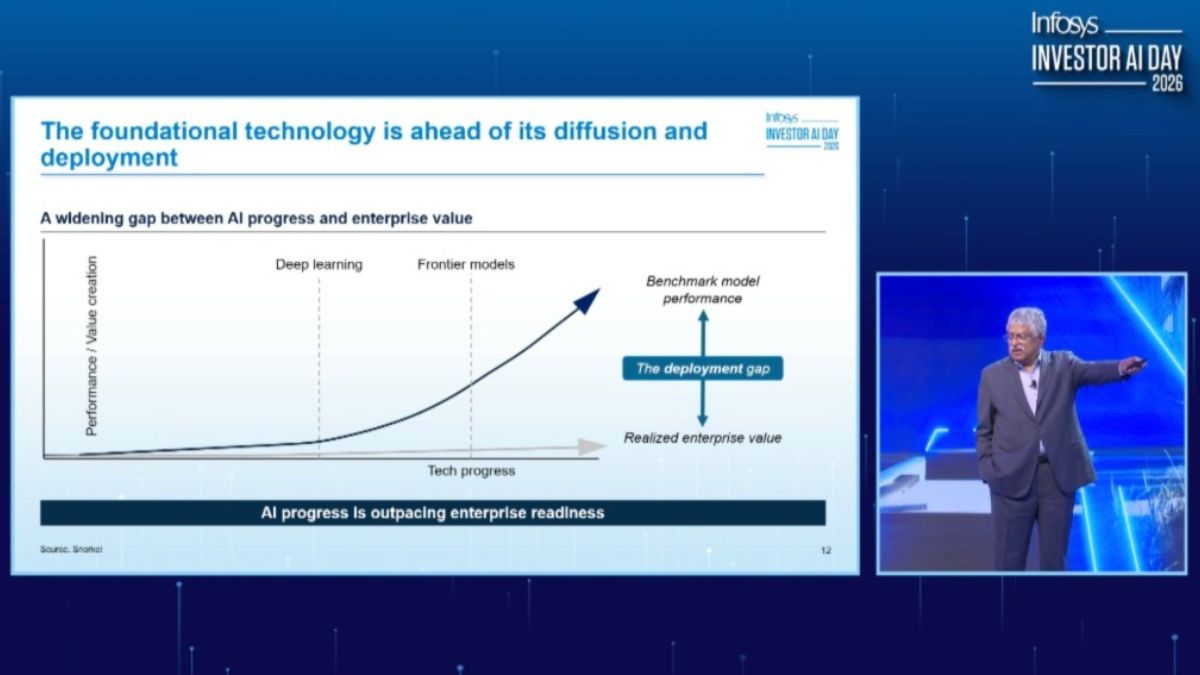
Sharing the ground reality of the speed at which the AI is transforming due to billions of investments being poured into it, Nilekani stated the biggest problem is that “technology is far ahead and is outpacing the enterprise readiness.”
He feels the solution lies in how fast companies can lessen the deployment gap between the power of the technology and the capability of the businesses to use it.
He also called attention to the fastest declining IT jobs, including front-end developers, QA testers, IT support specialists, and blockchain developers, adding that talent demand is clearly shifting toward AI-centric roles.
The urgent need to modernise legacy systems
Nilekani warned that delays in modernising legacy systems are no longer sustainable. He added that 60 to 70 percent of IT budgets are spent maintaining outdated systems, creating financial strain. Security risks are high, with breach detection taking over 200 days in legacy environments. Old systems also block innovation, keeping data siloed and preventing AI from performing at its best. “Accumulated tech debt must be paid now to unlock AI agility,” he said.
AI transition will fundamentally lead to change in organisational structures, business models, talent acquisition.
Talent transformation need of the hour
“The AI transition will bring about fundamental changes, a huge challenge for talent,” he said. Nilekani highlighted that jobs themselves will change, with demand shifting away from legacy roles toward AI-focused skills. Talent evolution is one of the biggest impact of the AI transition and the corporations have to deal with the world, where writing code will not be the goal.
“We cannot run the business in the same way. Talent will face different challenges. Jobs will change,” he added, emphasising how rapidly AI adoption is happening. ‘So this is a massive clean up jobs which everyone is dealing with. There is a reason for that. One if the financial drain,” he said.
Nilekani brutally stated that over 90 million jobs are at risk today, with jobs like front-end developers, QA testers, IT support specialists, blockchain developers be no longer relevant. However, it will open up new 170 million jobs – including data annotator, AI forensic analysts, AI leads, AI engineers and forward deployed engineers.
Nilekani also addressed fears around AI opportunities, saying, “There is no opportunity gap. According to me, there is more opportunity than ever.” He added that the real question is how businesses are using this opportunity, adding that it is an execution risk, as not every firm will have the same way to implement AI effectively.
From computerisation to the AI era
Nilekani described the AI revolution in context by tracing the evolution of enterprise technology. He explained how businesses moved from paper-based workflows to mainframe and PC systems, followed by the internet, which enabled globalisation and client-server models. Cloud adoption brought scalability, mobile computing, and microservices. Now, AI is again redefining operations through intelligent systems and high-growth AI skills. “This is not just a technological upgrade. It’s a complete shift in how we think and operate,” he said.
Nilekani warned companies not to be fooled by superficial AI output. He urged firms to set clear usage guidelines, maintain explainability and traceability, and focus on capturing real business value rather than just usage metrics. Empowering a skilled workforce is key to preventing organisational stagnation caused by low-value AI output.
AI demands a complete rethink
The chairman emphasised that AI is not a simple tool but a fundamental shift across technology, business, talent, operations, and mindset. Companies need AI-ready systems and AI-native architecture. Business functions must integrate AI at their core, with workflows designed around intelligent processes. Talent must be trained for a scalable, AI-augmented workforce, and operating models must adapt using cross-functional knowledge networks. Finally, the mental model of organisations must shift to prioritise evidence and responsible AI practices.
Build proprietary AI, don’t just buy
The chairman also spoke about a massive shift in enterprise AI investment. Spending on AI rose from $24 billion in 2023 to $140 billion in 2025, with IT budgets growing 23 percent to build customisable AI layers. Companies are preferring to build proprietary AI layers on top of foundational models rather than relying on off-the-shelf solutions.
Despite the rapid growth of AI technologies (from models with over 100 billion parameters in 2023 to more than 1 trillion parameters with 60+ agent frameworks in 2025) enterprise readiness has not kept pace. While new, Greenfield environments are seeing 15 to 50 percent productivity gains, older, Brownfield systems are struggling, with only 1 percent fully scaled to AI.
Nilekani added that while the opportunity is immense, execution is the real challenge. “There is no opportunity gap. According to me, there is more opportunity than ever,” he said.