



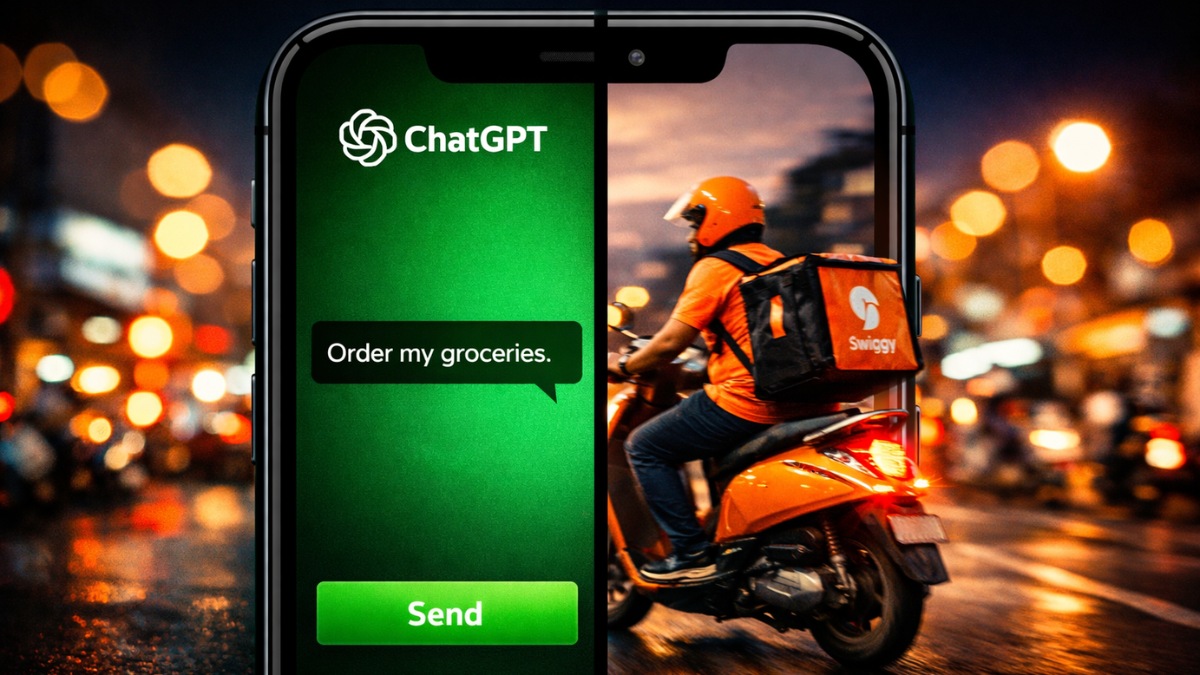
India’s new shopping companion does not own a warehouse, employ delivery riders, or manage returns. Instead, it writes poetry, plans holidays and answers homework questions.
ChatGPT has been among the most downloaded apps in India in the last 12 months, according to a Bernstein report. AI apps together now attract more than 100 million daily active users (DAUs). ChatGPT alone now sees more daily users than all e-commerce and quick commerce apps combined. For companies such as Swiggy and Zomato, this raises an obvious question: if consumers are already asking AI what to buy, will they soon ask it to buy for them?
Indians spend about 17 minutes a day on the app, a level of engagement that would make any consumer internet company take notice, the report detailed.
Here’s what the Bernstein report suggests:
Platforms are not standing still
Indian e-commerce companies are also embracing the technology, both for customers and for internal efficiency. Eternal recently announced a strategic collaboration with OpenAI to enhance capabilities across its businesses, including Zomato, Blinkit, Hyperpure, District and Feeding India, as well as its AI-native venture, Nugget, the report added.
Eternal and Swiggy have been deploying new features since 2025 for customers, restaurant partners and delivery riders. Both Zomato and Swiggy have enabled integration links that allow users to place food and grocery orders through apps such as ChatGPT and Claude.
Bernstein said it tested the feature and successfully placed and received an order from Swiggy’s Instamart via ChatGPT. According to the report, there are limitations for now, only cash-on-delivery orders are allowed as payment integration is yet to be enabled, and images are not provided, but the overall process was smooth.
Swiggy has also rolled out a range of tools, including enhanced search, a generative bot for its Dineout business (in beta), customer support chatbots and catalogue enrichment. For delivery partners, it offers an AI-powered bot, Driver Dost, to assist with onboarding, tracking and route planning.
Meesho, which Bernstein does not cover, has built and open-sourced its BharatML stack. It uses such systems for fraud detection and personalised recommendations, and in its logistics arm, Valmo, for cost optimisation. The company has partnered with Eleven Labs for voice bots across vernacular languages and with ViSenze to enable visual search. Its Project Suraksha initiative aims to combat counterfeit and restricted products to improve trust and reduce fraud.
Across the board, the use cases span improved discovery, faster technology upgrades, logistics optimisation, better routing for delivery partners, forecasting for suppliers and more efficient customer support, the report added.
High engagement, but still early days
While adoption has been rapid, usage levels remain well below the time consumers spend on large, established platforms such as Google, YouTube, Facebook and Instagram. For now, the primary use cases are search, “how-to” queries and writing or editing assistance. Shopping is still largely happening on dedicated e-commerce and quick commerce apps, the report said.
But the brokerage expects consumer behaviour to evolve gradually. Online shopping involves several friction points: checking product authenticity, comparing prices and delivery timelines across platforms, and scanning reviews and recommendations. It is natural, the report argues, for consumers to increasingly seek help from conversational apps during this process. That does not automatically mean transactions will shift away from marketplaces, as per the report.
The real moat: supply and execution
At first glance, e-commerce looks vulnerable. Marketplaces have long simplified discovery, built trust layers and offered convenience. If another app can do discovery better, does that weaken them? Bernstein argues the deeper advantage of Indian platforms lies elsewhere: in curating and governing a complex supply chain at scale.
Running an e-commerce or quick commerce business in India involves structuring largely unorganised seller ecosystems, managing daily operational and logistical challenges, deploying on-ground teams, handling customer service and absorbing high capital intensity. These businesses operate on razor-thin, low single-digit EBITDA margins.
In that context, the Bernstein believes that disruption is improbable. There is a limited margin pool to attack. As per the report, it also believes a large-scale shift from browsing-based shopping to text- or voice-led transactions is unlikely in the near term.
The more immediate concern, if any, is whether conversational apps could become an alternate demand channel, especially if traffic gets diverted from existing channels such as search and social media.
Time spent is not the same as transactions
The brokerage’s core argument is simple: high engagement does not automatically translate into high transaction value. Conversational apps may well become a larger part of the shopping journey. They could reduce friction, especially through voice-based, contextual and personalised interactions. That, in fact, could generate incremental demand for e-commerce platforms to fulfil.
The report added that without significant on-ground operations, however, such apps are more likely to act as a demand layer, potentially displacing traffic from search engines and social media platforms, rather than fully disintermediating marketplaces.
For investors, Bernstein says it remains constructive on Indian e-commerce and consumer internet names based on fundamentals. The sector could even serve as an “anti-AI” investment set, though it may require tolerance for narrative-driven volatility over the next few quarters, the report argued.
To conclude, India’s digital shoppers may increasingly ask a chatbot what to buy. But for now, it is still the e-commerce platforms that pack the order, move the inventory and deliver it to the doorstep.