



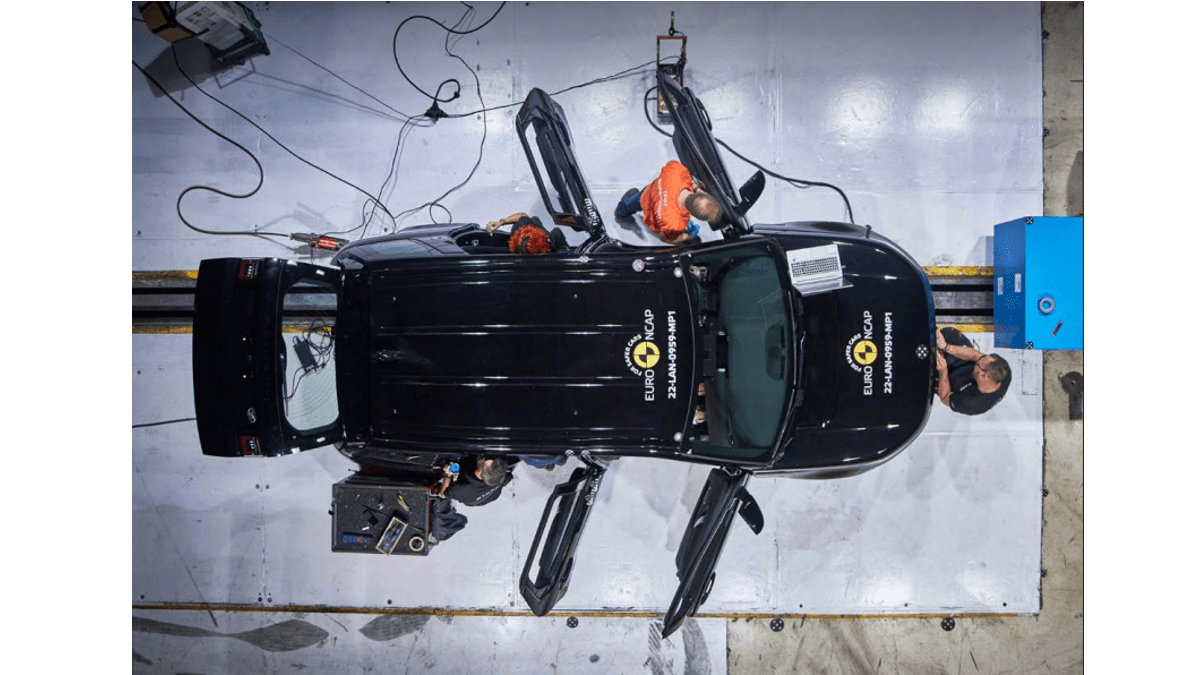
The Euro NCAP (European New Car Assessment Programme), a voluntary car safety performance assessment programme, is now moving to a three-year protocol update cycle and the new changes will come into effect from 2026.
Outlining its vision for the next decade and its role in improving vehicular safety, it is also phasing in virtual testing, improving testing for vulnerable road user protection and introducing rating incentives for a range of driver monitoring systems.
As part of ‘Vision 2030: a Safer Future for Mobility’ Euro NCAP has established the key focus areas for the European new vehicle market – both for existing automotive industry stakeholders, but also for new industry stakeholders that have not previously been involved in the Euro NCAP process.
This, the safety watchdog says, is taking into account the technology shift to encourage assisted and automated driving technologies, which are the four key areas of Euro NCAP assessment (since 2019) that will be adjusted to four distinct phases of a potential crash event: Safe Driving; Crash Avoidance, Crash Protection; and Post-Crash Safety.
Key updates to the Euro NCAP protocols looking forward to 2030 include:
- Testing and assessment of Assisted and Automated driver support systems
- Assessment of technology that monitors driver impairment and cognitive distraction
- Requirements to further improve the real-world efficacy of speed assistance technology
- Active safety tests which more closely simulate real road environments and examine human-machine interaction (HMI) design, ensuring more robust and efficient driver assistant systems
- Testing and assessment of safety functions enabled by V2V, V2I and V2X communication
- Passive safety tests which give greater focus to gender equality and the aging population of drivers/occupants
- Evaluation of fire risk and thermal runaway in electric vehicles and improved information for first and second responders
- Promoting best practice in vehicle security and data access.
Furthermore, Euro NCAP also plans to introduce new programmes to assess safety of motorcycles and scooters, as well as light and heavy goods vehicles, which it says will address the overrepresentation of these vehicles in road fatalities and serious injuries.
Dr Niels Ebbe Jacobsen, President, Euro NCAP said, “Given the importance of these assisted and automated driving technologies, Euro NCAP will adopt a penalty/rewards approach for cars that offer these systems. Also, Euro NCAP intends to accommodate all forms of connectivity and the various technical communication standards in the rating by evaluating each safety function in a technological neutral way.”
Michiel van Ratingen, Euro NCAP’s Secretary General added, “By developing timely voluntary standards for advanced safety technology, Euro NCAP sees an opportunity to act as a catalyst for accelerating uptake and promoting best practice, not just for passenger cars but also in the commercial vehicle fleet. Collaboration with industry is essential and has been key to our success.”