



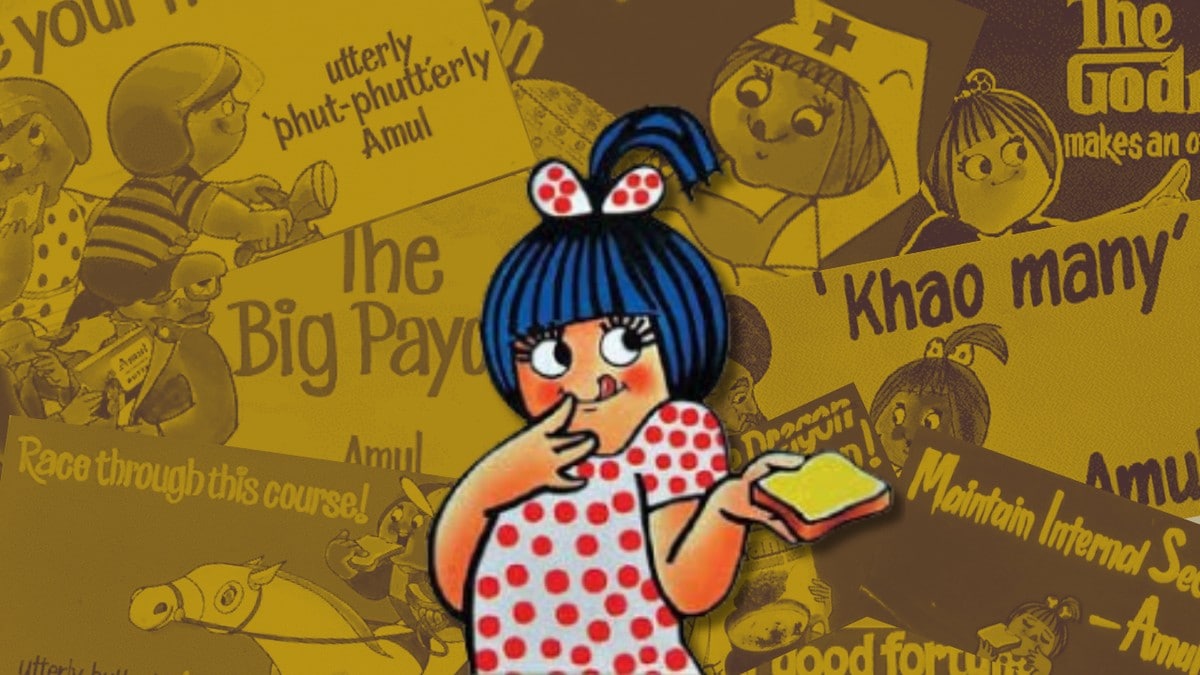
She is widely recognised for being witty and irreverent, mostly commenting on pop culture moments brandishing her “Utterly Butterly Delicious” slogan. But the numbers logged by the brand behind this blue-haired girl in a polka-dotted dress would be a source of envy for many of its rivals. Headquartered in Anand, Gujarat, and with a reach across the country and in international markets, Amul has crossed a turnover of Rs 1 lakh crore for FY26.
The 79-year-old’s path to this milestone is as much about a cooperative model that treats producers and consumers on an equal footing as it is about the use of trends, nostalgia, and celebrity to embed the brand into daily conversations. “A brand is a promise and most brands face only one dimension of the society — it is either the producer or the consumer,” says Jayen Mehta, managing director at the Gujarat Co-operative Milk Marketing Federation (GCMMF), that owns and markets the Amul brand. “Amul has always served two interests — one of the producers and the other of the consumers. More importantly, the purpose of the organisation is built in the brand’s DNA.”
All this did not happen overnight. What began with two village cooperative societies and procurement of 250 litres of milk a day has expanded to cover 18,600 village societies and 350 lakh litres of milk procured per day. The marketing entity Gujarat Cooperative Milk Marketing Federation (GCMMF) came into being in 1973 formalising the separation of marketing activities from production.
But Amul didn’t stop at milk. Its portfolio now spans paneer, dahi, cheese, ice-cream, bread spreads, a range of beverages — spanning 1,200 SKUs. Sachin Bobade, head of research, Monarch Networth Capital, says what works in the brand’s favour is its competitive pricing, large volumes and the huge portfolio of value-added products. Amul products also have immense reach — available at over 1 million retail outlets, from urban metros to the remotest villages.
Digital Transformation
That apart, the brand has kept pace with the times, embracing modern technnology while warding off opposition from animal lovers and the vegan lobby. Early this year, Amul introduced “Sarlaben”, an AI-powered virtual assistant who offers personalised guidance to over 3.6 million dairy farmers. Sarlaben is accessible in Gujarati via the Amul Farmer app and voice calls and provides advice on cattle diseases, vaccination schedules, artificial insemination, and nutrition.
“The biggest asset of the Amul brand is its credibility and relevance among all strata of the society,” says Nisha Sampath, founder, Bright Angles Consultancy. Industry veteran Sunil Parekh says besides the high decibel advertising, word of mouth has also helped in bringing the brand close to its target audience. It cannot be complacent about its outreach as the margins in the catetegory are thin, adds Bobade.
Amul’s expedition abroad has also felicitous. It exports to more than 50 countries and is looking to tie up with cooperatives abroad. The brand has a strong presence in Europe, UAE and in the Gulf region. Amul milk is also packed in the US and has a presence in over 35 states in that country.
From Anand to America
But competition is hotting up. Besides regional brands, many D2C brands are looking to rewrite the rules of the game. Should Amul worry? “One of our strategies is to continuously attack the category like an outsider. If I do not find chinks in my armour, somebody else will,” says Mehta.
Somdutta Singh, founder & CEO, Assiduus Global, says new-age brands are not beating Amul on scale, they are winning on perception. They are making purity, traceability, and health feel more visible and worth paying for. Amul should respond by making its strengths more visible. “It should also move faster in digital and quick commerce, where discovery is changing. The opportunity is not to protect volume, but to capture higher value from the same category. It has started moving in that direction, and that puts it in a strong position to shape what the next phase of dairy looks like.”