



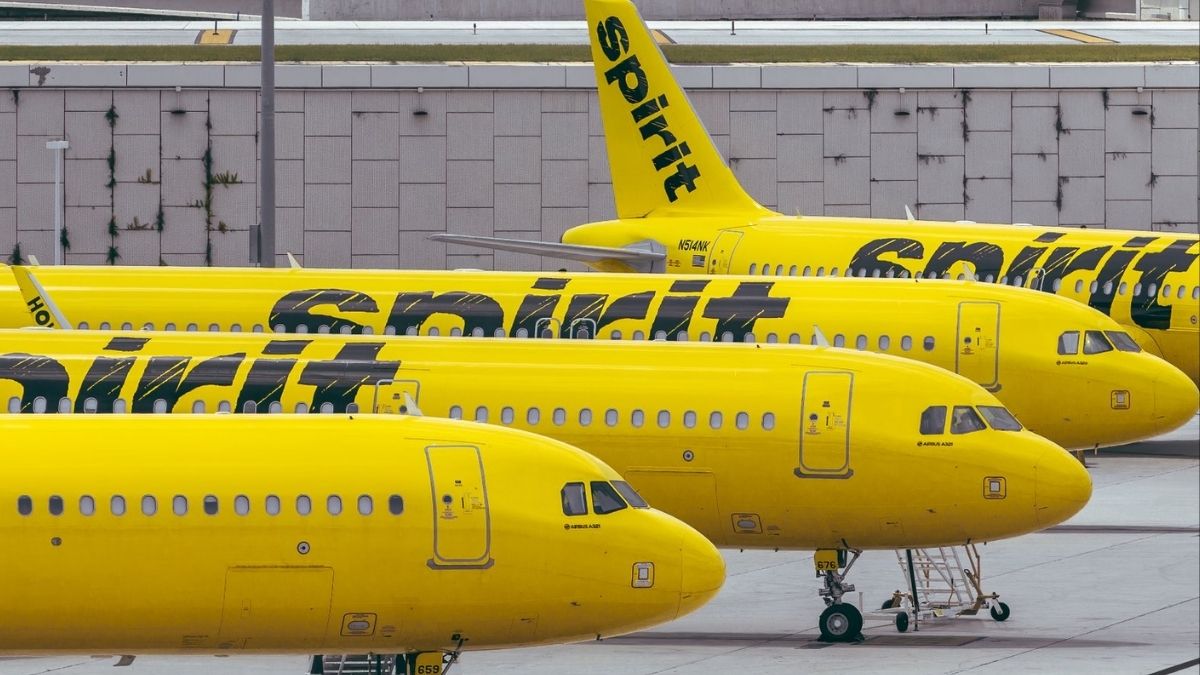
Spirit Airlines, the bankrupt discount carrier, ceased operations on Saturday (May 2), becoming the industry’s first casualty linked to the Iran war, after failing to secure creditor support for a US government bailout plan. The airlines has gone out of business after 34 years in the aviation sector. It can be seen that the collapse of the first carrier due to a doubling in jet fuel prices during the two-month-old Iran war will cost thousands of jobs.
The airline faces another blow as the stakes are high, with more than 17,000 employees set to lose their jobs.
This comes as a huge blow to US President Donald Trump, who had earlier proposed $500 million to save Spirit despite opposition from some of his closest advisers and many Republicans in Congress. It should be noted that no US carrier of Spirit’s size has liquidated in two decades. Spirit helped keep fares lower in markets where it competed against major carriers.
Will rivals benefit from Spirit Airlines’ flight cancellations?
On Friday, a Spirit board meeting ended without an agreement to rescue the company. “Unfortunately, despite the Company’s efforts, the recent material increase in oil prices and other business pressures have significantly impacted Spirit’s financial outlook,” Spirit said in a statement announcing “an orderly wind-down of operations.”
The statement further said that all flights have been cancelled and asked passengers not to go to the airport.
According to the data available from aviation analytics firm Cirium, Spirit had as many as 4,119 domestic flights scheduled between May 1 and May 15, offering 809,638 seats.
Meanwhile, global carriers are contending with surging jet fuel prices after the US-Israeli strikes on Iran disrupted traffic through the Strait of Hormuz. This comes as a big blow to Spirit as it was already struggling to turn a profit before the fuel shock.
The airline had built its brand around affordable fares for budget-conscious travelers ready to eschew add-ons like checked bags and seat assignments.
That demand tapered off quickly after the COVID-19 pandemic, as passengers preferred comfort and experience-based travel, leaving ultra-low-cost carriers struggling to adapt.
With Spirit’s shutdown, its rival carriers like JetBlue Airways and Frontier Airlines, who are reeling from the cost shock, will benefit.
On Friday, Spirit’s stock price cratered by up to 74%, whereas competitors such as JetBlue Airways Corp. and Frontier Group Holdings Inc. gained 10% and 4%, respectively.
Trump had also said that the White House gave Spirit and its creditors a final rescue proposal, after talks hit an impasse over a $500 million financing package that would have helped the airline keep operating through bankruptcy.
Speaking to reporters, Trump said, “If we can help them, we will, but we have to come first. If we could do it, we’d do it, but only if it’s a good deal.”
Spike in fuel price shocks weaker airlines
The collapse of Spirit Airline shows how the Middle East war and fuel-price shock exposed weaker airlines.
According to Spirit’s restructuring plan, the airline assumed jet fuel costs of about $2.24 a gallon in 2026 and $2.14 in 2027. However, prices spiked to around $4.51 a gallon by the end of April, leaving the carrier unable to survive.
In February this year, the airline flew around 1.7 million U.S. domestic passengers, with a 3.9% market share, down from 5.1% last year, Cirium data showed.
After Spirit’s announcement, major US carriers rolled out rescue-fare options for affected passengers. Frontier announced systemwide discounts and plans to add summer routes, JetBlue offered $99 fares through Wednesday, Southwest introduced special fares, United capped prices on one-way tickets; and American added rescue fares while reviewing options to boost capacity on key routes.