


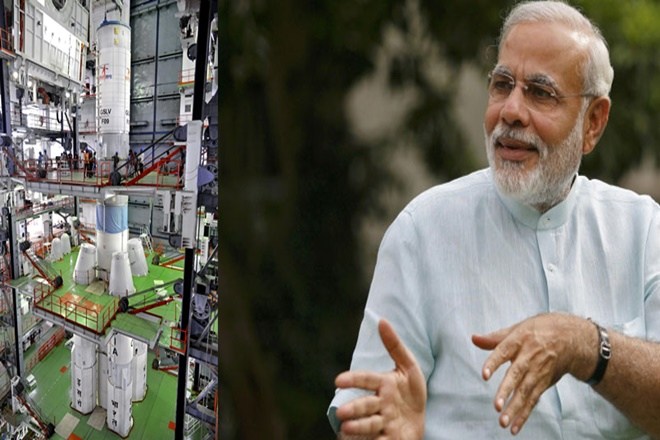

ISRO launched PM Narendra Modi’s ‘priceless gift’ satellite today. The satellite built by India Space Research Organisation is not only aimed to boost the ‘neighbourhood first’ policy but also make new inroads to global space diplomacy. Indian space agency’s GSAT-9, the South Asia Communication Satellite that is aimed to boost connectivity among nations in the region, will be launched at 4.57pm on Friday, according to a PTI report.
PM Narendra Modi, in the year 2014, just one month at the helm, made a surprising announcement to the world, when he told the scientists at ISRO in Sriharikota that the space community should take up the challenge of developing an SAARC satellite that can be dedicated to the neighbourhood as a ‘gift from India’. Now, PM Modi has announced the famous space diplomacy program, through a Rs 450 crore ‘gift’ to South Asian countries. Extending its neighbourhood first strategy, the government has also linked the announcement to its ‘Sabka Saath Sabka Vikas’ policy. The satellite will be launched on Friday, and it will have a footprint which will extend all over South Asia.
Watch the launch:
#WATCH | ISRO launches GSLV-F09 carrying South Asia Communication Satellite, from Satish Dhawan Space Centre, Sriharikota #SabkaSatellite pic.twitter.com/y02lvL9LHc
— TIMES NOW (@TimesNow) May 5, 2017
India’s gift to its neighbours is aimed at helping them utilise their space-based technologies in a better way. According to the government, the satellite will “enable a full range of applications and services to our neighbours in the areas of telecommunication and broadcasting applications viz. television, direct-to-home (DTH), very small aperture terminals (VSATs), tele-education, telemedicine and disaster management support”
I welcome President @ashrafghani, PM Hasina, PM @tsheringtobgay, @presidencymv Abdulla Yameen, PM Prachanda, President @MaithripalaS.
— Narendra Modi (@narendramodi) May 5, 2017
The historic occasion has been made better with a surprise- we have leaders of South Asian nations joining us in celebrating this launch.
— Narendra Modi (@narendramodi) May 5, 2017
I congratulate the team of scientists who worked hard for the successful launch of South Asia Satellite. We are very proud of them. @isro
— Narendra Modi (@narendramodi) May 5, 2017
This will also greatly benefit South Asia & our region’s progress.
— Narendra Modi (@narendramodi) May 5, 2017
Also read | ISRO’s ‘Naughty boy’ GSLV to put South Asia Satellite (GSAT-9) into orbit: Know why it is called so
The South Asia Satellite program is a partnership between India and most of the other member nations of SAARC: Bangladesh, Bhutan, the Maldives, Nepal and Sri Lanka. Afghanistan has not yet signed up to the program, while Pakistan has opted out of it.
The main structure of the satellite is cuboid in shape built around a central cylinder with a mission life of more than 12 years and is expected to support education, medical, disaster management and communications initiatives as well as international cooperation between South Asian countries.
Also read | ISRO ‘s GSAT-9 launch Live Updates: South Asian Communication Satellite set to take off in a few minutes
GSLV:
The GSLV is a three-stage vehicle with solid, liquid and cryogenic propulsion systems. GSLV-F09 mission is the eleventh flight of GSLV and its fourth consecutive flight with the indigenous Cryogenic Upper Stage (CUS). GSAT-9 is a Geostationary Communication Satellite with the objective to provide various communication applications in Ku-band with coverage over South Asian countries. The GSAT-9 spacecraft is a 2,230-kilogram satellite based on ISRO’s I-2K bus. The main structure of the satellite is cuboid in shape built around a central cylinder with a mission life of more than 12 years and is expected to support education, medical, disaster management and communications initiatives as well as international cooperation between South Asian countries.