



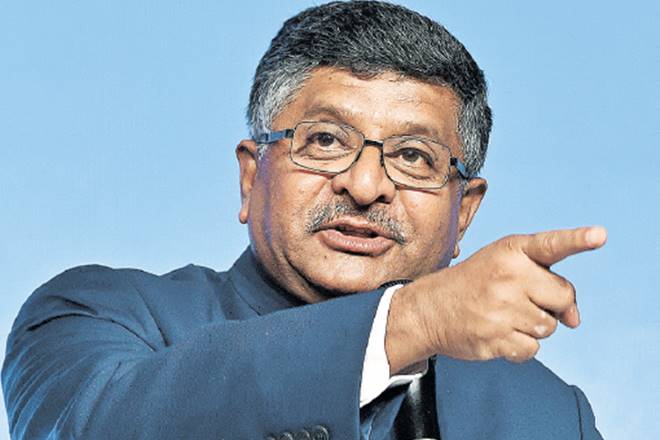
The Supreme Court’s ruling on Thursday that the right to privacy is a fundamental right is seen by many as a setback for the government’s Aadhaar initiative. IT minister Ravi Shankar Prasad rebutted the view saying the finance minister had expressed the same view while moving the Aadhaar Bill in Parliament, namely, that the right to privacy was a fundamental right. Excerpts from an interaction with FE:
Impact on Aadhaar:
Aadhaar during the UPA regime did not enjoy the protection of law. We made the Aadhaar law and provided a legal framework for protection of the data. The whole world appreciates the technological marvel that is Aadhaar, which operates on the principle of minimum information, maximum use. Aadhaar has shown its utility in a very short span of time and is completely safe and secure. Routing government subsidies through Aadhaar has ensured a saving of Rs 57,000 crore in the last nearly three years.
If it is a setback for the Centre:
There is no setback. The government has always seen right to privacy as a fundamental right. We welcome the view of the Supreme Court, which is consistent with all the necessary safeguards that government has been ensuring in its legislative proposals, which had been approved by the Parliament. The government is of the clear opinion that its legislation is compliant with the tests laid down in the judgment.
On data protection under Aadhaar:
Under Section 33 of the Aadhaar Act even the government cannot release data, except under compelling public interest, which needs to be affirmed by the joint secretary in the home ministry and vetted by a committee of the cabinet secretary, IT secretary and law secretary.
Impact on data collection by companies such as WhatsApp, Facebook, Google, etc:
The government is taking good care of cyber security and safety. All companies are welcome to come to India and do business, but we have outlined that data is important and the government is keen on robust use of data with due regard to safety and security. That’s why we have made a committee for data protection law under retired Supreme Court judge BN Srikrishna. All data collection has to be in line with the laws.
What the SC has said on right to privacy:
Right to privacy is not an independent fundamental right, but flows from Article 21, primarily, and also some other rights. It is not absolute but subject to reasonable restrictions. It has to be fair, just and proper.
The judgment reads that personal liberty is not an absolute right but liable to the restrictions provided in the Constitution which will be examined on a case to case basis. The SC has stated that the creation of such a regime requires a careful and sensitive balance between individual interests and legitimate concerns of the state.
On Opposition’s attack:
Today UPA is continuously comparing their and present government’s Aadhaar Act. It is unknown in civilised existence that a government was seeking to collect data of its countrymen without the authority of law. There was no legislative instrument at all available and therefore the concern citizens had was a very legitimate one: “We don’t know the terms and conditions and the context and the authority on which our data is being collected.” What is important is that from 2009 to 2014, they did not make any law on this. Also, what has been the Congress’ record in protecting individual liberties, I would like to know?