



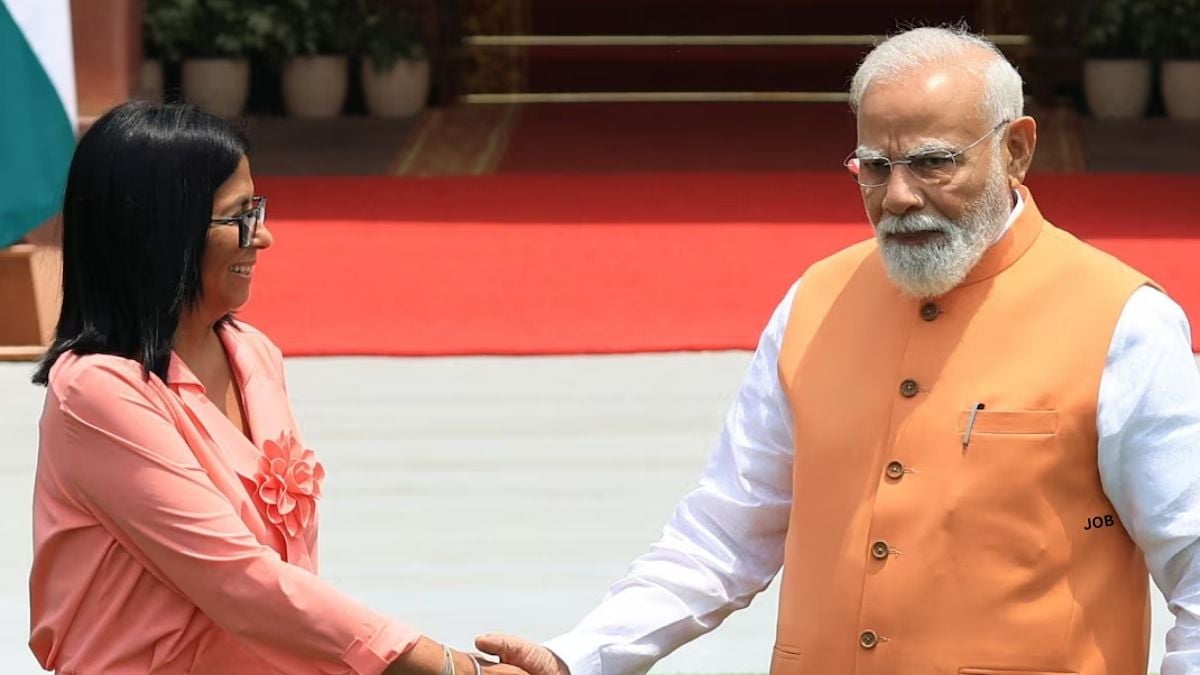
India and Venezuela have moved to deepen their ties with a strong focus on energy cooperation, as Prime Minister Narendra Modi held extensive talks with Venezuelan Acting President Delcy Rodriguez during her visit to India. The discussions covered oil and gas, critical minerals, pharmaceuticals, agriculture, automobiles and investment, signaling a broader push to strengthen economic relations between the two countries, reported PTI.
Rodriguez arrived in India on Wednesday for a five-day visit aimed at expanding bilateral cooperation at a time when India is looking to secure stable energy supplies amid disruptions in global markets caused by the West Asia crisis.
The meeting came as India increased imports of Venezuelan crude oil in recent months. Venezuela has emerged as India’s third-largest supplier of crude oil after Indian refiners resumed purchases following changes in the sanctions landscape earlier this year.
According to the Ministry of External Affairs (MEA), the Venezuelan leadership conveyed a clear message that it views India as a preferred long-term energy partner. The South American nation believes India’s rapidly growing economy and rising energy demand make it a reliable customer for years ahead, reported PTI.
Secretary (East) in the MEA, Rudrendra Tandon, said Venezuela sees India as a stable buyer in the global energy market. “They see India as a stable demander for many years to come. Therefore, there exists a perfect complementarity for India and Venezuela to work in the energy sector, in both upstream and downstream,” Tandon said.
Prime Minister Modi welcomed the proposal and expressed India’s interest in building a stronger energy relationship that covers exploration, production, refining and other related activities.
Why are India and Venezuela focusing on energy ties?
Energy security emerged as the central theme of the talks. India is one of the world’s largest consumers of crude oil and imports a significant share of its energy requirements. As geopolitical tensions affect global supply chains, India has sought to diversify its sources of crude oil.
Venezuela possesses some of the world’s largest proven oil reserves. The country once supplied large volumes of crude oil to India, with imports crossing 400,000 barrels per day at their peak. However, sweeping US sanctions and compliance concerns forced Indian refiners to halt purchases in 2020, reported PTI.
Following political developments in Venezuela and the easing of restrictions after the detention of former president Nicolas Maduro by US forces in January, Indian companies resumed purchases of Venezuelan crude. Imports have risen sharply in recent weeks as refiners look for alternative supplies amid instability in West Asia.
The two sides agreed that their energy sectors complement each other. Venezuela seeks stable buyers for its oil, while India requires dependable long-term suppliers to meet growing demand.
The talks also touched on cooperation beyond oil and gas. Venezuela offered opportunities in mining, particularly in critical minerals that are becoming increasingly important for technology, manufacturing and clean energy industries.
Tandon said Venezuela’s natural resources extend beyond crude oil. “Venezuela is a resource-rich country. It’s not just about critical minerals; it has also gold, diamonds, and other materials. So, mining is very much there,” he said.
He added that both sides discussed ways to assess the country’s resource potential and explore future collaboration in the mining sector.
What other issues came up during discussions?
Apart from energy and minerals, the two leaders explored opportunities in pharmaceuticals, healthcare, agriculture, transportation, technology and the automobile sector. Officials from both countries believe these areas can add new momentum to bilateral trade and investment.
MEA spokesperson Randhir Jaiswal said the leaders reviewed the full spectrum of bilateral relations and looked at new areas for cooperation. “The leaders also exchanged views on global and regional issues of mutual interest. Both sides reaffirmed their commitment to deepening the bilateral partnership and advancing the interests of the Global South,” Jaiswal said.
The Indian side also raised the issue of more than $500 million in dividends owed to ONGC Videsh, India’s overseas energy arm, reported PTI. The company has investments in Venezuela through a joint venture with state-owned Corporacion Venezolana del Petroleo.
Responding to questions on the matter, Tandon said, “It is our money. They are very sensitive to the issue,” he added.
India and Venezuela have a long history of cooperation in the energy sector. ONGC Videsh holds a 40 percent stake in Petrolera Indovenezolana SA, a joint venture involved in oil exploration and production in Venezuela’s San Cristobal field, reported PTI.
Rodriguez’s delegation includes ministers responsible for foreign affairs, economy and finance, science and technology, transportation, and communication. During the visit, the delegation will tour facilities linked to India’s energy, pharmaceutical and automobile sectors.
Officials expect Rodriguez to visit Reliance Industries’ refinery complex in Jamnagar, Gujarat, one of the world’s largest refining hubs.
“The Venezuelan leader will be exposed to the sophistication that India has achieved in the energy sector,” Tandon said.
Although questions arose about Venezuela’s political transition after Maduro’s detention, Indian officials focused on the future of bilateral ties. Tandon said India is working with a government that seeks closer cooperation and partnership.