



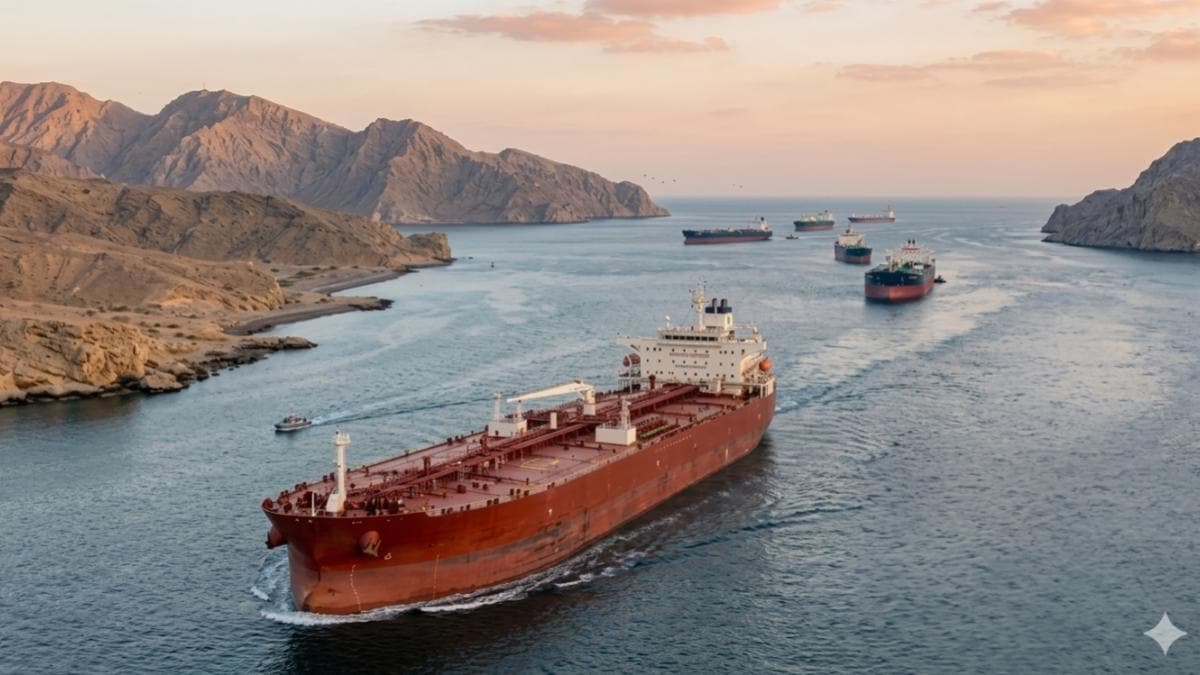
The recent two-week ceasefire agreement between the United States and Iran has sparked a glimmer of hope for global trade, with oil prices marginally cooling down. However, for the giants of the shipping industry, the ‘all-clear’ signal remains elusive.
While the diplomatic breakthrough suggests a cooling of tensions, major players like Maersk and the Norwegian Shipowners’ Association (NSA) are maintaining a “wait and watch” policy, citing a lack of long-term security guarantees for safe transit through the oil artery of the world that is the Strait of Hormuz.
Maersk stays cautious on Strait of Hormuz
Danish shipping heavyweight Maersk has clarified that while the ceasefire might open potential windows for transit, it does not yet provide the “security certainty” required to resume standard operations.
According to a Reuters report, the company is prioritising risk assessment over speed. “At this point, we take a cautious approach, and we are not making any changes to specific services,” the group noted in an official statement.
The firm emphasised that any decision to move vessels through the volatile Strait of Hormuz will depend on continuous real-time risk assessments, close monitoring of the local security environment and direct guidance from international maritime authorities and partners.
The high cost of uncertainty
The hesitation from shipping lines isn’t just about safety; it’s about the massive logistical and financial strain the conflict has already imposed.
Notably, Maersk last month suspended cargo bookings to several ports across the Gulf region. To tackle the volatility, the company also introduced emergency bunker fuel surcharges worldwide.
These surcharges were designed to offset the skyrocketing fuel costs and the expensive “workarounds” required to keep goods moving when traditional routes are blocked.
As per a recent report published by Al Jazeera, many shipping firms are still relying on rerouting cargo and using alternative ports, which adds significant time and cost to global supply chains.
Norwegian shipowners echo safety concerns
Maersk isn’t alone in its scepticism. The Norwegian Shipowners’ Association (NSA), which represents roughly 130 companies and a fleet of 1,500 vessels globally, stated on Wednesday that the ceasefire hasn’t brought the “clarity” needed to restart operations.
NSA leadership pointed out that the security situation in the Gulf remains fundamentally unpredictable. Hareide, a representative for the association, told Reuters that shipowners are seeking more granular information before committing their fleets to the route.
What lies ahead for global shipping?
As per analysts interviewed by Reuters, the two-week window agreed upon by Washington and Tehran is seen by industry observers as a ‘fragile agreement.’For the shipping industry, two weeks is a very short cycle in the world of maritime logistics, where voyages are planned months in advance.
Analysts interviewed by Reuters suggest that surcharges are likely to stay until a permanent resolution is reached and that maritime insurance for Gulf transits is likely to remain high due to the perceived risk of “sudden escalation.”
As per analysts interviewed by agencies, until the “security certainty” Maersk demands is met, cargo shipments are likely to be delayed as ships continue to take alternate routes for safety.