



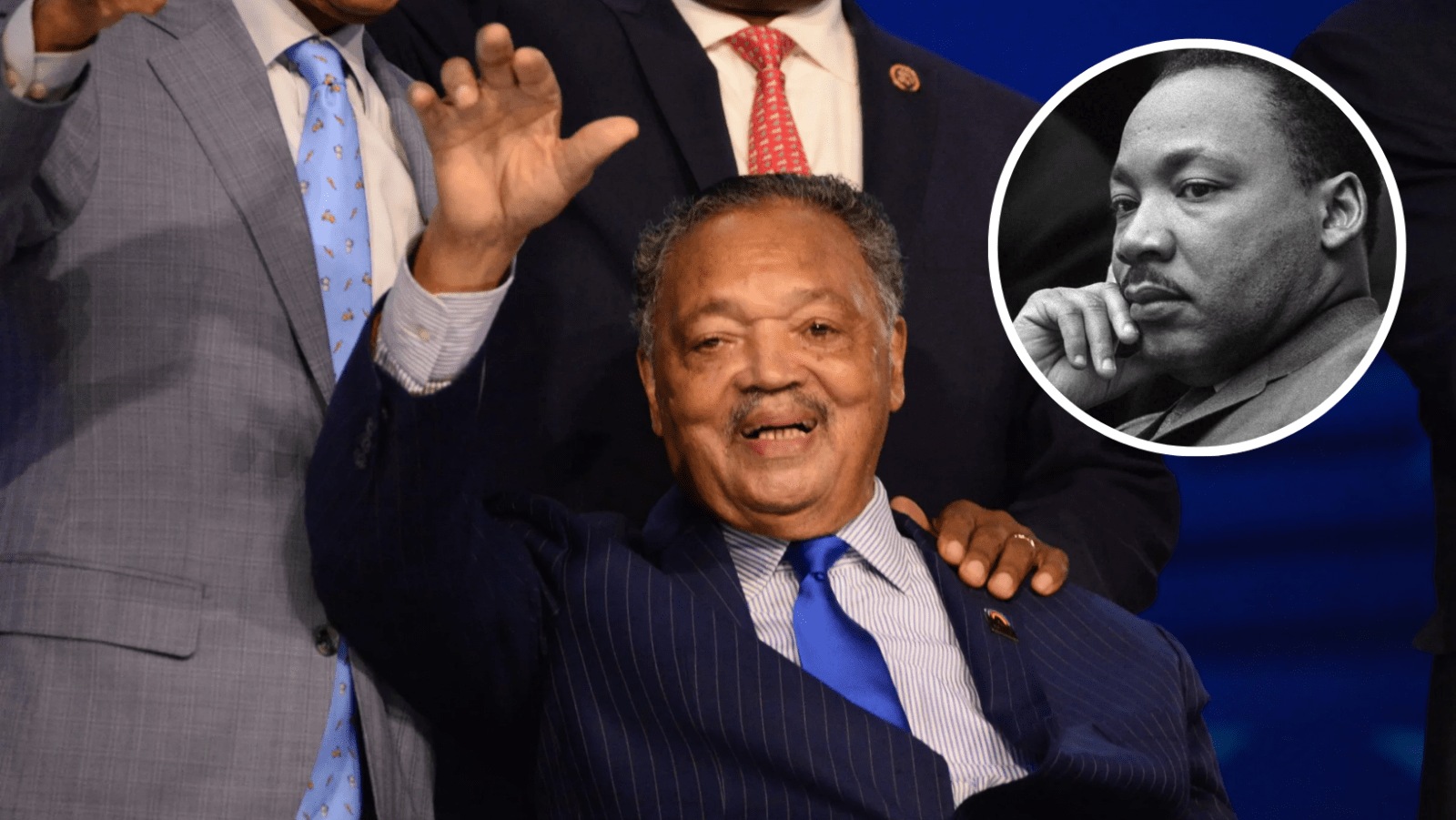
Jesse Jackson, one of the most influential figures of the American civil rights movement and a close associate of Martin Luther King Jr., has died at the age of 84. His family and organisation said he passed away peacefully on Tuesday morning, surrounded by loved ones. Jackson had been battling progressive supranuclear palsy, a rare neuromuscular disease similar to Parkinson’s disease. He was hospitalised on November 12 after his condition worsened.
“It is with profound sadness that we announce the passing of Civil Rights leader and founder of the Rainbow PUSH Coalition, the Honorable Reverend Jesse Louis Jackson, Sr.,” the organisation said in a statement posted on Instagram. “He died peacefully on Tuesday morning, surrounded by his family.”
Who was Jesse Jackson?
Born in Greenville, North Carolina, in 1941, Jackson grew up in a segregated South. His path into activism began early. In 1960, when he was just 18, he and seven other men were arrested for protesting segregation at their town’s public library. This marked the beginning of a lifelong commitment to civil rights.
He soon joined King’s growing movement and became deeply involved in the Southern Christian Leadership Conference. Jackson was with King during key moments of the struggle and was just feet away when King was assassinated in 1968, an event that deeply shaped his life and work. By the mid-1960s, Jackson had marched from Selma to Montgomery for voting rights and later ran operations for the SCLC in Chicago.
In Chicago, Jackson led Operation Breadbasket, which used boycotts and public pressure to force companies to hire more Black workers and do business in Black communities. This approach made him a national figure and showed how economic pressure could be used as a tool for justice.He later founded what became the Rainbow PUSH Coalition, an organisation focused on civil rights, economic justice and political participation. Through this work, Jackson helped energise and register millions of Black voters across the United States.
Presidential runs and global influence
Jackson took his activism into electoral politics when he ran for president as a Democrat in 1984 and again in 1988. Although he did not win the nomination, his campaigns reshaped American politics by giving voice to Black voters and other marginalised groups.
His influence extended beyond US borders. In 1983, shortly before his first presidential run, Jackson travelled to Syria to help secure the release of an American pilot shot down over Lebanon. The following year, he negotiated the release of 22 Americans and 26 political prisoners from Cuba after meeting with former leader Fidel Castro.
Even in his later years, when he was ill, Jackson remained active. He continued to show up during moments of racial trauma and protest. In 2021, he travelled to Minneapolis to support protesters awaiting the verdict in the trial of Derek Chauvin, who was later convicted of killing George Floyd. While there, Jackson also attended services for Daunte Wright, who was killed by police during a traffic stop in a nearby suburb. Speaking softly, he reminded young activists that their cause was just.
That same year, he was arrested twice while protesting the Senate filibuster rule, which he opposed for blocking voting rights legislation. Jackson was ordained as a minister in 1968 and later completed his divinity degree. In 2000, President Bill Clinton awarded him the Presidential Medal of Freedom, recognising decades of work in civil rights, politics and global human rights.
In 2017, when he publicly revealed his diagnosis, Jackson spoke with the same faith that had guided him throughout his life. “As we continue in the struggle for human rights, remember that God will see us through, even in our midnight moments,” he said.