



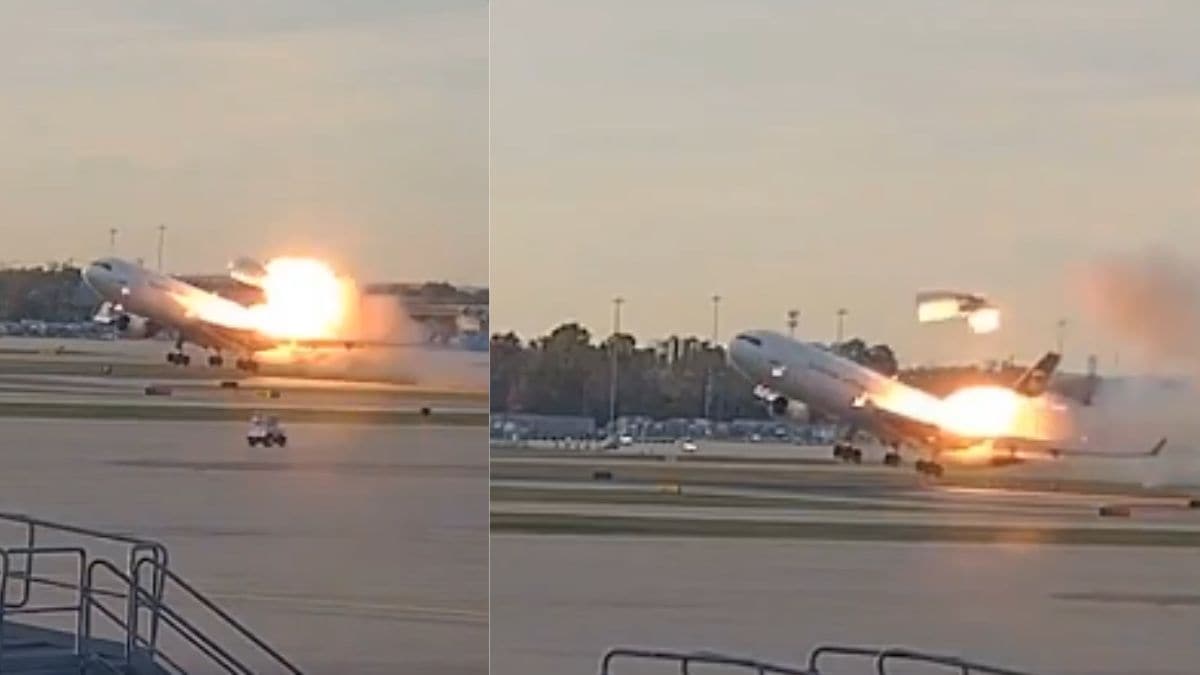
The National Transportation Safety Board (NTSB) on Tuesday released new video showing the terrifying moment a UPS cargo plane lost an engine during takeoff before crashing near Louisville, Kentucky, last year.
The surveillance footage recorded by CCTV at the airport, showed the aircraft’s left engine breaking away from the wing in a huge ball of fire seconds before the takeoff. Debris scattered across the airport area moments before the jet crashed.
The aircraft involved was UPS Flight 2976, a McDonnell Douglas MD-11F cargo plane flying from Louisville to Honolulu on November 4, 2025.
Newly released NTSB footage shows the terrifying moment a UPS cargo plane lost its left engine and pylon seconds after takeoff in Louisville, Kentucky.
— Visegrád 24 (@visegrad24) May 20, 2026
The plane crashed on November 4, 2025, killing 14 people.
The cause remains under investigation. pic.twitter.com/SsVWCm5z6H
Deadliest crash in UPS history
The crash killed all three pilots on board and 12 people on the ground after the aircraft slammed into a nearby industrial and business complex. More than 20 others were injured. Authorities said the crash caused a massive fire because of aviation fuel and nearby industrial facilities.
Investigators said the aircraft never gained much height after takeoff. Flight recorder data showed the plane climb only around 30 feet before the pilots lost control. The wreckage spread across nearly half a mile. The accident became the deadliest crash in UPS history.
Crew was reassigned before flight
During the first day of a two-day hearing in Washington, D.C., NTSB investigators revealed that the flight crew was not originally scheduled to fly the crashed aircraft. According to investigators, the pilots were first assigned to another MD-11 aircraft. However, that plane was removed from service after a fuel leak was discovered and reported to maintenance teams. The crew was then reassigned to the MD-11F that later crashed.
The NTSB said investigators found evidence of fatigue cracks in the structure holding the left engine to the wing.
Officials revealed that the failure happened in the engine pylon’s aft mount lug, a key metal part that connects the engine assembly to the aircraft wing. Over time, repeated stress weakened the metal until it failed during takeoff. Investigators believe this structural failure caused the engine and pylon to separate from the aircraft.
The NTSB had earlier reported finding cracks in the left wing’s engine mount. On Tuesday, investigators confirmed that metal fatigue was responsible for the failure of the component attaching the engine to the wing.
Boeing warning under scrutiny
An NTSB investigator also disclosed that UPS did not take additional action after reviewing a 2011 Boeing notice that warned about structural failures involving the MD-11 aircraft. UPS has said the notification did not require action.
Federal investigators are now examining whether warning signs were missed during inspections and maintenance checks. Reports said Boeing had identified similar structural problems in earlier aircraft years ago, raising questions about why broader corrective measures were not introduced sooner.
The aircraft involved in the crash was a 34-year-old MD-11 freighter originally developed by McDonnell Douglas before the company merged with Boeing. After the November 2025 crash, the Federal Aviation Administration (FAA) temporarily grounded MD-11 and related DC-10 aircraft models so emergency inspections could be carried out.
UPS has since retired the MD-11 from its fleet. Meanwhile, FedEx has started returning MD-11 aircraft to service after they underwent repairs recommended by Boeing and approved by the FAA.
“Our focus remains on supporting the investigation and honoring those affected by this tragedy,” UPS said in a statement Tuesday. The NTSB investigation is still ongoing. Investigators are focusing on aircraft design standards, inspection procedures, and whether manufacturers and regulators responded properly to earlier reports of fatigue-related structural failures. A final report determining the probable cause of the crash is expected next year.