



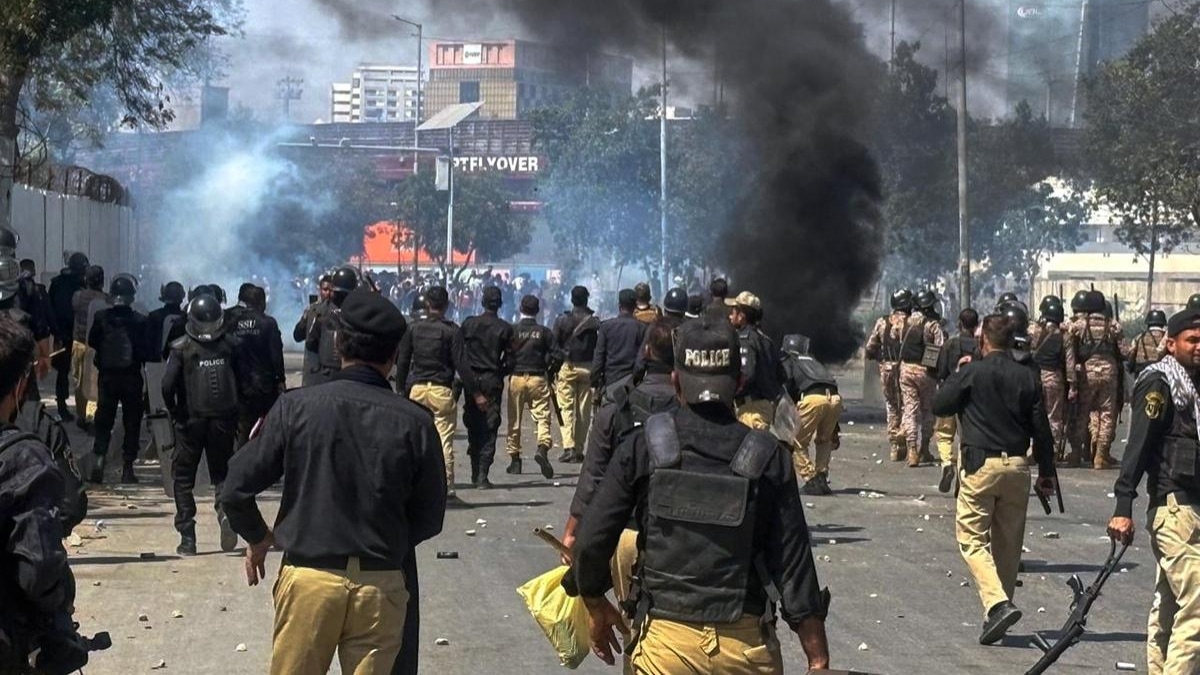
Pakistani security forces opened fire on protesters storming the US Consulate in Karachi and UN offices in Islamabad, killing at least 37 people and wounding over 170, amid fury over the US-Israeli assassination of Iran’s Supreme Leader Ayatollah Ali Khamenei.
Author Shanaka Anslem Perera described the events starkly: “A nuclear-armed US ally just killed its own citizens defending American soil from its own population.”
He highlighted Pakistan’s status as a major non-NATO Ally since 2004, receiving billions in US military aid, yet its police and Rangers used live rounds against crowds enraged by Washington’s actions.
Interior Minister Mohsin Naqvi condemned the violence while expressing “shared grief” for Khamenei—the very figure whose death by Pakistan’s ally sparked the riots.
Perera called this “not a policy contradiction” but “a state fracturing along the exact fault line this war was always going to expose.” With a 959-km border with Iran, shared Balochistan region, and strong Shiite ties to Tehran, Pakistan balances US logistics support against domestic sectarian pressures.
‘Pure Pak sovereign security response or direct American use of force on Pakistani soil?’
The author cited Dawn newspaper report which noted around 2,000 protesters in Karachi and 500 in Islamabad. Demonstrators breached the outer wall of the US Consulate, which under the Vienna Convention is considered inviolable sovereign US territory.
Perera noted that Karachi police chief Zeeshan Siddiqi had said that officers first used water cannons, tear gas and batons before escalating to live ammunition after the perimeter was breached. The US Embassy stated no American staff were injured but immediately issued safety advisories for all US citizens in Pakistan.
Perara also highlighted some reports, including India Today and Pakistani Senator Allama Raja Nasir, claiming that US Marine Security Guards also opened fire once the breach reached the inner compound.
Washington has neither confirmed nor denied any Marine involvement. The Sindh chief minister has ordered a judicial inquiry into the incident. The findings could determine whether this was purely a Pakistani sovereign security response or involved direct American use of force on Pakistani soil.
‘What no other analyst is stating’: Perara warns of ‘nuclear’ risks
Perera noted that Pakistan holds about 170 operational nuclear warheads, reliant on military and government stability now strained by surging oil prices near $90, sectarian divisions, and the “diplomatic impossibility” of backing America while mourning its target.
While Iran’s nuclear program remains latent, Perera argued the real proliferation danger lies in Islamabad. “Pakistan’s nuclear arsenal is operational, deployed, and sitting inside a country where security forces just fired live rounds into crowds mourning a man Washington killed. The proliferation risk the world should be watching is not in Isfahan. It is in Islamabad,” he said.
A judicial inquiry is underway into whether US Marines also fired, as some reports claim.