



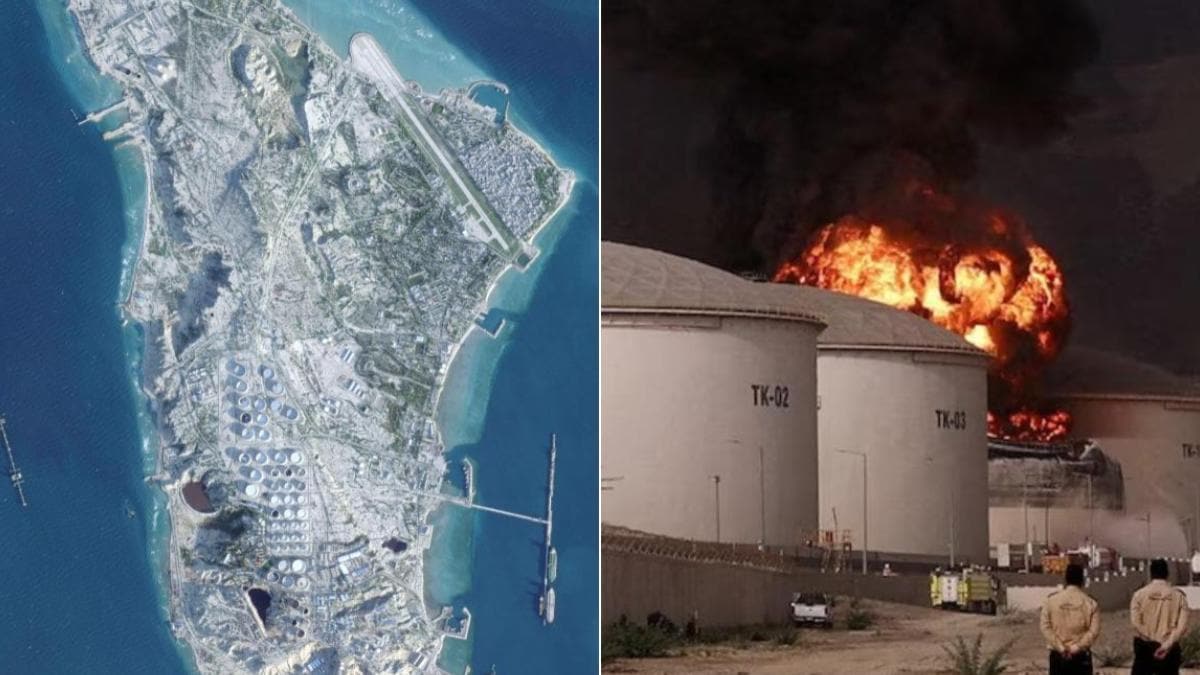
Tucked in the waters of the Persian Gulf lies a small island that holds the fate of Iran’s oil economy. Kharg Island is the loading point for nearly 90% of Iran’s crude exports, making it the single most critical artery in the country’s energy lifeline.
Earlier today (March 14), US President Donald Trump announced that US forces struck “every military target” on Iran’s Kharg Island. He described it as a major blow to Iranian capabilities. Trump also publicly warned that if Iran continues to interfere with shipping in the Strait of Hormuz, he is prepared to hit Kharg’s oil infrastructure itself, which was deliberately spared in this first round of attacks.
Iranian officials have responded by threatening to retaliate against energy infrastructure linked to US interests and allies in the region. The Islamic nation has signalled that oil and gas facilities could become targets if the confrontation escalates.
Why Kharg Island is so critical
Kharg Island handles roughly 90-95% of Iran’s crude oil exports, making it the central hub through which most of Iran’s export barrels move to global markets. The terminal can load up to around 7 million barrels per day and has large storage capacity, with pipelines connecting it directly to major onshore oil fields.
Because Kharg Island is the backbone of Iran’s oil export system and sits next to the already‑disrupted Strait of Hormuz, any US strike there raises the risk of a major and prolonged supply shock. Even though the latest US attack focused on military targets, markets are worried that either follow-on strikes or Iranian retaliation could damage export infrastructure or further choke off shipping routes that carry a large share of the world’s oil.
Also, because oil revenue is a key pillar of Iran’s state finances, Kharg is also a financial lifeline for Tehran. Moreover, its role in supplying crude, especially to Asian buyers such as China, gives it outsized importance for global energy security despite existing sanctions.
Immediate market reaction
After news of the Kharg Island strikes and Trump’s threat to target oil infrastructure, Brent crude prices jumped, with some platforms showing trades around 103 dollars per barrel compared with about 100 dollars the previous day. More broadly, the US-Israel-Iran confrontation and effective disruptions around the Strait of Hormuz have already pushed Brent above 100 dollars and raised prices by nearly 40% versus pre‑war levels, as traders factor in the risk of sustained supply losses.
Key risk channels for oil markets
Concentrated infra risk at Kharg: Iran relies on a single location for around 90-95% of its crude exports — about 1.3–1.7 million barrels per day under current sanction‑limited conditions — so serious damage to Kharg’s terminals would immediately remove most Iranian barrels from the market.
Retaliation against regional energy facilities: Iranian officials and media have pointed to potential retaliation against oil infrastructure in countries that host US military bases, including Saudi Arabia, the UAE, Qatar and others. This has raised the spectre of strikes on export terminals and refineries across the Gulf. Analysts warn that attacks on facilities comparable to Saudi Arabia’s Abqaiq complex in 2019 would have a much larger, longer‑lasting impact on global supply than temporary shipping disruptions alone.
Strait of Hormuz chokepoint risk: Roughly 20% of global oil trade and a large share of LNG exports pass through the Strait of Hormuz. And shipping there has already slowed after multiple vessel attacks and Iranian threats. Iranian leaders have talked of ensuring that “not a litre of oil” passes through the strait and security reports detail several recent attacks on merchant vessels in and near the corridor.
Higher shipping, insurance and risk premia: With tankers being attacked and risk rising, shipowners are reconsidering transits through Hormuz and even through other routes such as Bab al‑Mandab, which lengthens voyages and drives up freight and insurance costs per barrel. Even if physical flows continue, these higher costs and perceived risks add a persistent premium to oil prices.
Limited policy cushion: Analysts note that while some Gulf producers can reroute a portion of exports through pipelines that bypass Hormuz, this capacity is not enough to offset a major loss of flows through the strait. The International Energy Agency has signalled possible emergency stock releases, but traders doubt that these can fully cover an estimated shortfall in the range of 15-20 million barrels per day if Hormuz traffic remains severely constrained.
Why this matters globally (including for India)
Kharg’s exports predominantly serve Asian markets, so any sustained disruption would hit major importers such as China, India, South Korea and Japan, which depend heavily on Gulf crude. For India in particular, higher Brent prices, costlier shipping and insurance and potential supply rerouting could widen the current account deficit, pressure the rupee and feed into domestic fuel prices and inflation.
Analysts say the biggest risk now is a potential escalation that directly targets oil infrastructure. According to JPMorgan, Iran’s export capacity will likely remain around 1.5-1.7 million barrels per day as long as key facilities at Kharg Island, including its loading jetties and pipelines, remain intact.
But a strike on those assets could dramatically reshape global oil supply. Dan Pickering of Pickering Energy Partners warned that destroying Kharg’s infrastructure could permanently remove around 2 million barrels per day from the market. JPMorgan estimates such an attack could put nearly half of Iran’s total oil production at risk, forcing swift production shutdowns upstream.
Analysts also caution that Iran could retaliate by targeting major Gulf energy hubs linked to US allies, including Saudi Arabia’s Ras Tanura export terminal, the UAE’s Fujairah oil hub, and the Abqaiq processing facility, all considered critical and highly vulnerable nodes in the global energy supply chain.
Because oil is priced at the margin, even the threat of a strike on Kharg’s oil infrastructure or Iranian retaliation against regional facilities forces markets to build in a higher and more durable geopolitical risk premium.