



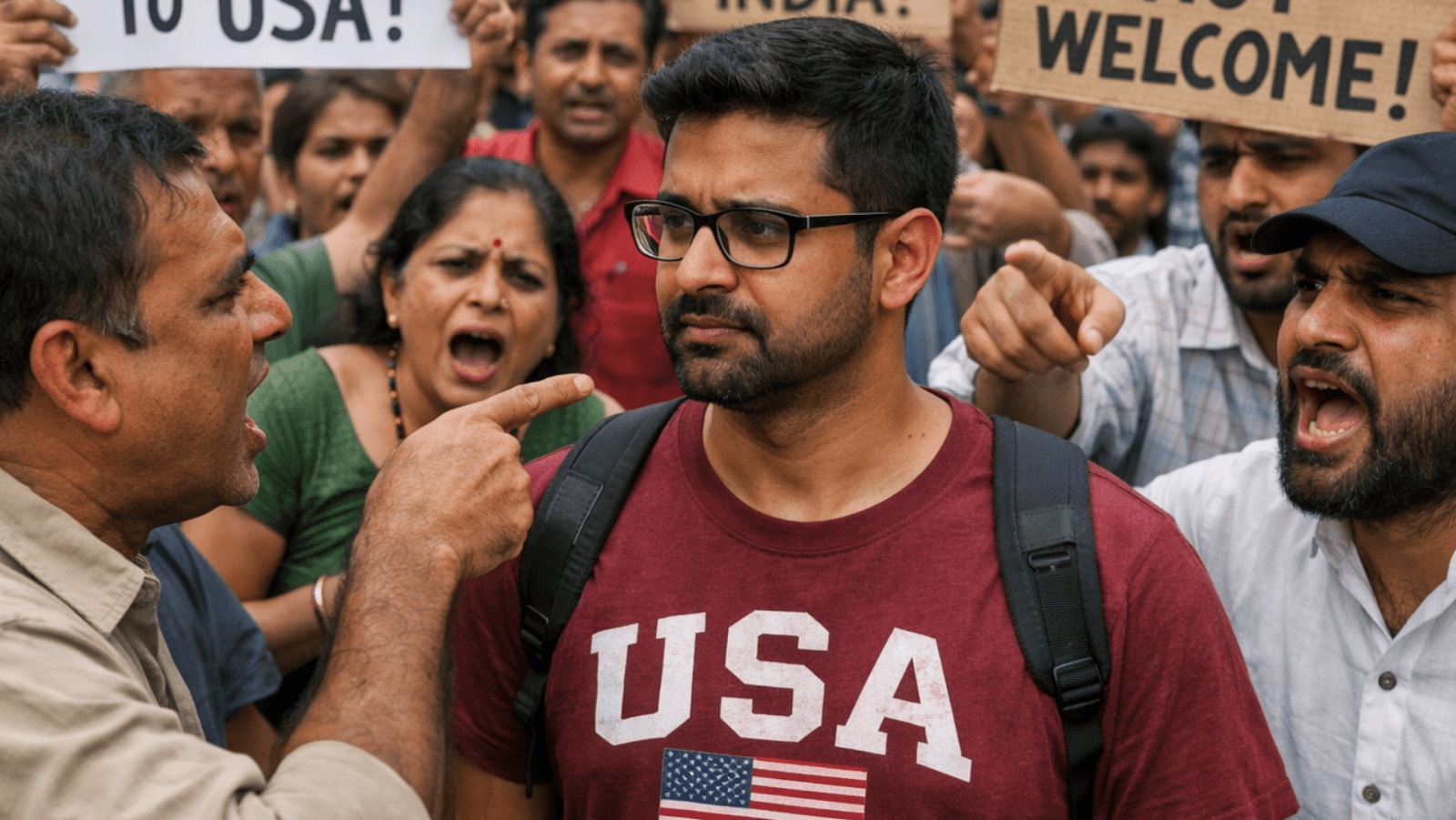
The debate around Indians on H-1B visas being disliked by Americans is not new. For years, immigration, job competition, and outsourcing have increased tensions in the United States. But a new and uncomfortable narrative is now gaining ground, one where Indians are being accused of harming fellow Indians.
This time, the conflict is not just between Americans and immigrants. It is increasingly playing out within the Indian community itself, particularly between Indian nationals on work visas and Indian Americans who were born and raised in the US.
What Kumar is saying
Kumar, an NRI based in the United States, recently stated this issue in a post on X. Through his videos and posts, Kumar says he has been discussing what he calls “H-1B–related abuses” carried out by some Desi networks in the tech industry. According to him, the response has been unexpected and troubling.
Many Indians born in the U.S.—Americans by birth—are learning from my videos and posts about alleged H-1B–related abuses by some Desi networks. Several have reached out via DMs and emails to share shocking personal experiences.
— KumarXclusive (@KumarXclusive) February 4, 2026
They are losing jobs to Indians and large…
“Many Indians born in the US-Americans by birth are learning from my videos and posts about alleged H-1B–related abuses by some Desi networks,” Kumar wrote. He added that several Indian Americans have reached out to him privately to share their experiences.
What they described, Kumar says, reveals a painful reality. “They are losing jobs to Indians and large outsourcing firms,” he wrote, calling it a “peculiar and painful situation.” In these cases, the people affected are not just white Americans, but Indian Americans and US-born children of Indian origin.
Kumar claims that practices such as “fake résumés, proxy interviews, and caste-based hiring” are playing a role in this shift At the same time, American jobs are increasingly being taken over by major global outsourcing firms. Kumar argues that this has made the situation worse.
Indians turning against Indians in the US
This conversation also draws back to debate within the Indian diaspora in recent years, where many have stated that they identify as American first and Indian second.
In one such instance, Rakesh Malhotra, founder of The Global Indian Diaspora Foundation (GIDF), stated in October 2025, “Our commitment to America First is not in conflict with our pride in India’s progress—it strengthens our credibility and relevance as a bridge between two dynamic democracies,” the tweet reads.
“It is our duty to speak out whenever short-term politics or misinformation threatens to weaken the longstanding relationship between these two nations.”
Malhotra urged Indian Americans to move beyond symbolism and engage more deeply in the civic life of the United States, especially at the local and grassroots levels, so diaspora voices are better represented in national conversations.
Indian Americans and political identity
In October 2025, Hindu American Foundation’s co-founder Suhag Shukla wrote in an opinion piece for The Print that Indian Americans are not “mouthpieces for any Indian government or political party.” She was responding to Congress leader Shashi Tharoor’s call for greater opposition from the Indian American community to US policies towards India, such as the proposed $100,000 H-1B visa application fee, tariffs, and other measures.
Shukla argued that Indian Americans, as citizens of the United States, have a responsibility to prioritise American interests and should not act as extensions of India’s political agenda.
Tharoor, on the other hand, argued that Indian Americans, because of their access to power and public platforms, should be more vocal against policies that harm their community. He also noted that the community is not a monolith and includes people with diverse political views, ideologies, and lived experiences.
Rather than serving as instruments of Indian government policy, Tharoor suggested that Indian Americans can play a key role in educating the American public and policymakers about the complexities of Indian society, without being used to promote any government’s agenda.
Shukla also added that there is growing concern over the influence of certain diasporic groups that actively misinform American policymakers about India.