



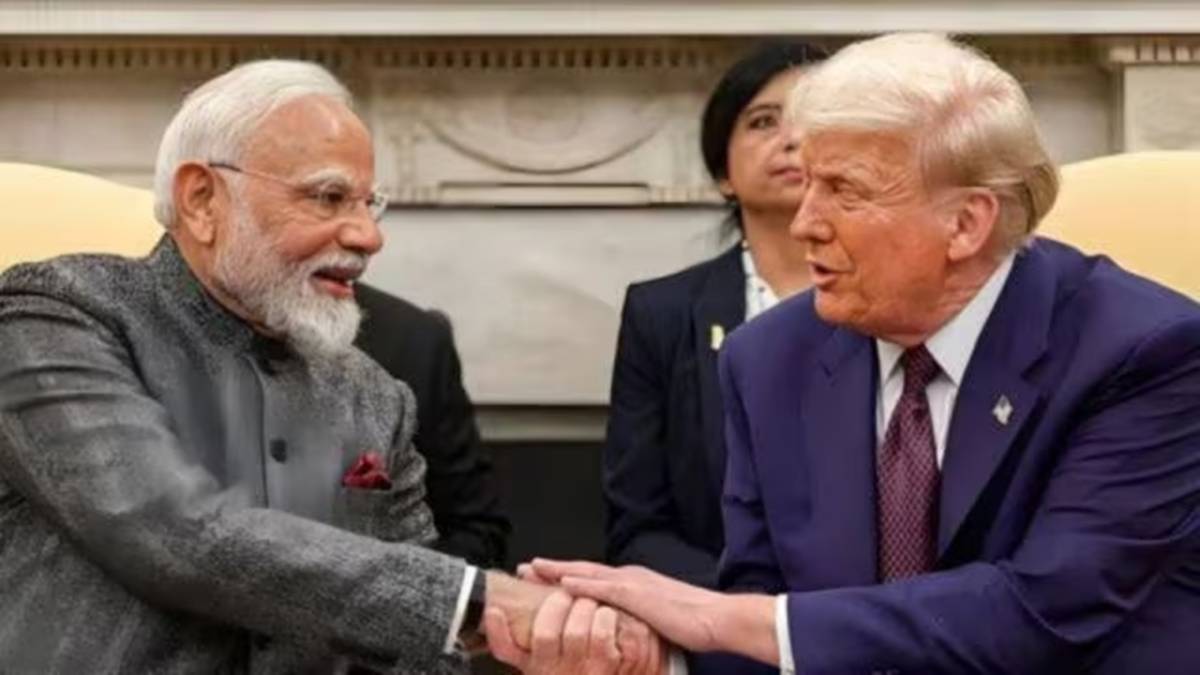
The recent announcement of a landmark trade deal between Prime Minister Narendra Modi and US President Donald Trump has sent shockwaves through global markets. Under the agreement, the US has agreed to lower its reciprocal tariffs on imports from India from the current 25 per cent to 18 per cent, effective immediately.
“The world order is changing, and its trajectory is increasingly tilting towards India. I have been saying this at various global platforms, and today we are seeing India benefit even amid trade tensions across many countries,” PM Modi reportedly told NDA leaders amid chants of chants of “Jai Modi,” “Vande Mataram,” and “Bharat Mata ki Jai”.
While the government has projected the development as a “win-win”, attention has shifted to a much bigger claim, that India has committed to buying more than $500 billion worth of American goods. The viral skepticism regarding the math was shared by investor Shankar Sharma, who claimed to be “early Amazon, Apple investor” on his X bio.
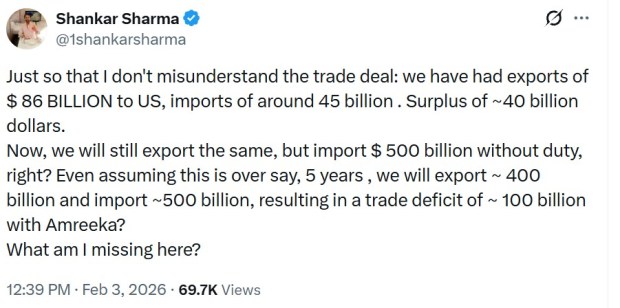
The post is being widely shared on the social media platform.
The “surplus” reality check
In 2024-25, India exported goods worth $86 Billion to the US, while allowing $45 Billion worth exports from the US to the country, tilting the surplus of $41 Billion in India’s favor.
It is this past trade surplus that is the basis of his logical question: If we keep exporting at current levels but commit to importing $500 billion worth of US goods, aren’t we just signing up for a massive $100 billion deficit?
What the Math is Missing: Target vs. Annual Commitment
It may be noted that the $500 billion figure is widely reported as a target for total bilateral trade (Exports + Imports) to be achieved by 2030, not a one-year import bill.
Textiles, gems & more: The sectors that will benefit
Under “Mission 500,” both India and the US aim to more than double their total trade from the current ~$191 billion to $500 billion over the next five years. If India increases its exports to $275 billion and imports to $225 billion by 2030, the $500 billion “deal” is achieved while maintaining a surplus.
India’s gems and jewellery industry is set to be one of the biggest beneficiaries of reduction in tariff. The US is India’s largest market for gems and jewellery, accounting for about 30% of industry sales, and the tariff rollback comes after nearly six months of uncertainty, shipment delays and a sharp fall in exports.
The textiles and apparel sector is also likely to greatly benefit from the reduced US tariffs.
On the other hand, American imports are likely to include petroleum, defence, electronics, pharmaceuticals, telecom products and aircraft. American agricultural products are also likely to gain access in India, news agency Reuters said quoting an official.