



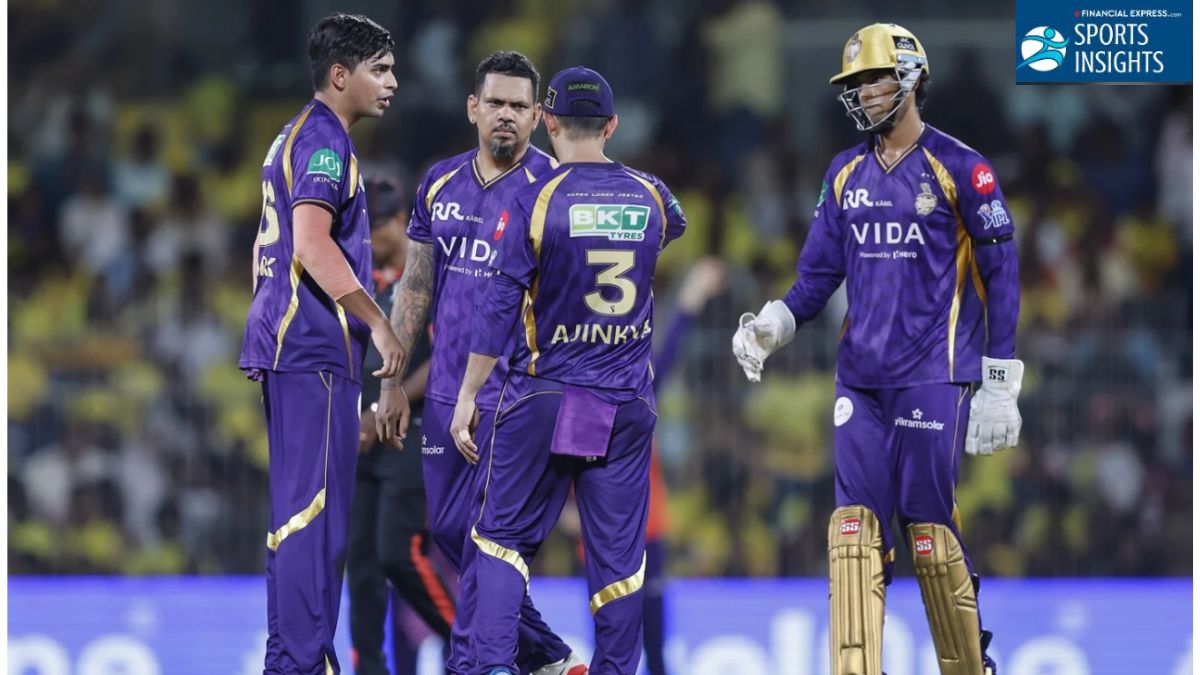
At half past ten on a humid April night, the Eden Gardens locker room smells of liniment and defeat. A cleaner mops the same tile twice, not because it is dirty, but because he does not know where else to look.
Outside, twenty thousand people have gone home. Inside, eleven men sit with their pads still on, as if removing them would make this real.
This is Kolkata Knight Riders in 2026. Not a bad team. Not an unlucky team. A team that has simply stopped understanding why it plays.
The Man Who Left
Shreyas Iyer is batting for Punjab Kings when you see it. That familiar shuffle, the backlift that starts late and finishes right, the way he finds gaps without seeming to look. He has made this runs before, in this same city, wearing purple.
Now he wears red and sits second on the points table. KKR sits last. The mathematics of regret is simple here.
The franchise did not want to pay him what he wanted. They kept Sunil Narine instead. They kept Andre Russell, who is no longer there either. These decisions made sense on a spreadsheet. They made sense in a boardroom with air conditioning and charts about “retention value” and “auction flexibility”.
They do not make sense when you watch Iyer shepherd a chase against SRH, or when you see the KKR middle order freeze like boys who have forgotten their lines.
Rahul Dravid once said that Indian cricket runs on relationships. The Australians have systems. The English have processes. Indians have trust, built over chai and net sessions and shared silences after losses.
KKR broke something when they let Iyer go. Not just a captain. A thread that connected 2024 to whatever came next.\
The Twenty-Five Crore Question
Cameron Green stands at mid-off and looks at the ground a lot. This is what they notice first, the television people and the old men in the member’s stand who have watched cricket since Dujon was behind the stumps. He looks at the ground like it might answer him.
Twenty-five crore rupees. That is what KKR paid. In Australian dollars it is less impressive, but in Indian cricket it is a statement. It says: this man will fix things. He will bowl in the powerplay. He will bat at four and hold the innings together.
He will be the new Russell, except Russell never looked at the ground. Russell looked at the bowler and dared him.
Green is not Russell. He is a good player having a bad time, which is different from being a bad player. But the money creates a lens. Every failure becomes heavy. Every dot ball in the middle overs, and there have been many, becomes a small tragedy.
Aaron Finch, who knows something about pressure, said Green looks like he is searching. That is the word. Searching. Not finding.
The truth is simpler. Green was bought to do a job that does not exist anymore because the people who created that job are injured or gone or both. He is a solution to a problem that changed while he was flying over from Perth.
The Boy Who Became a Hope
Angkrish Raghuvanshi is nineteen. He bats like he has not yet learned to be afraid. This is the only good news KKR have, and it is not small news. In a season of collapsed partnerships and run-outs that make you cover your eyes, Raghuvanshi has played one way. Forward. Always forward.
He made fifty against Sunrisers on a pitch where everyone else looked like they were batting in wet cement. But here is the cruelty of team sport. Raghuvanshi’s runs have come in defeats.
The kind where you make 180 and the other team chases it with three overs left. So his brilliance becomes footnote. A silver lining, which is just a way of saying the cloud is very large and very dark.
The Mystery That Is Not Mysterious Anymore
Varun Chakravarthy took the most wickets in the T20 World Cup. This was just few weeks ago. Now he bowls and batsmen seem to know what is coming. Not because they have decoded him. Because he is bowling like he does not believe in his own tricks.
R Ashwin, who understands spin the way fishermen understand tides, noticed the hand speed first. Chakravarthy’s fingers used to whip across the ball. Now they push. The difference is milliseconds, but cricket is a game of milliseconds. The carrom ball that used to skid and panic right-handers now sits up and says hit me.
Against Sunrisers he went for thirty-one in two overs. He is yet to take a wicket in this season and when a mystery spinner loses his mystery, he becomes a man throwing a ball slowly.
KKR have two of these men now. Narine still bowls tight, but tight is not enough when you need wickets and the pacemen are all in hospitals.
The Hospitals
Harshit Rana has a back that will not let him bowl this year. Akash Deep, the new signing, something went wrong in his side during a practice game.
Matheesha Pathirana, the eighteen-crore death bowler, pulled up in the nets before the first match. His hamstring made a sound, someone said, though these stories grow in the telling.
This is not bad luck. This is bad planning dressed as misfortune. You do not spend forty-three crore on two players when one of them has a body that breaks down regularly. You do not build a pace attack around three men and keep no reserve that you trust.
When the injuries came, KKR had to call up Navdeep Saini, who has not bowled well in first-class cricket for two years, and Saurabh Dubey, who is twenty-two and lacked significant IPL experience.
The bowling figures tell a story of desperation. Vaibhav Arora has taken 6 wickets at an economy of twelve. Kartik Tyagi, who once looked like he might be something, is going at ten and a half. These are not death overs figures. These are “please stop hitting me” figures.
And because they cannot defend anything, the batsmen press. Rinku Singh, who used to finish games with that flat bat swing through midwicket, now blocks and nudges and gets out anyway.
The Vice Captain’s Silence
Rinku Singh was kept for fourteen crore. The logic was sound. In 2023 he finished innings with a strike rate near one fifty. He hit five sixes in an over once, which is the kind of thing franchises remember when they open their wallets.
But something has shifted. You can see it in the way his weight goes back now, Finch said. Back and across, when it used to go forward and through. He is vice-captain this year, which means meetings and interviews and the pressure of being the local face when everything is falling.
The runs have not come. The intent has not come. Against CSK he made 6 off 12 in the middle overs when the asking rate was climbing past twelve.
The fans have noticed. On the forums they ask why KKR kept him instead of buying a foreign finisher, someone with cold eyes and no memory.
They forget that last year, before the World Cup, Rinku was that man. Form is temporary, the old saying goes. But temporary can last a whole season, and in the IPL a whole season is forever.
The Captain’s Dilemma
Ajinkya Rahane is 85 Test matches worth of calm. He has batted through collapses and waited through storms. When KKR made him captain after Iyer left, it felt like sense. Stability. A man who would not panic.
But cricket has changed. Rahane’s calm works in Test matches where you have five days and the draw is always possible. In T20, especially when your bowling cannot defend 220, calm looks like inertia.
He has made runs himself, steady fifties that keep the scoreboard moving. But the team keeps losing, and after each loss he says the same things. Partnerships. Execution. We will learn.
Against Chennai they tried everything. Opened with Narine after saying they would not. Dropped Rahane down the order after saying he would anchor.
The Impact Player rule, which is already a nonsense, became a symbol of their confusion. Then Narine made 24 and Chakravarthy watched from the dugout while Noor Ahmad took three for twenty-one.
This is what fans mean when they say musical chairs. Not just the changes. The sense that no one knows the music will stop until it does.
The What Ifs
What if they had kept Iyer. What if Pathirana’s hamstring had held. What if Mustafizur Rahman had been allowed to play, his cutters on the Eden Gardens pitch, instead of being sent home because of politics that have nothing to do with cricket. What if Rinku had said no to the vice captaincy and yes to just batting.
These are not useful thoughts for the team. They are useful for understanding. The 2026 KKR story is not one of simple failure. It is a story of compounding, each small crack widening because there was nothing to hold it together.
The auction strategy assumed health. The retention strategy assumed loyalty that had already been tested. The batting strategy assumed Green would become Russell and Rinku would remain Rinku and someone would tell them what their jobs were.
None of this happened. And so you have a team that cannot defend, cannot finish, cannot settle on an opening pair, and sits in the locker room while a cleaner mops the floor twice.
The Road Back
There is a break coming. Seven days, which is long in this tournament. Pathirana might return. Robin Uthappa, who knows this ground and these pressures, has suggested opening with Narine permanently, putting Raghuvanshi at three, letting Rahane be the anchor at four. Simple things. Clear things.
But simple is hard when you have lost four in a row. The mind starts to expect defeat. The fielder at deep midwicket stands a yard too fine because he has seen so many balls go there. The bowler runs in expecting the boundary. This is what losing does. It becomes habit.
KKR can still make the playoffs. Mathematically. Two wins, then three, then momentum, then who knows. But they will need to find something that has been missing since the first ball of the season. Not talent. They have that. Not history. They have three trophies.
They will need to find a reason to look up from the ground.