



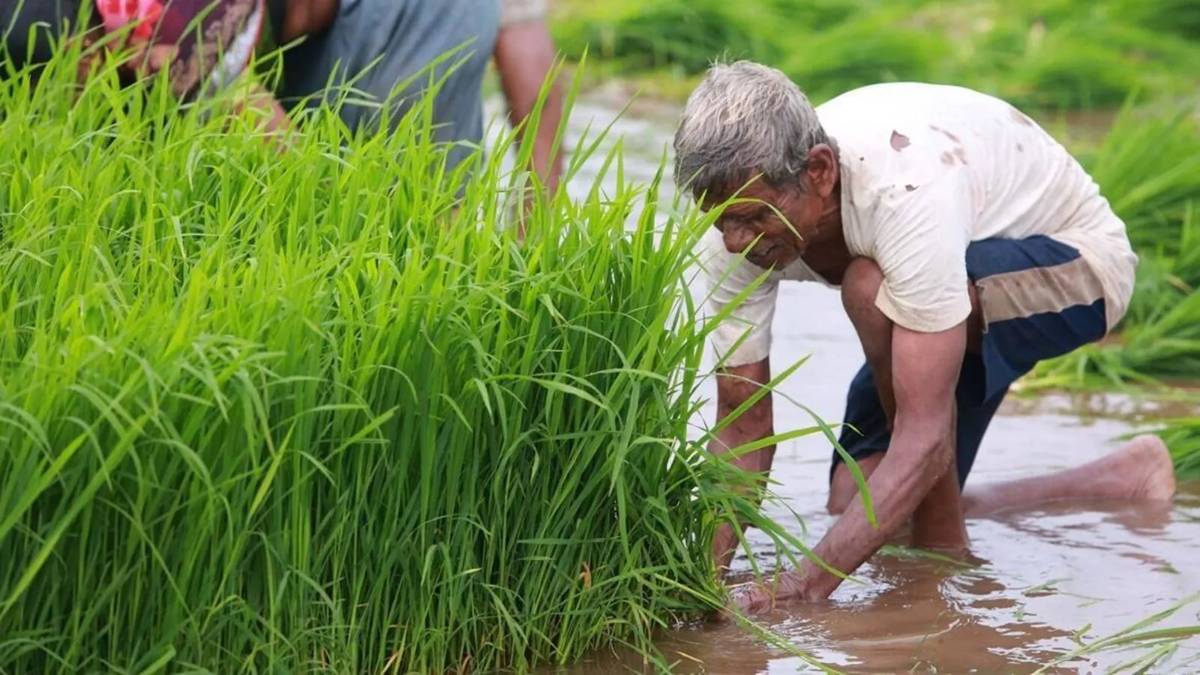
Sowing of kharif crops, including rice, pulses, oilseeds and cotton, was down 16% year-on-year at 53.1 million hectares (mha) as of July 10, agriculture ministry data showed on Thursday, reflecting the impact of a delayed and uneven monsoon.
The sown area was nearly 10 million hectares lower than a year ago, accounting for just 48% of the normal kharif acreage of 110 mha during the period.
Agriculture Minister Shivraj Singh Chouhan said contingency plans have been prepared for all rainfall-deficient districts.
Cumulative rainfall during June 1-July 16 stood at 231.3 mm, 23.9% below the long-period average (LPA), according to the India Meteorological Department. While the monsoon deficit in June was as high as 40%, rainfall in July so far has been 4% above the benchmark.
Heavy Rainfall Deficits
Region-wise, northwest India (-22%), east and northeast (-36%), central India (-14%) and the south peninsula (-27%) have received deficient rainfall so far this monsoon season.
Chouhan also said there is an urgent need to boost productivity in pulses and oilseeds, as the country relies heavily on imports to meet domestic demand. “If countries without access to genetically modified seeds can get better yields in pulses, why can’t India?” he said at the 98th ICAR Foundation Day.
Highlighting the wide productivity gap across crops, Chouhan said, “An acre under maize can produce over 100 quintals, against roughly 30-35 quintals for rice and just about five quintals for pulses such as gram or moong.”
Resolving the Yield Gap
He said farmers with access to irrigation in Madhya Pradesh, Bihar, Odisha and other eastern states tend to shift towards rice and wheat, while the country continues to import substantial quantities of pulses and edible oils to meet domestic demand.
India imports around 20% of its annual pulse requirement and 58% of its edible oil consumption. In volume terms, the country imports 6-7 million tonnes (MT) of pulses and 15-16 MT of edible oils every year.
Chouhan also said that while rice and wheat output has risen sharply, the focus must now shift to quality. He released 43 improved crop varieties and 17 advanced agricultural technologies, including Basmati and climate-resilient rice varieties tolerant to saline and alkaline soils, export-oriented mango production technology, the country’s first indigenous African Swine Fever vaccine, a digital swine disease atlas, and an affordable cassava harvester for smallholders.