



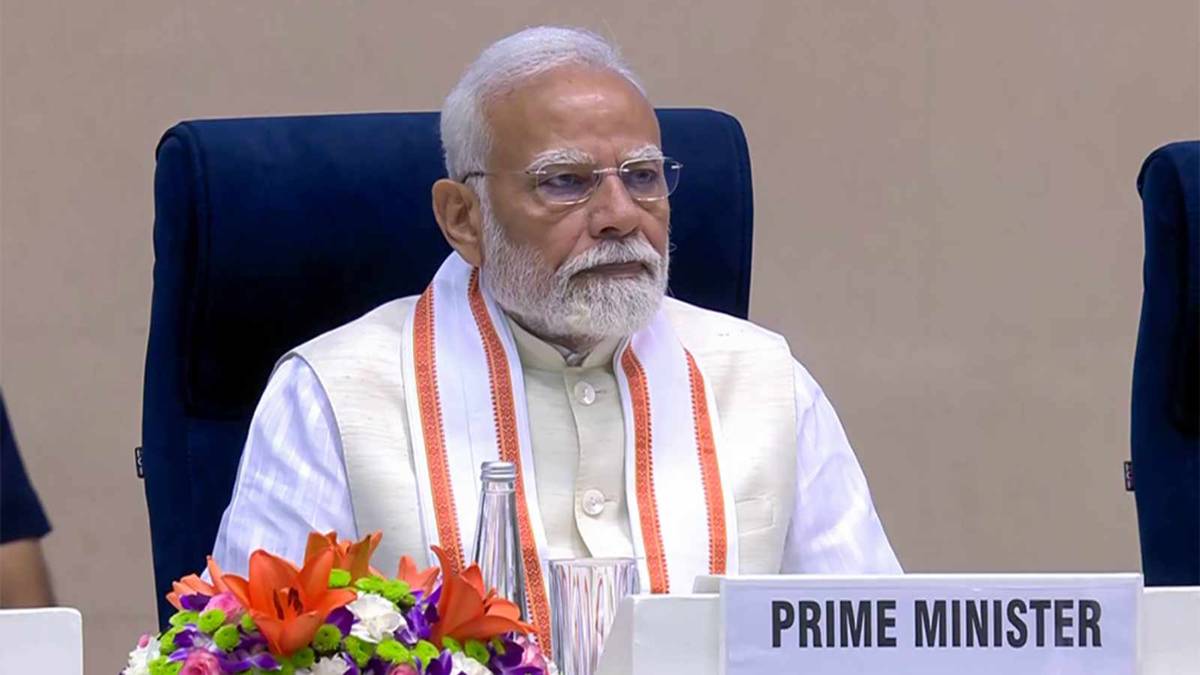
Prime Minister Narendra Modi unwittingly is a believer in Robert Frost: he took the road less travelled and that perhaps made all the difference.
India’s prime ministerial leadership has bookended two distinct eras through Jawaharlal Nehru and Narendra Modi—each defined by its own constraints, choices, and ambitions. Nehru presided over a fragile, newly sovereign state; Modi has govern-ed a vast, digitally networked, hyper-competitive democracy navigating global shocks. The contrasts in their leadership styles reveal how the demands of India’s governance have scaled—and why Modi’s tenure has been more impactful across state capacity, inclusion, infrastructure, diplomacy, and delivery.
Nehru’s governing philosophy centred on top-down institution-building and a state-directed economy. It was appropriate for a nation stitching itself together after Partition, yet it also enshrined centralised control.
Modi’s approach flips that logic: governance as a mass movement powered by dignity and delivery: Sabka Saath, Sabka Vikas, Sabka Vishwas, Sabka Prayas. This bottom-up mobilisation—bank accounts, direct benefit transfer, affordable gas connections, housing, toilets, rapid road-building, and digitised welfare—makes state benefits visible at the household level, scaling trust alongside outcomes.
Scale itself is the signature difference. Nehru took office when India’s population was near 340 million and party competition minimal; Modi took office with a population crossing 1.31 billion and a party system that had mush-roomed to thousands of registered entities. India’s first general election saw roughly 170 million voters; the 2014 electorate exceeded 830 million, expanding further by 2024.
Modi’s repeated national mandates have come in the teeth of this intense fragmentation and 24×7 digital scrutiny, a media climate far removed from Nehru’s institution-led, print-era politics. Governing amid continuous online judgement imposes a higher tempo of accountability and narrative competition. That Modi has remained electorally central across three Lok Sabha cycles—and relevant across three generations in many families—speaks of an unusual political durability in a networked age.
Economically, Nehru’s model nurtured foundational industries and scientific institutions but settled into what later became known as the “Hindu rate of growth” near 3–4%. Modi’s India has operated as a global growth engine, with average growth of 6.5–7% in a decade. The economic upgrade is mirrored in physical connectivity: national highways expanded by over 54,000 km between 2014 and 2024, turning logistics from a bottleneck into a competitive lever. The combina-tion of infrastructure scale-out and digital rails—UPI payments, Aadhaar-enabled delivery, and portable welfare—has compressed time between policy announce-ment and citizen impact, reducing leakage and bureaucracy that hampered earlier decades.
While institutionally, Nehru laid pillars like the Indian Institutes of Technology (IIT) and the All India Institute of Medical Sciences (AIIMS) that seeded India’s knowledge economy, Modi’s decade has emphasised mass expansion: IITs grew to 23, IIMs to 21, and AIIMS to 23, scaling elite excellence while broadening access. This twin-track approach—prestige plus prolifera-tion—reflects a politics that treats aspiration as policy currency.
Socially, cabinet composition under Modi has foregrounded representation of OBC, SC, and ST communities at unprecedented levels, and women’s represent-ation has moved from low single digits in the 1950s to a legislative path for one-third reservation through the Nari Shakti Vandan Adhiniyam.
Foreign policy presents a sharp stylistic and strategic divergence. Nehru’s non-alignment was principled but often isolating in a bipolar world. Modi’s multi-align-ment is transactional, layered, and overtly interest-based: engaging the US, Russia, Europe, the Gulf, and the Global South simultaneo-usly, converting India’s market, technology demand, and diaspora influence into bargaining power.
Security and statecraft have also evolved. Modi’s doctrine has paired deterrence with calibrated responses and proactive border management, avoiding full-scale conventional war amid a volatile neighbourhood. This does not imply the absence of risk; it indicates a steadying of the security environment while domestic modernisation proceeds.
The developmental arc from scarcity to scale is starkest in food security. The early post-independ-ence period’s “ship-to-mouth” dependence under PL-480 has given way to record procurement, digital PDS distribution, nutrition missions like POSHAN, and the PM Garib Kalyan Anna Yojana. This is not merely welfare; it is
macro-stability.
On environmental and civilisational stewardship, Nehru’s period predated modern conserva-tion regimes. Modi’s era has over-seen the expansion of protected areas, Ramsar sites, and the landmark cheetah reintroduction. Parallel to ecological scaling has been a deliberate civilisational re-centering—temple restoration, heritage projects, and cultural diplomacy—reframing identity as an asset in global engagement and national confidence.
Critically, the metrics of human development have shifted. Life expectancy has nearly doubled since the 1950s and fertility has fallen below replacement. These demographic transitions demand a state that can scale services quickly while deepening quality—precisely the dual challenge Modi’s governance model seeks to meet through digital rails and institutional expansion.
Even by the yardstick of time served, Modi’s tenure marks a hinge point: surpassing Indira Gandhi’s longest consecutive run, closing in on Nehru’s continuous service benchmark, and already achieving the country’s longest cumulative span as an elected head across state and national offices. The broader significance lies not in the count of days but in their compounded effect: an India that is larger, faster, more connect-ed, more contested—and yet more governable than many assumed.
Nehru’s legacy is foundational: sovereignty, parliamentary culture, scientific temper, and institutional seeds. Modi’s distinction is in scaling: converting foundations into systems that touch hundreds of millions of lives daily, in real time, with measurable outcomes—while repositioning India as a rule-shaping power.
Different eras demanded different leadership. The first built the frame; the second tightened the bolts, extended the highways, digitised the wiring, and turned the lights outward to the world.
By the tests of inclusion, delivery, infrastructure, and leverage, Modi has been the more impactful prime minister and a global statesman for a more complex age. Which is why the age of Modi’s leadership will extend way after he demits office.
For millions of Indians, Narendra Modi has been the enabler that India so desperately needs.
(The author is the founder and managing partner of consultancy firm Counselage India)
Disclaimer: The views expressed are the author’s own and do not reflect the official policy or position of Financial Express.