



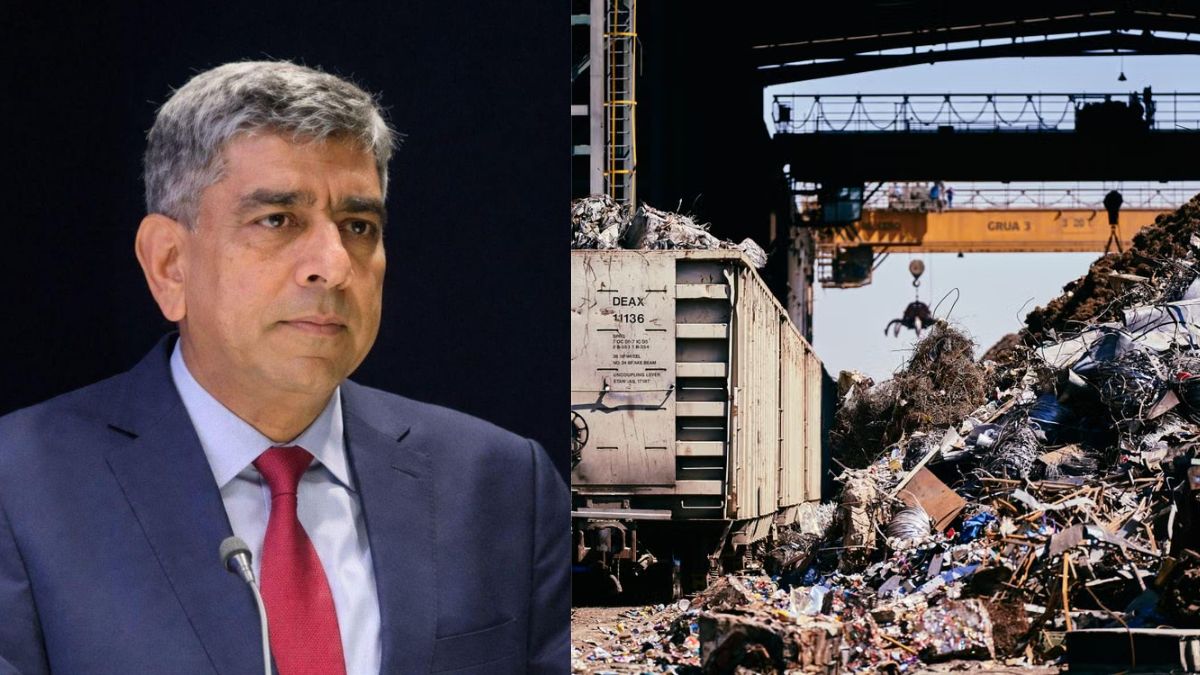
By- Yogesh Bedi
As India’s steel industry scales up to meet the demands of a growing economy, it faces a parallel imperative: slashing its carbon footprint. With crude steel production already exceeding 160 million tons (Mnt) annually and consumption continuing to rise, the sector remains one of the country’s largest industrial emitters. While most decarbonization pathways are some distance away in terms of technical maturity and economic viability, one of the most powerful and immediately available levers lies right in front of us: ferrous scrap.
Scrap Recycling is a technically mature, low capital-intensive route achievable through better scrap quality, preheating, and charge optimization without requiring major plant retrofits.
Scrap-based steelmaking bypasses the conventional carbon-intensive iron ore reduction stage of the blast furnace-basic oxygen furnace (BF-BOF) route. Every ton of scrap recycled in electric arc furnaces (EAFs) avoids approximately 1.5 tons of CO₂ emissions compared to the BF-BOF route. Additionally, in the BF-BOF operations, which still dominate much of India’s steel production, increasing scrap charge from current levels of around 10% to 25% can reduce emissions by approximately 11%.
In recent years, India’s ferrous scrap consumption in steelmaking has shown encouraging growth, rising from 35 to 40 Mnt between 2024 and 2025. With increasing urbanization, infrastructure redevelopment, and the gradual formalization of the recycling ecosystem, domestic scrap generation is also steadily increasing. However, scrap accounts for only about 23% of crude steel production—well below the global average of 32% and far lower than the 60-70% seen in mature economies. Hence there is enormous headroom to accelerate this transition.
Demand signals from steel users can act as powerful accelerators. When infrastructure developers, automakers, real estate firms, and government procurement agencies begin specifying low-carbon or recycled steel, they create “bankable demand”. Clear and consistent demand-side momentum can de-risk investments across the value chain, much like corporate offtake agreements propelled renewable energy adoption.
Projections suggest that by 2050, domestic scrap demand could exceed 200 Mnt, potentially leaving a shortfall of 40-50 Mnt. Globally, many countries are instituting protectionist measures to retain their own scrap, restricting potential imports into India. Hence, bridging the domestic gap requires treating scrap as a strategic national resource.
India’s Green Steel Taxonomy, introduced by the Ministry of Steel, provides a strong foundation by classifying low-emission steel based on clear CO₂ thresholds. Complementary measures—such as stronger enforcement of vehicle and white goods scrappage policies, mandatory deconstruction norms for buildings, and incentives for formal recycling—can help bridge the impending demand-supply gap. Further, the Government Policies need to be inclusive and encompass the Reverse Logistics starting with the Kabadiwala/ Peddlar to the end-consumer.
There is need to professionalize the scrap ecosystem as the current supply chains are largely informal, fragmented, and low on mechanization.
The India Green Steel Coalition (IGSC)—a joint initiative of WWF-India and the Confederation of Indian Industry (CII)—is actively supporting this ecosystem. Through evidence-based whitepapers, policy advocacy, and demand aggregation platforms, IGSC is helping align ambitions with actionable steps to build scalable demand for green steel.
India stands at a unique inflection point. Scrap is not just a supplementary input; it is a strategic enabler of our green steel ambitions. What is needed now is collective intent from policymakers, industry leaders, and end-users alike to embrace scrap as a cornerstone of sustainable growth.
The time to act is now.
The author is Chairman, Scrap Action Group, India Green Steel Coalition (IGSC).
Disclaimer: The views expressed are the author’s own and do not reflect the official policy or position of Financial Express.