



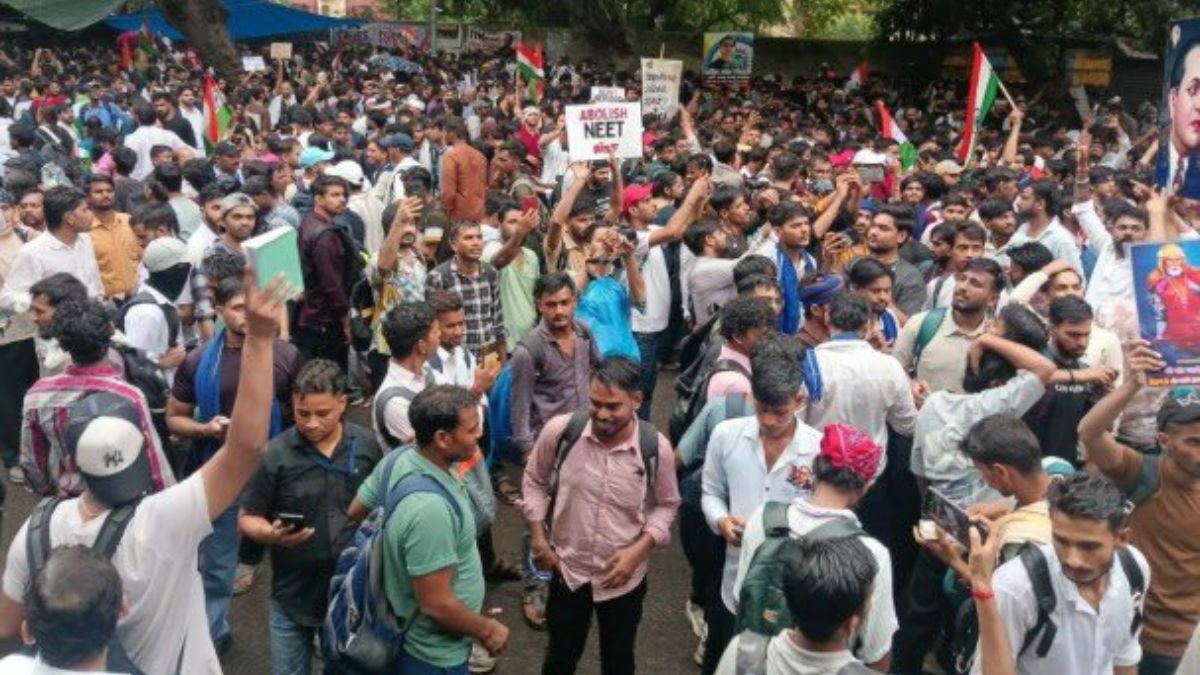
It seems a fuse has been lit. A “Gen-Z” movement was anticipated in India after youth-led protests in Bangladesh last year, Nepal more recently, and in Sri Lanka back in 2022. The dust is yet to settle at Jantar Mantar. But this week’s march to Parliament, led by the Cockroach Janta Party (CJP), drew India’s Gen-Z although it was not limited to them.
It is different from the other upsurges in South Asia in that they were singularly focused on unseating regimes. The CJP’s raison d’être is something much less radical. It started as a satirical online movement that tapped into public anger over a broken education system, with student supporters from across India enthusiastically joining a chorus of demand for the resignation of Education Minister Dharmendra Pradhan. It has merely sought accountability while Gen-Z demonstrations elsewhere reacted against elite privilege and graft.
Yet, a core, common concern has festered in India just as much — unemployment and bleak job prospects, which are directly linked to the education-related anxiety of India’s youths. Employed youths too have to contend with concerns like inequality, as voiced in Noida earlier this year by industrial workers and youths seeking higher wages and improved labour conditions.
One reason Monday’s march has snowballed is the state’s response. The heavy-handed police action, including caning and tear-gassing protesters, many of them in their teens, has attracted more sympathisers and handed the Opposition a political opening it was quick to seize. The images of Rahul Gandhi, suffering a nosebleed and being dragged away outside the Prime Minister’s residence, and defiantly invoking democracy as he lay on the ground, inevitably added to the government’s discomfort and gave the protests a wider political resonance.
Whether the Opposition can turn that opening to its advantage is another matter. It has struggled to build sustained political momentum around public discontent and has yet to establish the credibility needed to put the government seriously on the defensive. Indeed, too overt a political embrace could allow what began as a spontaneous youth protest to be dismissed as partisan mobilisation. The significance of the moment, therefore, lies less in the opportunity it offers the Opposition than in the warning it carries for the government: grievances over education, examinations, and employment can acquire a political force of their own when met with indifference or coercion.
Irrespective of the political support it attracts, the movement carries echoes of previous popular protests against the current regime. The year-long farmers’ agitation at the doorstep of Delhi compelled the Narendra Modi government to repeal three agricultural laws. Prior to that, the historic Shaheen Bagh protests, led by Muslim women, opposed the controversial Citizenship (Amendment) Act, 2019, for months until the Covid-19 pandemic broke out.
A research of resistance movements between 1900 and 2006 by Harvard professor Erica Chenoweth has shown that non-violent civil resistance campaigns are more than twice as likely to achieve their goals as compared to armed uprisings. India, with its long history of youth-led protests, has had a thriving culture of civil disobedience. In the past 12 years, the BJP government has repeatedly tried to crush any civil opposition and encouraged its supporters to perceive dissenters as “anti-national”. That was reflected in the brutal police crackdowns on university campuses such as JNU and Jamia Millia Islamia. This not only does a disservice to democracy but also erodes public faith in the state as a guardian of citizens.
Unemployment, too, has been a touchy topic for the Modi government. While it has batted for self-employment and atmanirbharta, such a push also couches formal sector growth and the lack of quality jobs. No doubt, policy has taken initiatives to bridge skilling gaps to ensure India’s youths find smoother pathways between education and employment. However, unless it urgently plugs technical loopholes to prevent paper leaks for a gruelling exam like NEET, millions will suspect its sincerity. Worse, it will further fuel criticism of the government tending to promote pseudoscience at the cost of scientific temper.
For the CJP, the lack of a concrete ideology within its ranks will be a handicap if it tries to expand and take up other causes that civil society or political parties have failed to highlight. But for now, theirs is not a political fight. The government now faces their anger; it should not respond with condescension.