



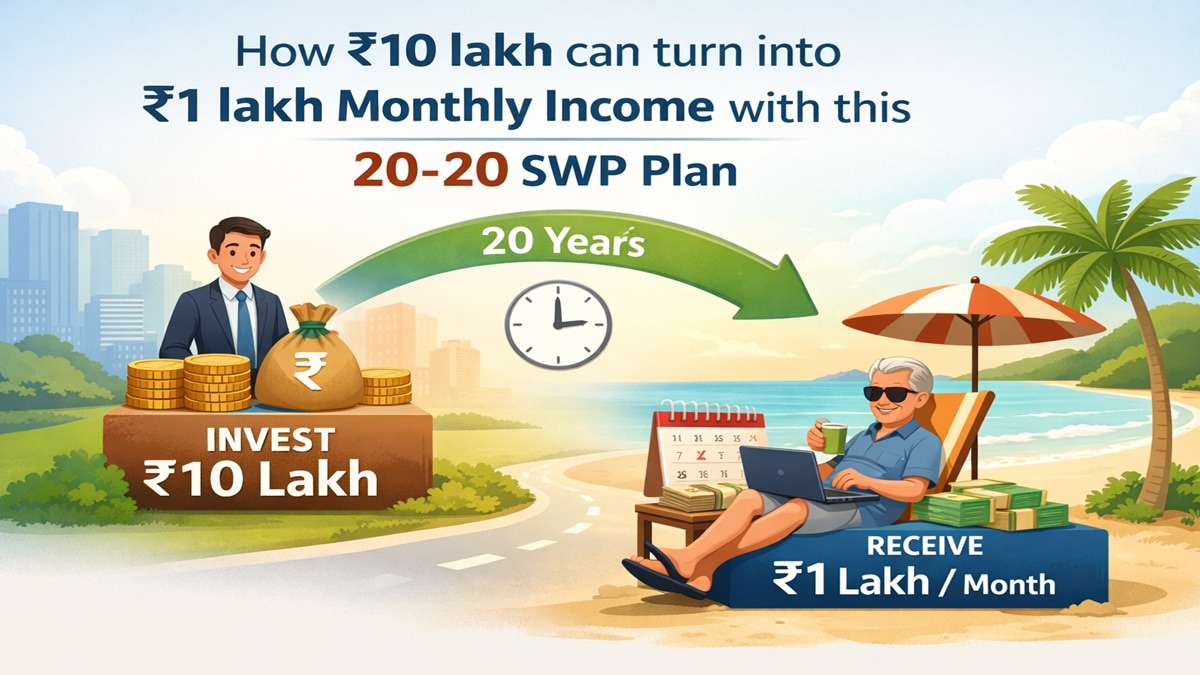
Can you invest once, build wealth for 20 years, and then withdraw Rs 1 lakh every month for the next 20 years? That’s the idea behind this simple ’20-20 Plan’ — 20 years of wealth creation and 20 years of steady income.
For young Indians who want financial independence before the traditional retirement age, this strategy combines the power of equity investing with the stability of systematic withdrawals. Let’s break it down in simple terms.
Step 1: First 20 years – build a big corpus
The first half of the 20-20 plan focuses on wealth creation.
If you invest Rs 10 lakh as a lump sum in equity mutual funds and assume a long-term average return of 14% per annum, here’s what the numbers look like:
One-time investment: Rs 10,00,000
Investment period: 20 years
Expected return: 14% annually
Value after 20 years: Rs 1,37,43,490
That’s how compounding works — your money earns returns, and those returns earn further returns over time.
Why assume an annual return 14% on lump sum investment?
Over the past 15–20 years, several equity mutual fund categories like small-cap, mid-cap, flexi-cap and focused funds have delivered long-term CAGR in the range of 14% or even higher. While returns fluctuate year to year, equity as an asset class has historically rewarded patient investors.
But remember — more on risk and caution later.
Step 2: Next 20 years – turn corpus into monthly income
Now comes the second half of the 20-20 plan.
After 20 years, your Rs 10 lakh has grown to about Rs 1.37 crore. Instead of withdrawing the entire amount at once, you shift to a Systematic Withdrawal Plan (SWP).
Here’s how it works:
Initial corpus: Rs 1,37,43,490
Investment period (SWP phase): 20 years
Assumed return: 6.5% annually
Monthly withdrawal: Rs 1 lakh
Total withdrawn in 20 years: Rs 2.40 crore
Balance left after 20 years: Rs 9,44,601
Total return earned during SWP phase: Rs 1,12,01,111
In simple words, you withdraw Rs 1 lakh every month for 20 years — just like receiving a pension — and still have some money left at the end.
What is SWP and why is it powerful?
A Systematic Withdrawal Plan (SWP) allows you to withdraw a fixed amount from your mutual fund investment at regular intervals — usually monthly.
Think of it as creating your own pension.
You decide the amount.
You decide the date.
The money is credited directly to your bank account.
The remaining corpus stays invested and continues earning returns.
Unlike traditional pension plans where returns are fixed and often lower, SWP keeps your money market-linked, giving it the chance to grow even during the withdrawal phase.
Why keep SWP return at 6.5%?
In the accumulation phase (first 20 years), we assumed 14% because the investment was fully into equity — suitable for long-term growth.
But during the withdrawal phase, the goal changes. Now, the priority is stability and capital protection, not aggressive growth. That’s why we assume a conservative return of 6.5%, which could come from either hybrid funds or conservative allocation funds or debt-oriented funds.
A lower assumed return makes the plan more realistic and reduces the risk of the corpus getting exhausted early.
Why SIP + SWP is a smart combination
Even though this example used a lump sum investment, many investors prefer building the corpus through SIP (Systematic Investment Plan) over 15–20 years.
Benefits of SIP first, SWP later
-Disciplined investing – You invest every month, regardless of market mood.
-Rupee cost averaging – You buy more units when markets are low and fewer when high.
-Power of compounding – Long-term investing multiplies wealth.
-Flexible income later – SWP converts your corpus into steady monthly cash flow.
In short, SIP builds your pension. SWP delivers your pension.
How is this different from traditional pension plans?
With SWP, you remain in control of your money. You can increase, decrease, pause or stop withdrawals anytime.
Important: A word of caution
While many equity funds have delivered 14% or more over long periods, past returns do not guarantee future returns.
Markets can go through long periods of volatility, economic slowdowns and global uncertainties
Returns can be lower than expected. That’s why diversification is important. Asset allocation should change as you age. You may need professional advice before committing large sums.
The 20-20 plan is a model to understand the concept — actual results may vary.
Can this help you retire early?
Yes — if you start early and stay disciplined.
A 30-year-old investing wisely today can potentially create enough wealth to generate regular income well before 55 or 60. Financial independence is not about age — it’s about planning.
The 20-20 plan shows how 20 years of patience, followed by 20 years of structured income can turn Rs 10 lakh into a self-created pension machine. The earlier you start, the easier the journey becomes.
Disclaimer: The above content is for informational purposes only. Mutual Fund investments are subject to market risks. Please consult your financial advisor before investing.