



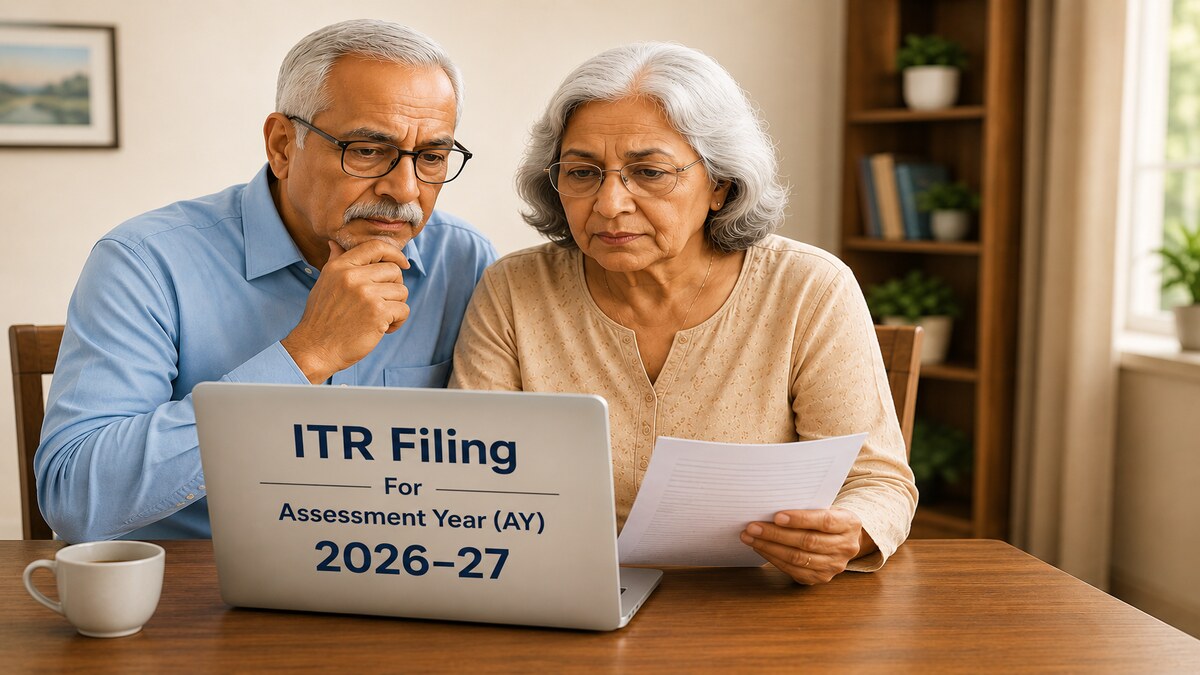
If you’re a senior citizen getting ready to file your Income Tax Return (ITR) for AY 2026-27, one question may arise in your mind: Which ITR form should I use between ITR-1, ITR-2, ITR-3, and ITR-4?
With the Income Tax Return (ITR) filing season for Assessment Year (AY) 2026–27 underway, senior citizens should note that the selection of the correct ITR form does not depend on age, but on the nature and source of income earned during the financial year.
Choosing an incorrect form may render the return defective and could potentially lead to delays, notices, or compliance-related concerns, so before you start filing your return, it’s worth taking a few minutes to identify the correct ITR form.
Which ITR form applies to senior citizens?
A brief overview of the applicability of different types of ITR forms would be as follows:
| ITR Form | Applicable To | Not Applicable To |
| ITR-1 (Sahaj) | Resident individuals having a total income up to Rs. 50 lakhs from salary/pension, two house properties, and other sources such as interest income, along with agricultural income up to Rs. 5,000 and long-term capital gains up to Rs. 1.25 lakh from listed equity shares or equity-oriented mutual funds | Non-residents, individuals with income exceeding Rs. 50 lakh, business or professional income, foreign assets/income, carried forward capital losses, company directorships, investment in unlisted equity shares, ESOP taxation, or income taxable at special rates |
| ITR-2 | Individuals and HUFs, including NRIs and RNORs, having income from salary/pension, capital gains, multiple house properties, foreign assets/income, agricultural income exceeding Rs. 5,000, unlisted shares, ESOPs, or company directorships | Individuals or HUFs having income from business or profession |
| ITR-3 | Individuals and HUFs earning income from proprietary business or profession, including partners in partnership firms (other than LLPs), F&O trading, or holding unlisted shares, along with income from salary, house property, or capital gains | Companies, partnership firms, LLPs, and charitable trusts |
| ITR-4 (Sugam) | Resident individuals, HUFs, and firms (excluding LLPs) opting for the presumptive taxation scheme having a total income up to Rs. 50 lakhs, including salary, one house property, and eligible long-term capital gains up to Rs. 1.25 lakhs | Taxpayers are required to maintain books of account, and persons are not eligible to opt for presumptive taxation |
What are the most common mistakes senior citizens make while selecting between ITR-1, ITR-2, ITR-3 and ITR-4?
Assuming ITR-1 is Applicable in All Cases Merely Because Income is Pension-Based – CA CA (Dr.) Suresh Surana says many senior citizens presume that ITR-1 (Sahaj) would automatically apply in their case.
However, ITR-1 is available only where the taxpayer satisfies prescribed conditions and in cases where the senior citizen has capital gains, more than two house properties, foreign assets, agricultural income beyond the prescribed limit, or certain exempt income disclosures, ITR-1 may not be permissible, and ITR-2 or other ITRs may become applicable.
Incorrectly Filing ITR-1 Despite Having Capital Gains from Mutual Funds or Shares – A common mistake among senior citizens is ignoring small capital gains arising from redemption of mutual funds, sale of listed shares, or Systematic Withdrawal Plans (SWPs). Even nominal capital gains may render ITR-1 inapplicable (except for LTCG u/s 112A up to Rs. 1.25 Lakhs). Since many retirees invest in debt funds, equity mutual funds, or listed securities for post-retirement income, overlooking this aspect often results in incorrect return selection.
Confusion Between Pension Income and Business/Professional Income – Certain senior citizens continue consultancy, freelancing, directorship, commission-based assignments, or professional practice after retirement.
“In such cases, the income may qualify as business or professional income, making ITR-3 applicable. Where presumptive taxation provisions are opted for (subject to eligibility conditions), ITR-4 may instead apply. Many mistakenly continue filing ITR-1 or ITR-2 despite earning professional receipts, which may lead to defective return notices,” said CA (Dr.) Suresh Surana.
Ignoring Foreign Income or Foreign Asset Reporting Requirements – Senior citizens receiving overseas pension, holding foreign bank accounts, inheriting overseas investments, or being authorised signatories in foreign accounts often incorrectly file ITR-1. Presence of foreign assets or foreign income generally requires ITR-2 or ITR-3, depending on the nature of income, along with additional disclosure requirements under Schedule FA.
Relying Solely on Prefilled Data or Prior-Year ITR Forms – Several senior citizens simply continue using the same ITR form as filed in earlier years without reassessing changes in their income profile. A new investment redemption, sale of property, consultancy assignment, or foreign remittance in the current year may change the applicable form. Therefore, form selection should be reviewed each year afresh rather than relying solely on prefilled data or historical filings.
What red flags in Form 26AS, AIS, or TIS should retirees check before filing?
Retirees should carefully review their Form 26AS, Annual Information Statement (AIS), and Taxpayer Information Summary (TIS) before filing their Income-tax Return, as discrepancies in these statements may trigger notices or lead to incorrect tax reporting.
“Key red flags include a mismatch in pension income, non-reflection or under-reporting of interest income from bank deposits, post office schemes or senior citizen savings schemes, dividend income not considered, incorrect reporting of capital gains arising from redemption of mutual funds or sale of securities, and TDS entries not appearing or appearing incorrectly,” according to Surana.
Retirees should also verify whether high-value financial transactions, such as the purchase or sale of property, substantial cash deposits, or investments, are accurately reflected in AIS. Further, instances where income reflected in AIS/TIS does not match bank statements,
Form 16/16A, or actual receipts, should be carefully reconciled. Since AIS may contain both reported and derived information, taxpayers should not rely on it blindly and must cross-check all disclosures to ensure completeness and accuracy before filing the return.
ITR forms for senior citizens, Which ITR form to file, ITR-1 vs ITR-2 vs ITR-3 vs ITR-4, Senior citizen ITR filing AY 2026-27, Income tax return for senior citizens, ITR filing for retirees, Correct ITR form selection, AY 2026-27 ITR forms, Income tax return filing 2026, ITR filing guide for senior citizens, Which ITR form is applicable for senior citizens, ITR-1 or ITR-2 for pensioners,
Disclaimer: This article is for informational purposes only and does not constitute professional tax advice. Tax laws and regimes are subject to frequent changes by the government. Readers should verify details with official Income Tax Department notifications or consult a Chartered Accountant before making any financial decisions.
Every financial journey has a turning point. What’s yours?
Financial Express is launching a new series highlighting real experiences with money, investments, and the taxman. Did a sudden tax rule catch you off guard? Did a piece of financial advice change your life? Your story could provide invaluable, practical lessons for thousands of fellow taxpayers. Share your experience with us. We respect your privacy: no stories will be featured without a direct conversation and your full consent. Thank you.