



The debate over the 8th Pay Commission has quickly narrowed down to one critical aspect — the fitment factor. There is a sharp divide emerging between employee unions and market estimates about how much salaries of over 50 lakh central government employees and over 65 lakh pensioners may rise.
While employee representatives are pushing for a fitment factor as high as 3.83, brokerage estimates suggest a far more conservative range of 1.8 to 2.46, translating into a wide variation in expected salary hikes — from about 13% to over 34%.
Unions vs experts: A wide gap in expectations
At the aggressive end, the National Council–JCM (NC-JCM), the apex consultative body of central government employees, has in its memorandum to the 8th Pay Commission has demanded a fitment factor of 3.83, along with a minimum pay of Rs 69,000. This demand is based on a revised 5-member family consumption model, a shift from the earlier 3-unit norm, significantly raising the wage calculation base.
The proposed 3.83 fitment factor has been derived by factoring in:
A substantially higher cost of living index compared to 2015–16 levels used by the 7th Pay Commission
The need to restore real wage erosion due to sustained inflation over the past decade
A demand for a more realistic multiplication factor over the existing basic pay, rather than incremental adjustments
The body has further argued that a higher fitment factor is essential to maintain parity with public sector wages and private sector benchmarks, as well as to ensure adequate post-retirement benefits since pensions are directly linked to basic pay.
Other employee bodies have taken a relatively moderate stance. For instance, postal employees’ body FNPO has proposed a fitment factor in the range of 3.0 to 3.25, with minimum pay pegged around Rs 54,000. Across unions, a 3.0+ fitment factor has emerged as the common expectation, largely driven by inflation concerns and rising living costs.
In contrast, brokerage firms are projecting much lower outcomes.
-Kotak Institutional Equities expects a fitment factor of around 1.8, implying a 13% salary hike
-Ambit Capital sees a broader range, with a base case of 1.82 (~14% hike) and an upper range of 2.15–2.46, translating into a 30–34% increase
This creates a clear negotiation band — 1.8 vs 3.83 — which will ultimately determine the salary structure under the new pay regime.
What different fitment factors mean for salaries
The fitment factor is used to revise basic pay under the pay matrix. Even small changes in this multiplier can significantly alter take-home salaries.
For example:
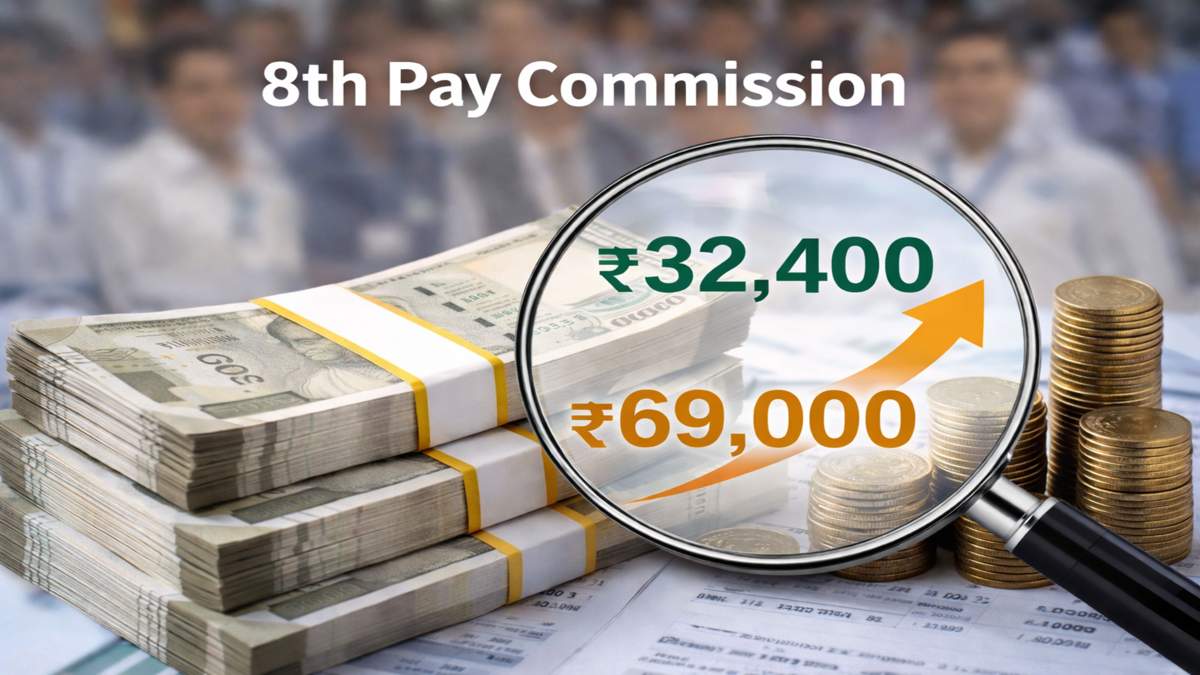
At a 1.8 fitment factor, the minimum basic pay would rise from Rs 18,000 to about Rs 32,400
At 2.46 (upper brokerage estimate), it could rise to around Rs 44,000+
At 3.83 (union demand), minimum pay could surge close to Rs 69,000
This means the difference between conservative and aggressive scenarios could be more than double the current basic pay, making the fitment factor the single most crucial variable in the 8th CPC outcome.
Why unions are demanding a higher fitment factor
The push for a higher fitment factor is not arbitrary. Employee bodies have linked their demands to structural changes in wage calculation:
-Adoption of a 5-member family unit instead of 3
-Rising inflation and cost of living
-Alignment with need-based minimum wage norms
-Demand for periodic revisions and better pension parity
These factors, unions argue, justify a multiplier well above 3.0 — a sharp jump from the 2.57 fitment factor under the 7th Pay Commission.
8th Pay Commission: Terms of Reference and timeline
The government constituted the 8th Pay Commission on November 3, 2025, to review salaries, allowances and pensions of central government employees and pensioners.
The panel is chaired by Justice Ranjana Prakash Desai, with Prof. Pulak Ghosh as Member and Pankaj Jain as Member-Secretary.
Key highlights:
-Covers 50 lakh employees and 69 lakh pensioners
-Mandate includes revision of pay matrix, allowances and pensions
-Factors in fiscal constraints, economic conditions and private sector parity
-Report timeline: within 18 months (by around May 2027)
-Effective date: January 1, 2026 (likely with arrears)
Current status: Consultations begin, unions step up pressure
As of April 2026, the commission has started groundwork:
-Official portal launched
-Consultants being onboarded
-Stakeholder consultations planned in cities like Delhi, Pune and Dehradun
Employee unions have already submitted memoranda, with a strong focus on raising the fitment factor, indicating that this will be the central issue in upcoming deliberations.
The big picture: How much salary hike is realistic?
The final outcome is likely to lie somewhere between fiscal prudence and employee demands.
A low-end scenario (1.8–2.0) may deliver 10–15% hikes
A mid-range outcome (2.15–2.46) could result in 20–34% increases
A high-end scenario (3.0+), if accepted, would lead to a transformational jump in salaries
Given past trends, governments have typically balanced demands with fiscal realities — suggesting that while a jump to 3.83 may be unlikely, a moderate increase above 2.0 cannot be ruled out.
Summing up…
The 8th Pay Commission is shaping up to be a battle over one number — the fitment factor.
With unions pushing for historic highs and experts warning of fiscal constraints, the final recommendation will determine not just salaries, but also the government’s wage bill and broader economic impact.
Disclaimer:
The figures cited are based on current proposals, expert estimates and publicly available data. Actual salary revisions will depend on the final recommendations of the 8th Pay Commission and subsequent government approval.