




For decades, India’s defence planning was largely a land story.
The country’s biggest security challenges sat on its borders. Defence budgets followed soldiers, tanks, artillery guns and fighter aircraft. Investors looking for defence opportunities naturally gravitated towards companies supplying the Army and the Air Force.
But geopolitics has a habit of changing priorities. China today has the world’s largest navy by number of vessels. Chinese naval deployments across the Indian Ocean have become increasingly common.
From ports in Pakistan and Sri Lanka to growing influence across key maritime routes, Beijing’s presence at sea is steadily expanding. As global trade and energy flows become increasingly dependent on maritime routes, control of the seas is becoming just as important as control of borders.
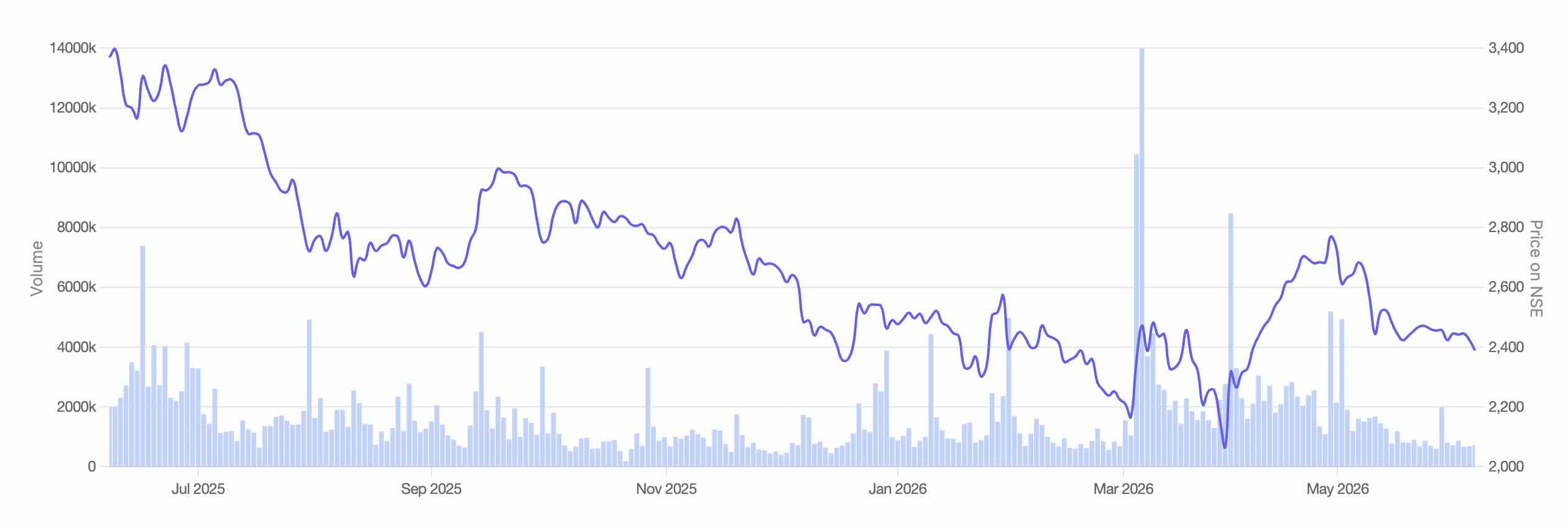
Mazagon Dock Shipbuilders Ltd 1-Year Share Price Chart
For India, responding to that challenge is not simply about buying more missiles or aircraft. It is about building a stronger navy. And navies are not built overnight. Warships take years to design and construct. Submarines take even longer. Which is why the next decade could witness one of the largest naval procurement cycles in India’s history.
If that happens, one listed company is likely to find itself at the centre of the opportunity. That company is Mazagon Dock Shipbuilders.
A company few can replicate
Mazagon Dock occupies a unique position in India’s defence ecosystem . It is the country’s only public sector shipyard with proven expertise in building both destroyers and conventional submarines. The company currently has the capacity to construct 11 submarines and 10 warships simultaneously, a capability that very few shipyards in the region can match.
Since 1960, the company has delivered 808 vessels, including 33 warships and eight submarines. Over the decades, it has become one of India’s most strategically important defence manufacturing assets, playing a central role in the Indian Navy’s modernisation efforts.
Unlike many defence companies that manufacture components or subsystems, Mazagon Dock sits at the very top of the naval manufacturing chain. It assembles the final product. Building a submarine yard or a destroyer programme is not something competitors can replicate in a few years. It requires decades of expertise, specialised infrastructure, technology partnerships and close integration with the defence establishment.
That position creates enormous barriers to entry and has allowed the company to build a formidable competitive moat. Yet despite all these strengths, the most interesting thing about Mazagon Dock today is not what it has built. It is what it has already delivered.
A rare corporate contradiction
The interesting thing about Mazagon Dock is that its recent slowdown is actually a by-product of success.
The company has spent the last several years completing some of India’s largest naval programmes. As ships get delivered and projects move closer to completion, the order book naturally begins to shrink. Normally, a shrinking order book would be viewed as a warning sign. In Mazagon Dock’s case, it is partly a reflection of the company’s successful execution of projects awarded years ago.
The numbers tell an unusual story. FY26 revenue rose 13.8% year-on-year to Rs 13,006 crore from Rs 11,432 crore in FY25. Net profit increased 6.8% to Rs 2,578 crore, while operating profit rose 9.7% to Rs 2,266 crore. Operating margin moderated slightly to 17.4% from 18.1% in FY25, but remained among the highest in the broader capital goods universe.
The March quarter remained healthy despite concerns around the order book. Revenue grew 21.3% year-on-year to Rs 3,850 crore, while profit after tax jumped 107% year-on-year to Rs 674 crore. Quarterly operating margin stood at 14.1%, lower than the exceptionally strong levels seen earlier but still healthy by industry standards.
The first nine months of FY26 painted a similar picture. Revenue growth remained in double digits while profitability stayed robust, suggesting that the company continues to benefit from favourable project execution and operating leverage.
The contrast becomes even more striking when viewed over a longer period. Since FY21, revenue has risen from Rs 4,048 crore to Rs 13,006 crore. Net profit has increased from Rs 514 crore to Rs 2,578 crore. Yet during the same period, the order book has steadily declined.
Few companies find themselves in a situation where financial performance keeps improving while future visibility appears to be shrinking. That contradiction sits at the heart of the Mazagon Dock investment story.
The Great Disconnect: Financials Up, Backlog Down
| Metric | FY21 | FY26 | Change |
| Revenue | ₹4,048 Cr | ₹13,006 Cr | +221% |
| Net Profit | ₹514 Cr | ₹2,578 Cr | +401% |
| Order Book | ₹49,744 Cr | ₹20,535 Cr | -59% |
The shrinking order book that nobody seems worried about
Mazagon Dock’s order book has been steadily shrinking. It stood at Rs 49,744 crore in FY21, fell to Rs 38,755 crore by FY23, dropped further to around Rs 32,260 crore in FY24 and FY25, and ended FY26 at just Rs 20,535 crore.
In other words, the backlog has fallen by nearly 59% over five years. Ordinarily, investors would punish a company facing such a decline. Yet Mazagon Dock continues to command a market capitalisation of roughly Rs 96,000 crore.
The reason is simple. Investors are not looking at the current order book. They are looking at what comes next.
India’s naval modernisation programme is far from complete. Several major projects are moving through the procurement pipeline, including three additional Kalvari-class submarines, six next-generation submarines under Project 75I, future frigate programmes and next-generation destroyers.
Industry estimates suggest the six submarines under Project 75I could be worth roughly Rs 99,000 crore. The proposed order for three additional Kalvari-class submarines could add another Rs 30,000 crore to Rs 40,000 crore. Future destroyer and frigate programmes could further expand the opportunity.
Collectively, these projects represent a potential naval spending cycle running into several lakh crore rupees over the coming decade. This explains why investors remain surprisingly relaxed about the shrinking backlog. They are treating the decline as a temporary gap between two procurement cycles rather than a sign of structural weakness.
A balance sheet built for patience
Why Investors Can Afford To Wait
| Metric | FY26 |
| Cash & Equivalents | ₹13,100+ Cr |
| Total Debt | ~₹440 Cr |
| Net Cash Position | ₹12,600+ Cr |
| ROE | 29.2% |
| ROCE | 36.0% |
| Market Cap | ~₹96,000 Cr |
One reason investors are willing to give the company the benefit of the doubt is the strength of its balance sheet. Mazagon Dock has virtually no debt. At the end of FY26, total debt stood at around Rs 440 crore. Cash and cash equivalents, meanwhile, exceeded Rs 13,100 crore, giving the company one of the strongest balance sheets in the Indian defence sector.
This financial strength provides management with significant flexibility. It can invest in expansion projects, pursue acquisitions, withstand delays in defence procurement and continue rewarding shareholders without depending heavily on external borrowing.
The company has also consistently generated strong cash flows while maintaining a healthy dividend payout. In an industry where project timelines are often influenced by government processes, a cash-rich balance sheet is not merely comforting. It can become a competitive advantage.
Defence procurement rarely follows a smooth schedule. Contracts get delayed, approvals take time and priorities change. Companies carrying large debt burdens often struggle during such periods. Mazagon Dock, thanks to its financial position, can afford to wait.
Returns that tell their own story
Strong companies often leave clues in their return ratios, and Mazagon Dock is no exception. Return on equity currently stands at 29.2%, while return on capital employed is 36%. These numbers place the company among the stronger performers in the broader capital goods and defence universe.
What makes these figures particularly impressive is that they are being generated without meaningful leverage. Many companies improve return ratios by taking on debt. Mazagon Dock achieves them through its specialised capabilities, strong execution record and strategically important market position.
The result? A business that combines high profitability with a remarkably conservative balance sheet, a combination that is rarely found in heavy manufacturing industries.
Preparing for the next decade
Management appears convinced that the long-term opportunity is far larger than the current order book suggests. The company is exploring expansion opportunities, including plans that could eventually involve investments of around Rs 15,000 crore in Tamil Nadu through new facilities and partnerships. While these plans are still evolving, they indicate management’s confidence in long-term demand.
Mazagon Dock has also acquired a controlling 51% stake in Colombo Dockyard PLC for approximately Rs 237 crore. Although small compared to the company’s size, the acquisition is strategically significant because it provides exposure to commercial shipbuilding and ship repair markets while expanding the company’s international footprint.
For decades, the company’s fortunes were tied almost entirely to Indian naval spending. The Colombo Dockyard acquisition suggests management is attempting to build a broader maritime engineering platform rather than remain solely dependent on defence contracts. If successful, that strategy could create an additional growth engine alongside naval shipbuilding.
What The Market Is Pricing In
| Current Reality | What Investors Are Betting On |
| Order book down 59% from FY21 | Project 75I submarines |
| FY26 backlog at ₹20,535 Cr | Additional Kalvari-class submarines |
| Current orders being executed | Future destroyer programs |
| Existing projects nearing completion | Next-generation frigates |
| Revenue visibility narrowing | Decade-long naval capex cycle |
What about valuation?
This is where the debate becomes more complicated. Even after falling nearly 30% from its peak over the last year, the stock still trades at around 37 times trailing earnings. That is hardly a bargain valuation for a company whose order book has more than halved over the past five years.
Viewed through the lens of current earnings and backlog visibility, the valuation appears demanding. The market, however, is making a different calculation.
Investors are effectively assigning value to future contracts before they enter the order book. They are betting that India’s naval modernisation programme is still in its early stages and that Mazagon Dock will remain one of the largest beneficiaries.
If those contracts arrive broadly on schedule, today’s valuation may appear reasonable in hindsight. If procurement decisions get delayed, investors may become far more sensitive to slowing growth and declining backlog.
In many ways, the stock’s valuation reflects confidence in future naval spending rather than confidence in current earnings.
The bottom line
The interesting thing about Mazagon Dock is that it no longer needs to prove it can build warships or submarines. It has already done that. Over the last decade, it has delivered some of the Indian Navy’s most important programmes while building a balance sheet that most manufacturers would envy.
The uncertainty now lies elsewhere. The company’s order book has fallen from nearly Rs 50,000 crore to just over Rs 20,000 crore, even as revenue and profits have reached record highs. Investors are therefore making a different bet today. They are no longer betting on Mazagon Dock’s ability to execute. They are betting on India’s willingness to keep ordering.
If India is indeed entering a prolonged naval expansion cycle, Mazagon Dock could remain one of the biggest beneficiaries. If those orders arrive more slowly than expected, investors may discover that future opportunities are harder to value than completed ships.
That, ultimately, is the question hanging over one of India’s most important defence companies.
Note: We have relied on data from www.Screener.in throughout this article. Only in cases where the data was not available, have we used an alternate, but widely used and accepted source of information.
The purpose of this article is only to share interesting charts, data points and thought-provoking opinions. It is NOT a recommendation. If you wish to consider an investment, you are strongly advised to consult your advisor. This article is strictly for educative purposes only.
Manvi Aggarwal has been tracking the stock markets for nearly two decades. She spent about eight years as a financial analyst at a value-style fund, managing money for international investors. That’s where she honed her expertise in deep-dive research, looking beyond the obvious to spot value where others didn’t. Now, she brings that same sharp eye to uncovering overlooked and misunderstood investment opportunities in Indian equities. As a columnist for LiveMint and Equitymaster, she breaks down complex financial trends into actionable insights for investors.
Disclosure: The writer and her dependents do not hold the stocks discussed in this article. The website managers, its employee(s) and contributors/writers/authors of articles have or may have an outstanding buy or sell position or holding in the securities, options on securities or other related investments of issuers and/or companies discussed therein. The content of the articles and the interpretation of data are solely the personal views of the contributors/ writers/authors. Investors must make their own investment decisions based on their specific objectives, resources and only after consulting such independent advisors as may be necessary