




Welcome to the latest edition of Dividend Hunter. Over the past few weeks, we have analyzed companies where strong cash flows could translate into consistent dividends going forward. In our previous edition, we covered a cigarette giant offering 5% dividend yield.
In this edition of Dividend Hunter, we are looking at India’s largest domestic workforce management platform. It generates highly reliable cash flows and has a formally structured, aggressive track record of returning earnings to its investors.
While it has grown by supplying workers to retail stores, banks, and factories, this company’s profit engine has shifted entirely. Today, half of its operating profits are driven by premium and emerging segments, such as Global Capability Centers, Data Centers, and the Artificial Intelligence sector.
This company also serves the overseas market. This high-margin tech and international staffing allow the company to generate robust free cash flow, which it is fully committed to returning to shareholders.
By now, you have likely identified the staffing conglomerate that we are focused on today: Quess Corp Limited.
For investors seeking regular income, this company heavily prioritizes returning capital to its shareholders. The company paid a ₹10-per-share dividend in FY25 and increased the payout in FY26. Effective FY26, it has also formalised a policy to return a fixed percentage of its free cash flow to shareholders.
However, the question remains: can the company continue to pay dividends over the long run?
Let’s find out.
The Business Blueprint: Dissecting Quess Corp’s Operational Mix
In India, Quess acts as a critical bridge. It helps drive the transition of workers from unorganized, agricultural labor (“farm to non-farm”) into the formal economy. When Quess gives someone a formal job, that person suddenly has a trackable income, social security benefits, and a stepping stone to a better life.
The Value Engine vs. The High-Margin Edge
The General Staffing segment remains the core revenue driver, accounting for 86% of revenue.
It provides personnel for industries such as BFSI (Banking, Financial Services, and Insurance), Retail, Telecom, FMCG, and Industrials. The segment employs 466,000 associates.
Professional Staffing is a higher-margin division and accounts for 6.1% of revenue. This segment focuses on specialized digital and technology roles. This vertical operates with a headcount of around 7,000. A primary focus of this division is serving Global Capability Centers.
Quess provides these clients with personnel experienced in specific skill sets, such as data center operations, artificial intelligence, and cybersecurity. Its overseas staffing operations (7.8% of revenue) provide geographic diversification, with around 6,000 employees in the Middle East, Singapore, Malaysia, and the Philippines.
Financial Health
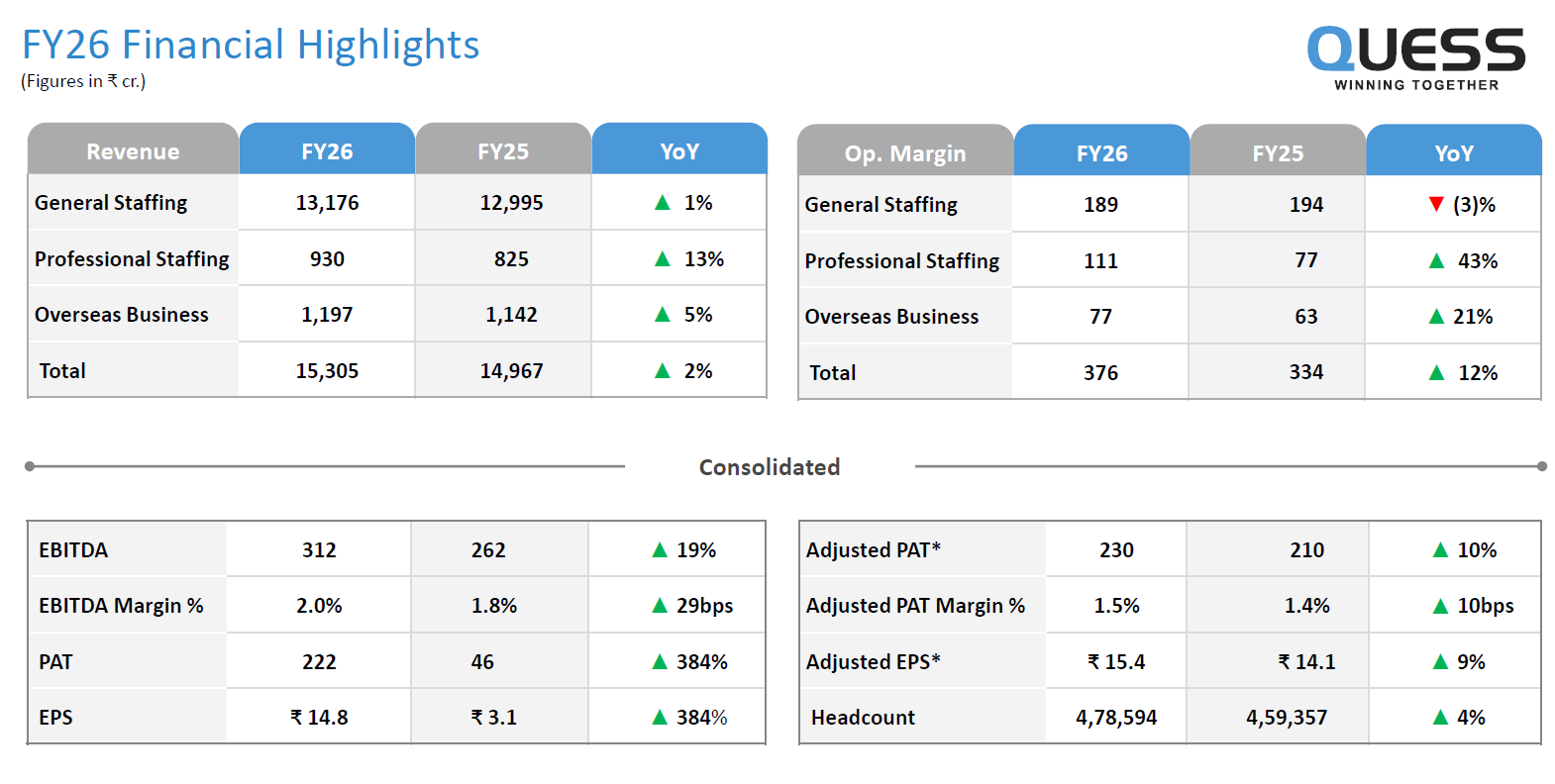
Over the last five years, Quess’s net profit grew at a 38% CAGR, reaching ₹222 crore in FY26. Revenue in FY26 rose by 2.3% year-on-year to ₹15,305 crore. But its operating performance was stronger as it shifted toward higher-margin businesses.
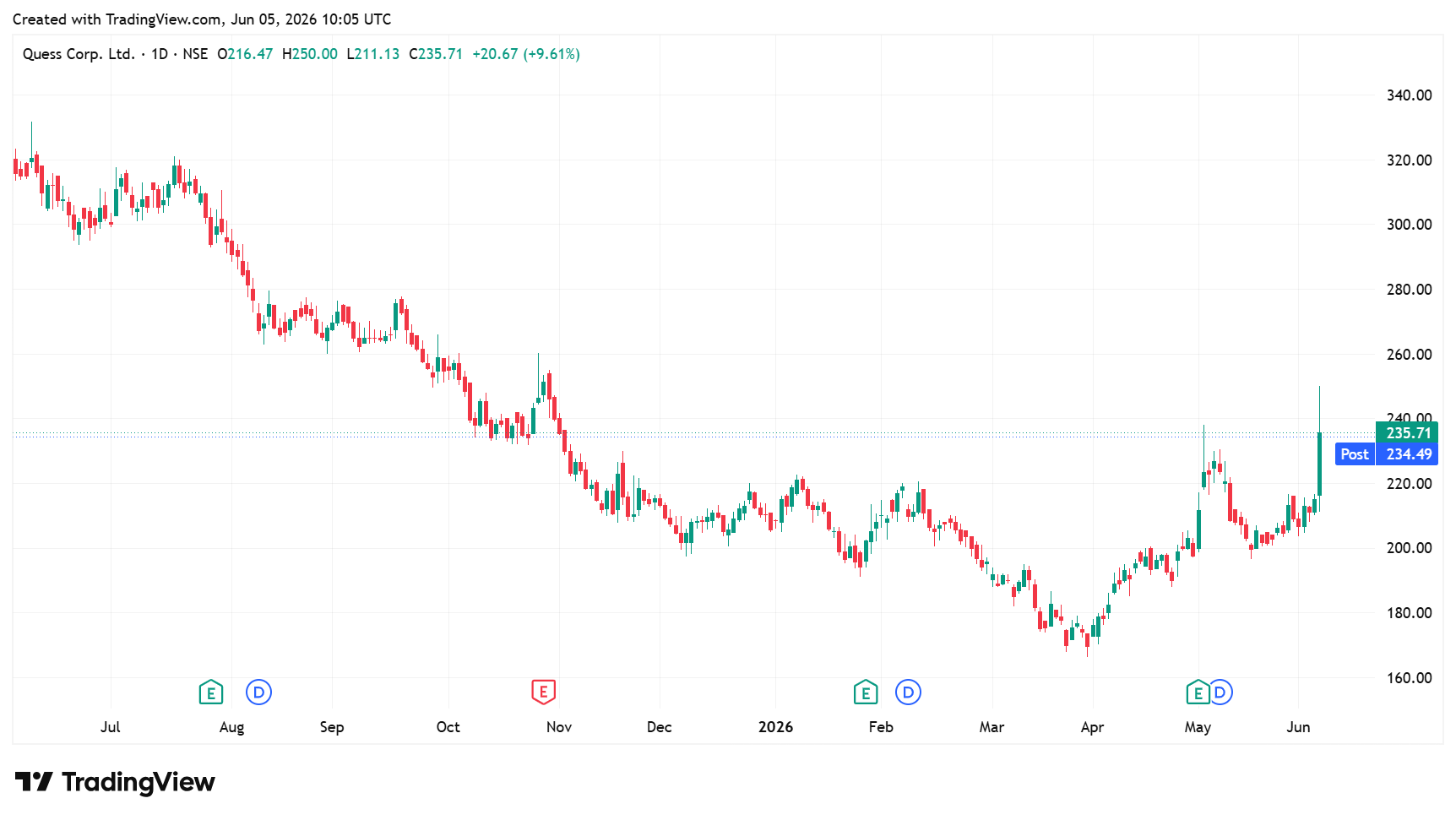
The company’s market cap is ₹3,522 crore, as of 5th June 2026.
The GCC Engine: Driving the Higher-Margin Professional Pivot
While revenue growth was modest, EBITDA (Earnings Before Interest, Taxes, Depreciation, and Amortization) grew 19% to ₹312 crore as it is pivoting its business mix. But the consolidated EBITDA margin remains extremely low at 2%.
This is because the business is dependent on the low-margin general staffing segment. However, this is now changing. High-margin businesses (professional staffing and Overseas Business) now account for 50% of operating profit, despite contributing a smaller share of revenue.
Professional Staffing was the driver for profitability. It is shifting focus away from lower-margin entry-level IT roles toward high-value, experienced tech talent. Segment revenue grew 13% YoY to ₹930 crore, while EBITDA surged 43% YoY to ₹111 crore. Margins expanded significantly to reach 11.9%.
Performance was heavily driven by strong demand from Global Capability Centres (GCCs), which now account for 67% of its revenue. The segment added 61 new client logos over the year.
Quess Corp Financial Highlights
Regional & Digital Mix: Unpacking the High-Value Verticals
On the other hand, revenue from international operations grew 5% YoY to ₹1,197 crore, while EBITDA increased 21% to ₹77 crore. As a result, EBITDA margins stood at 6.4%. In contrast, the general staffing business generated revenue of ₹13,176 crore but has a much lower EBITDA margin of around 1.4%.
Thus, the ongoing shift augurs well for Quess’s profitability. To support and improve margins going forward, Quess is executing a strategy that balances both volume and value.
Analyzing the Balance Sheet: Deconstructing the Unleveraged 20% ROE Metric
Quess Corp reported a strong Return on Equity (ROE) of 20% for FY26. The true strength of this 20% return lies in the company’s unleveraged capital structure. Quess operates with zero gross debt and closed the year with a net cash position of ₹271 crore.
This shows that improvements in business execution and profitability are the core drivers of ROE. The company’s Return on Capital Employed (ROCE) also stood at 23%. One of its top financial priorities moving into FY27 is maintaining capital discipline and driving an even higher return on capital.
As the high-margin segments grow faster than the rest of the business, every incremental rupee of profit flows more efficiently to the bottom line, naturally lifting the company’s overall return on capital.
Cash Conversions: Working Capital Mechanisms Behind the Yield
A company’s ability to pay dividends is only as strong as its cash generation. Quess Corp displays operational discipline in this area. It maintains an EBITDA-to-Operating Cash Flow conversion rate of 70-80%.
For instance, in FY26, Quess converted 73.4% of its EBITDA into operating cash flow, generating ₹229 crore against EBITDA of ₹312 crore. This high conversion is driven by tightly controlled working capital management. After deducting ₹9 crore spent on property, plant, and equipment (PPE), Quess generated free cash flow of ₹220 crore.
It has a steady Days Sales Outstanding of just 24 days, including unbilled revenue. Even in the General Staffing segment, Quess maintains a very healthy 76% “Collect & Pay” ratio. This means that it collects from the client before paying the associate, reducing working capital risk.
Assessing the Long-Term Sustainability of the 4.7% Dividend
Quess has a strong and consistent track record of rewarding shareholders. It has distributed a total of ₹54 per share in dividends between FY21-26. At the current price of ₹236, the company has effectively returned 22.9% of the investment as dividends.
The payout began at ₹4 per share in FY22, rising to ₹12 per share in FY23. However, the payout moderated to ₹10 in FY24 and FY25.
Quess Historical Dividend Payout
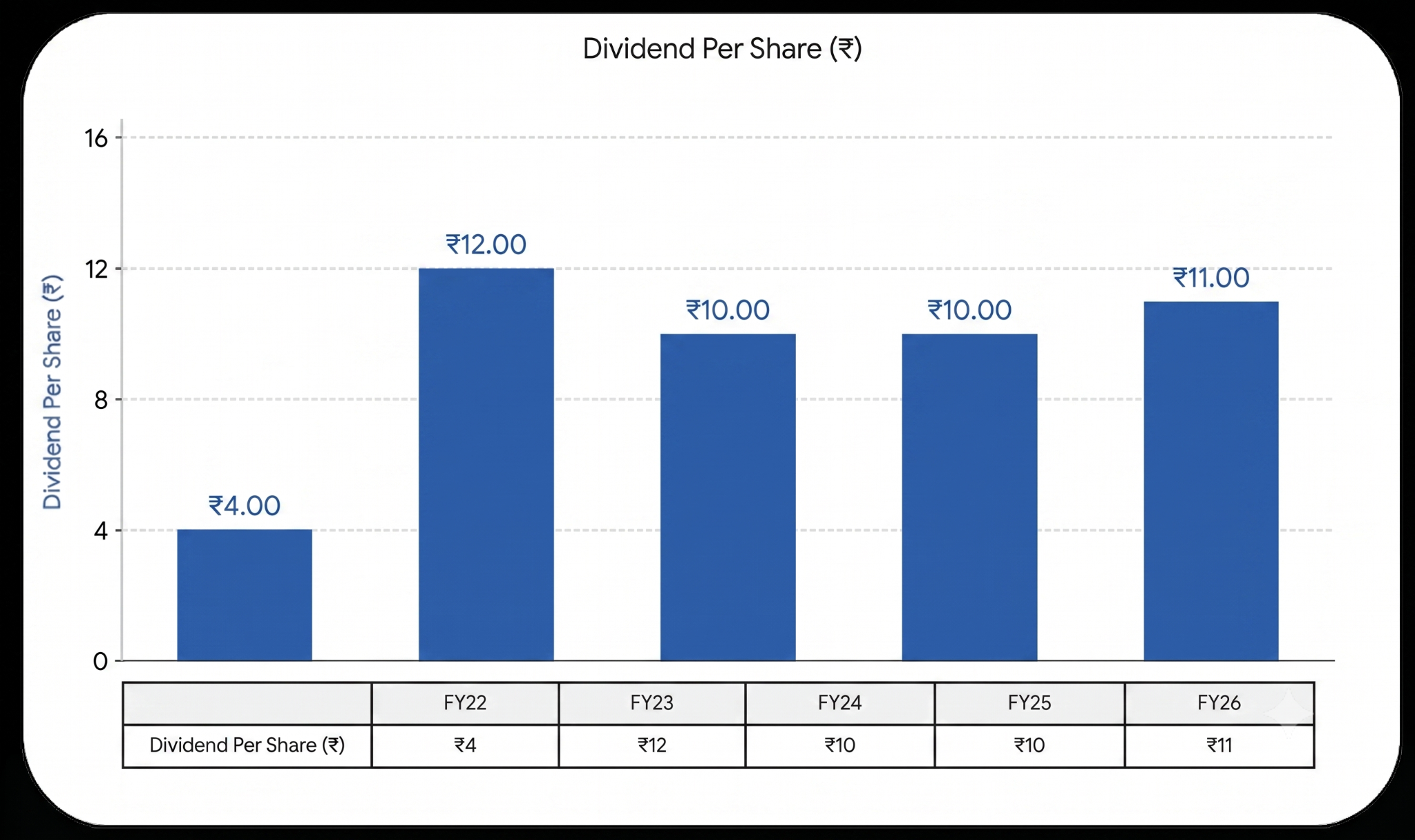
The company increased the payout slightly to ₹11 per share (including a special dividend of ₹3) in FY26. This translates to a dividend yield of around 4.7% at the current market price. That said, if the past track record is to be believed, these payouts could continue as well.
Demerger Dynamics: Corporate Actions Altering Shareholder Math
It is important to note that in FY25, Quess demerged into three listed entities: Quess Corp (the company we are focused on), Digitide, and Bluspring. As a result, shareholder returns during this period were not limited to cash dividends. Investors also realized value through the demerged entity.
The Payout Calculus: Inside Quess’s 75% FCF Allocation Blueprint
For dividend hunters, one of the key positives post-demerger is Quess’s formalized payout structure, which offers clearer expectations around shareholder returns.
Effective FY26, Quess has committed to returning 75% of its free cash flow to shareholders. This return is planned over a cumulative rolling three-year block. The distribution can take the form of interim dividends, final dividends, and/or share buybacks. The policy removes ambiguity and provides visibility for future payouts.
Most importantly, its transition to a higher-margin business will generate better-quality earnings. This, in turn, will continue to increase its free cash flow in the coming years. Higher earnings growth could also lead to higher dividend payouts.
The dividend outlook, therefore, appears favourable. However, investors should monitor a few risks that could affect earnings and cash generation.
The Risk Matrix: Assessing Dividend Safety Barriers & Regulatory Overhangs
Quess faces substantial contingent liabilities due to ongoing tax and regulatory disputes.
A ₹296.4 crore tax demand is pending due to the disallowance of deductions claimed under Section 80JJAA for FY17-22. There is a GST penalty of ₹371.6 crore. This penalty relates to disputed input tax credits availed by certain customers for services provided between FY18-23.
This is significantly larger than its annual profit and free cash flow. Thus, any adverse ruling against the company could pose a financial risk.
The recent hiring slowdown can directly impact client demand and hiring volumes. The Professional Staffing segment, particularly within the IT sector, is facing subdued demand. Trade policies, tariffs, and economic slowdown can pose downside risks to its growth outlook.
It has also observed supply-side talent reduction. The revised billings due to the rollout of the new Labor Codes create near-term implementation uncertainty.
Valuation Arbitrage: Does Quess Stock offer a Deep Value?
Valuation-wise, Quess trades at a price-to-equity (P/E) multiple of 15.2x, which is at a discount to its 10-year historical median (20x). However, the company trades at a valuation similar to its closest peer, Team Lease Services (16x), and the Diversified Commercial Services sector (16x).
The “Dividend Hunter” Verdict: Is This a Long-Term Income Fortress?
Based on operational metrics, balance sheet, and capital allocation strategies, Quess can be a potentially reliable dividend payer with a sustainable cash-generation engine. Quess also meets the key Dividend Hunter filters.
It has stable profit growth, strong cash flows, and a payout ratio within thresholds.
Given a 4.7% yield, consistent cash flow generation, a dividend distribution policy, and a historical dividend payout track record, it appears likely that the dividend payout trend could continue. Dividend hunters should add this stock to their watchlist.
Disclaimer:
Note: Throughout this article, we have relied on data from http://www.Screener.in and the company’s investor presentation and conference call. Only in cases where the data were unavailable have we used an alternative, widely accepted source of information.
The purpose of this article is only to share interesting charts, data points, and thought-provoking opinions. It is NOT a recommendation. If you wish to consider an investment, you are strongly advised to consult your advisor. This article is strictly for educational purposes only.
About the Author: Madhvendra has been deeply immersed in the equity markets for over seven years, combining his passion for investing with his expertise in financial writing. With a knack for simplifying complex concepts, he enjoys sharing his honest perspectives on startups, listed Indian companies, and macroeconomic trends.
A dedicated reader and storyteller, Madhvendra thrives on uncovering insights that inspire his audience to deepen their understanding of the financial world.
Disclosure: The writer and his dependents do not hold the stocks discussed in this article.
The website managers, their employees (s), and contributors/writers/authors of articles have or may have an outstanding buy or sell position or holding in the securities, options on securities, or other related investments of issuers and/or companies discussed therein. The articles’ content and data interpretation are solely the personal views of the contributors/ writers/authors. Investors must make their own investment decisions based on their specific objectives, resources, and only after consulting such independent advisors as may be necessary.