




In technical analysis, price tells a story, but volume tells us whether the market truly believes that story.
Many investors focus only on price breakouts. However, some of the most powerful wealth-creating opportunities emerge when a price breakout is supported by an extraordinary surge in volume. It signals participation, conviction, and often the beginning of a new phase in the stock’s life cycle.
Interestingly, there are three microcap stocks like Rain Industries, Diamond Power Infrastructure and Black Box Ltd. which have recently formed breakout patterns on the monthly chart accompanied by volume expansion of more than 300% of their 20-month average monthly volumes. Such patterns deserve attention because monthly chart breakouts tend to carry greater strength.
1. Rain Industries: Breaking Out Of A Multi-Year Falling Channel
Rain Industries had been in a wide downtrend channel for almost four years.
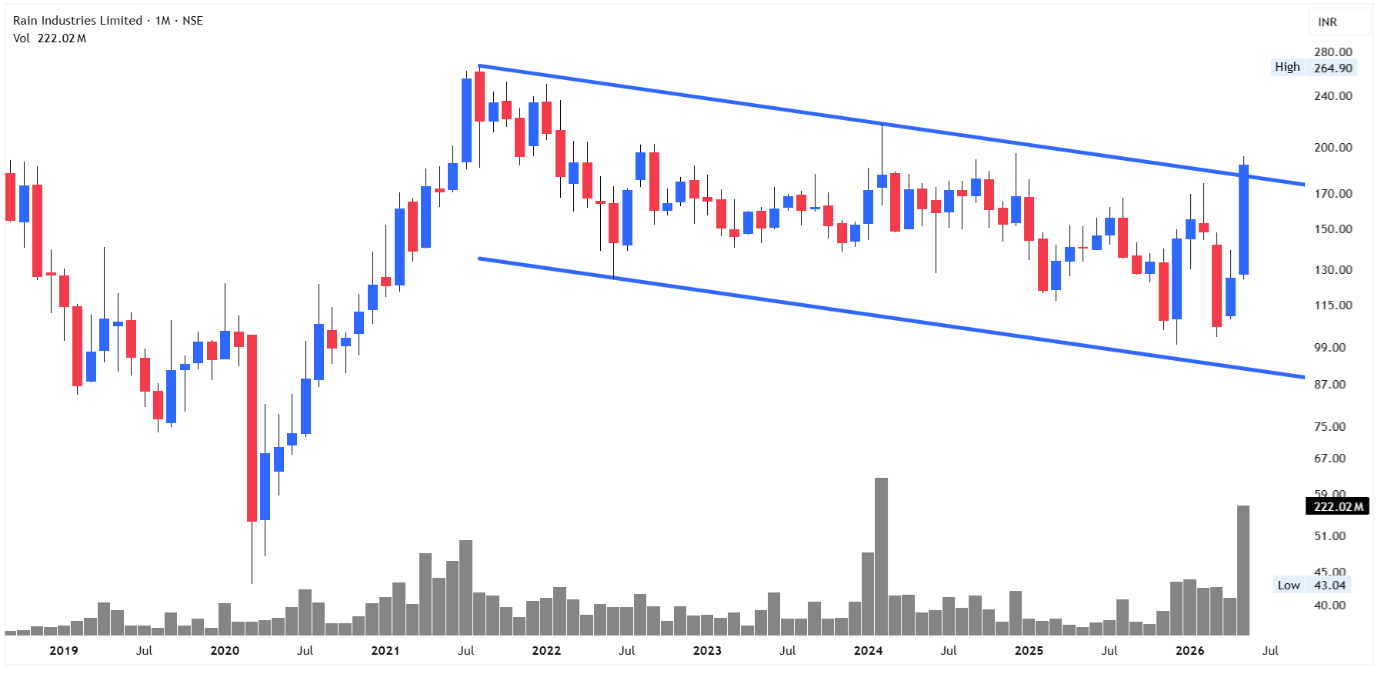
Each rally was met with selling pressure, with a string of lower highs and lower lows. But the latest monthly candle has altered the character of the chart dramatically.
The stock has shot up above the upper boundary of the falling channel, indicating that the long-term downtrend may be finally over.
Monthly volumes have surged to levels more than three times the 20-month average, suggesting strong institutional participation.
From a technical perspective, this type of breakout is typically a signal of transition from a “distribution phase” to an “accumulation and expansion phase.”
What makes the setup interesting is that the breakout comes after several years of consolidation and frustration for investors. Long periods of inactivity often result in powerful moves once the resistance barrier is crossed.
The breakout offers a potential investment opportunity for high-risk investors.
2. Diamond Power Infrastructure: New Lifetime High Territory
Among the three stocks, Diamond Power Infrastructure presents one of the cleanest chart structures.
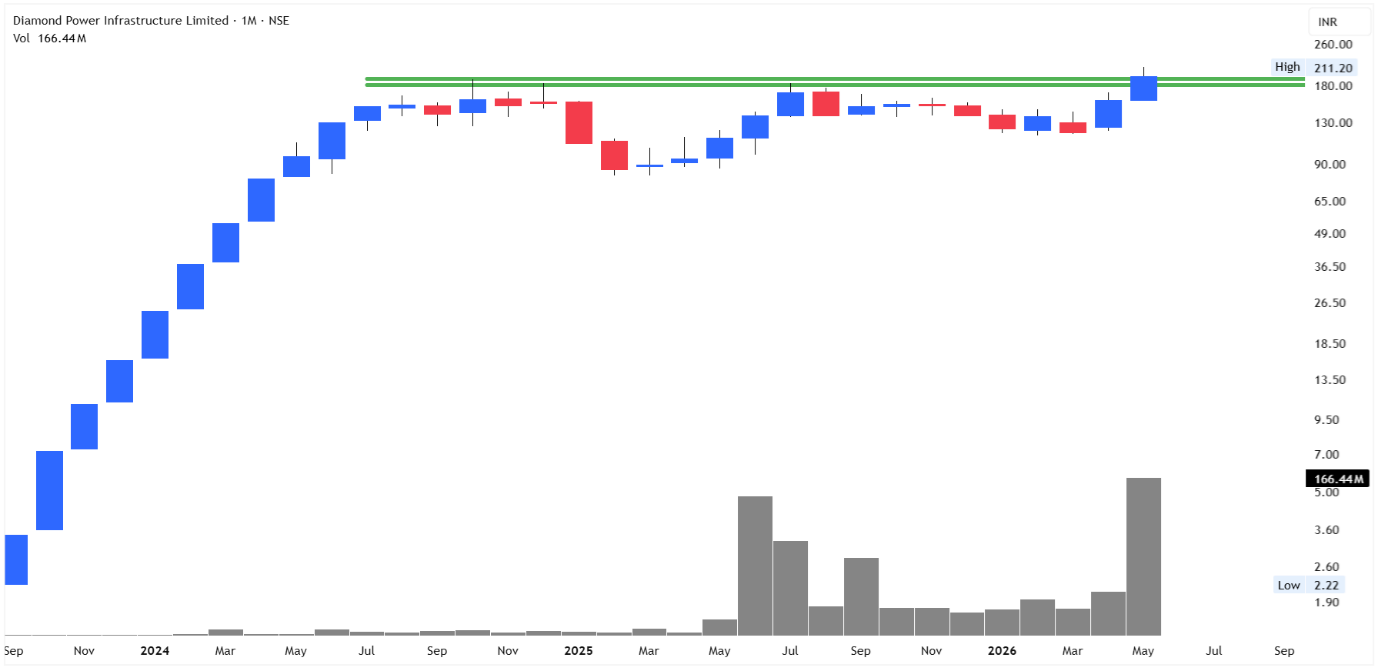
The stock spent almost two years consolidating below a major resistance zone around the Rs.180–190 region. Multiple attempts to cross this hurdle failed, creating a clear ceiling on the monthly chart.
Now that ceiling has been decisively broken. Such breakouts are often important because there is virtually no overhead supply from trapped investors waiting to exit.
What further strengthens the case is the volume behaviour. Monthly turnover has expanded sharply, registering more than 300% of the 20-month average monthly volume.
This combination of:
• New highs
• Strong price structure
• Exceptional volume participation often reflects growing market confidence in the underlying trend.
In technical analysis, new highs with increasing volume often indicate that demand overshadowing supply. The chart structure remains constructive as long as the breakout level holds and it is a potential opportunity for investors
3. Black Box Ltd.: Emerging from a Long-Term Base
If Rain Industries represents a trend reversal and Diamond Power represents a new high breakout, Black Box Ltd. represents the power of long-term base formation.
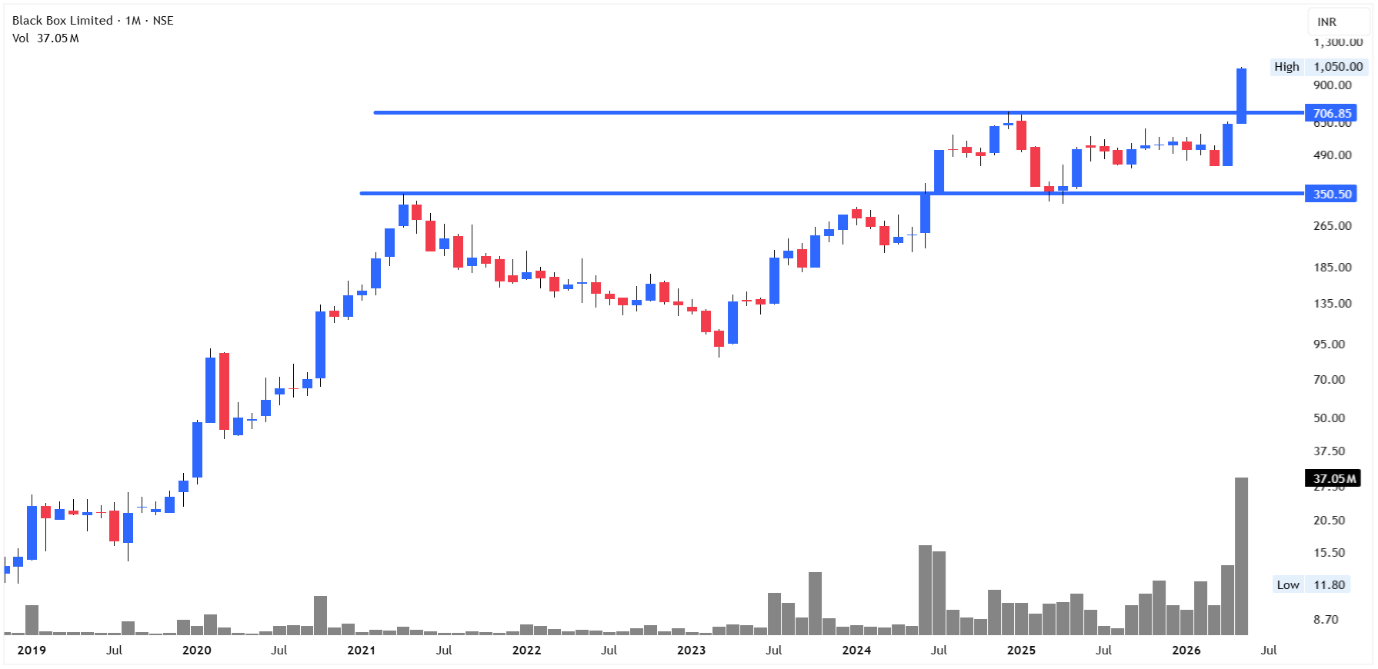
The stock spent several years oscillating within a broad trading range. During such periods, impatient participants often lose interest while stronger hands gradually accumulate positions.
The monthly chart now suggests that the waiting period may be ending.
Black Box has convincingly crossed a major resistance zone near the Rs.700 mark while recording a substantial jump in volume. The monthly volume spike is more than 300% of its 20-month average monthly activity, making the breakout difficult to ignore.
Large bases often act like compressed springs. The longer the consolidation, the more powerful the potential expansion on breakout.
The breakout above the multi-year range suggests that market participants may be applying a different valuation framework to the company than previously.
While future performance is never guaranteed, the chart is clearly signalling a significant shift in demand dynamics.
What Should Investors Do?
One of the biggest mistakes investors make is chasing every stock that appears in headlines. Instead, they should focus on evidence.
Currently, the evidence on the monthly charts points toward three important factors:
- Price Breakout
- Multi-Year Resistance Violation
- Volume Expansion Above 300% of the 20-Month Average
When these three elements appear together, they often deserve a place on an investor’s watchlist. Rather than rushing to buy immediately after a sharp move, investors may consider monitoring whether these stocks can hold above their breakout levels during the coming months.
Successful breakouts often undergo retests before continuing higher. The stock market rewards patience more than excitement. Rain Industries, Diamond Power Infrastructure and Black Box Ltd, all indicating demand has come in a meaningful way. Whether these breakouts become long-term wealth creators will depend on their ability to sustain momentum, but for now, these microcap names have certainly earned the market’s attention.
Disclaimer:
Note: The purpose of this article is only to share interesting charts, data points and thought-provoking opinions. It is NOT a recommendation. If you wish to consider an investment, you are strongly advised to consult your advisor. This article is strictly for educative purposes only.
Brijesh Bhatia is an Independent Research Analyst and is engaged in offering research and recommendation services with SEBI RA Number – INH000022075. He has two decades of experience in India’s financial markets as a trader and technical analyst.
Disclosure: The writer and his dependents do not hold the stocks discussed here.
The website managers, its employee(s), and contributors/writers/authors of articles have or may have an outstanding buy or sell position or holding in the securities, options on securities or other related investments of issuers and/or companies discussed therein. The content of the articles and the interpretation of data are solely the personal views of the contributors/ writers/authors. Investors must make their own investment decisions based on their specific objectives and resources, and only after consulting such independent advisors if necessary.